

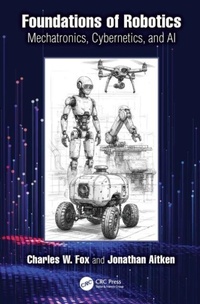
Foundations of Robotics
Mechatronics, Cybernetics, and AI
1st Edition
Will be published approx. on 3. November 2026
Book
Paperback/Softback
440 pages
978-1-032-81801-6 (ISBN)
Description
This book introduces readers to graduate-level study of robotics through an integrated, interdisciplinary approach that spans mechatronics, control theory, computer science, and AI. It is designed to unite students from these fields, equipping them with the collaborative skills needed to excel in robotics.
It is structured around three core pillars: Mechatronics, Cybernetics, and AI. Mechatronics introduces practical tools and materials for robot building, programming, and design, covering open-source hardware, sensors, actuators, and embedded systems like ROS2. Cybernetics explores feedback, control, kinematics, and dynamics, enabling the execution of complex trajectories for robots such as drones, mobile robots, and robotic arms, grounded in linear algebra and Lagrangian mechanics. AI explores modern transformer-based models, including GPTs and diffusion models, teaching robots to perceive, learn, and plan using Bayesian probability, neural networks, and PyTorch programming. Together, these sections provide a comprehensive foundation for understanding and innovating in robotics.
Bridging foundational theory and real-world applications, this book is core course reading for advanced undergraduate and graduate students of robotics, mechatronics, and artificial intelligence. It is also a valuable resource for maker communities, equipping them with the skills needed to succeed in this cutting-edge field.
It is structured around three core pillars: Mechatronics, Cybernetics, and AI. Mechatronics introduces practical tools and materials for robot building, programming, and design, covering open-source hardware, sensors, actuators, and embedded systems like ROS2. Cybernetics explores feedback, control, kinematics, and dynamics, enabling the execution of complex trajectories for robots such as drones, mobile robots, and robotic arms, grounded in linear algebra and Lagrangian mechanics. AI explores modern transformer-based models, including GPTs and diffusion models, teaching robots to perceive, learn, and plan using Bayesian probability, neural networks, and PyTorch programming. Together, these sections provide a comprehensive foundation for understanding and innovating in robotics.
Bridging foundational theory and real-world applications, this book is core course reading for advanced undergraduate and graduate students of robotics, mechatronics, and artificial intelligence. It is also a valuable resource for maker communities, equipping them with the skills needed to succeed in this cutting-edge field.
More details
Language
English
Place of publication
London
United Kingdom
Publishing group
Taylor & Francis Ltd
Target group
College/higher education
Postgraduate and Undergraduate Advanced
Illustrations
156 s/w Abbildungen, 78 s/w Photographien bzw. Rasterbilder, 78 s/w Zeichnungen, 3 s/w Tabellen
3 Tables, black and white; 78 Line drawings, black and white; 78 Halftones, black and white; 156 Illustrations, black and white
Dimensions
Height: 246 mm
Width: 174 mm
ISBN-13
978-1-032-81801-6 (9781032818016)
Copyright in bibliographic data and cover images is held by Nielsen Book Services Limited or by the publishers or by their respective licensors: all rights reserved.
Schweitzer Classification
Other editions
Additional editions
Book
approx. 11/2026
1st Edition
CRC Press
€148.50
Not yet published
Persons
Charles Fox is the Programme Leader of MSc Robotics and AI at the University of Lincoln, UK. The programme provides a unified approach linking traditional Computer Science and Engineering topics with modern AI. He served as the programme chair of the UK's robotics and AI conference, TAROS, in 2021. Fox advises leading venture capital, investment bank, and private equity firms on AI strategy and implementation. He studied MA Computer Science at Cambridge, MSc Informatics at Edinburgh, and DPhil Information Engineering at Oxford. He has won teaching awards from students and universities and is the author of over 100 peer-reviewed publications and the book 'Computer Architecture: from the stone age to the quantum Age' with No Starch Press.
Jonathan Aitken is Senior University Teacher in the School of Electrical and Electronic Engineering at the University of Sheffield, UK. Previously as a Research Fellow he worked in the Autonomous Control Laboratory within the Autonomous Systems and Robotics Group of the Department of Automatic Control and Systems Engineering. His research focuses on autonomous reconfiguration of robotic systems, especially on quadcopter platforms. Dr Aitken holds an MEng and PhD in Electronic Engineering, both awarded by the University of York. He has previously worked in the Computer Science Department at the University of York's High Integrity Systems Engineering Group, working on safety in Systems-of-Systems.
Jonathan Aitken is Senior University Teacher in the School of Electrical and Electronic Engineering at the University of Sheffield, UK. Previously as a Research Fellow he worked in the Autonomous Control Laboratory within the Autonomous Systems and Robotics Group of the Department of Automatic Control and Systems Engineering. His research focuses on autonomous reconfiguration of robotic systems, especially on quadcopter platforms. Dr Aitken holds an MEng and PhD in Electronic Engineering, both awarded by the University of York. He has previously worked in the Computer Science Department at the University of York's High Integrity Systems Engineering Group, working on safety in Systems-of-Systems.
Content
Introduction
Part I: Mechatronics - Building Robots
Chapter 1. Building Robots
Chapter 2. Programming Robots
Chapter 3. Working with Space and Time
Chapter 4. Mechanics
Chapter 5. Electromagnetism
Chapter 6. Sensors
Part II: Cybernetics - Controlling Robots
Chapter 7. Controlling Behaviours
Chapter 8. Kinematics and Inverse Kinematics
Chapter 9. Dynamics and Inverse Dynamics
Chapter 10. Digital Control of Dynamics Trajectories
Part III: Aritifical Intelligence (AI) - Automating Robots
Chapter 11. Probabilistic AI
Chapter 12. Tracking, Localisation and Mapping
Chapter 13. Planning
Chapter 14. Neural Networks
Chapter 15. Robot Vision
Chapter 16. Transformers and Foundation Models
Part I: Mechatronics - Building Robots
Chapter 1. Building Robots
Chapter 2. Programming Robots
Chapter 3. Working with Space and Time
Chapter 4. Mechanics
Chapter 5. Electromagnetism
Chapter 6. Sensors
Part II: Cybernetics - Controlling Robots
Chapter 7. Controlling Behaviours
Chapter 8. Kinematics and Inverse Kinematics
Chapter 9. Dynamics and Inverse Dynamics
Chapter 10. Digital Control of Dynamics Trajectories
Part III: Aritifical Intelligence (AI) - Automating Robots
Chapter 11. Probabilistic AI
Chapter 12. Tracking, Localisation and Mapping
Chapter 13. Planning
Chapter 14. Neural Networks
Chapter 15. Robot Vision
Chapter 16. Transformers and Foundation Models