

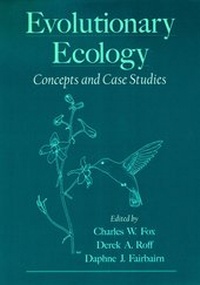
Evolutionary Ecology
Concepts and Case Studies
Published on 25. October 2001
Book
Hardback
424 pages
978-0-19-513154-3 (ISBN)
Description
This text unifies conceptual and empirical advances in evolutionary ecology and provides a volume that can be used as a primary textbook or supplemental reading in an advanced undergraduate or graduate course. The focus is on current concepts in evolutionary ecology and the empirical study of these concepts. Chapters are written by prominent biologists who have made significant contributions to this field and both synthesize the current state of knowledge and identify areas for future investigation. It is divided into five major sections: an overview of the major topics in evolutionary biology for ecologists, and sections on life histories, behaviour, co-evolution, and adaptation to athropogenic change.
More details
Language
English
Place of publication
New York
United States
Target group
Professional and scholarly
Illustrations
num. fig.
numerous line figures
Dimensions
Height: 251 mm
Width: 174 mm
ISBN-13
978-0-19-513154-3 (9780195131543)
Copyright in bibliographic data and cover images is held by Nielsen Book Services Limited or by the publishers or by their respective licensors: all rights reserved.
Schweitzer Classification
Other editions
Additional editions
E-Book
10/2001
1st Edition
OUP USA
€93.49
Available for download
Persons
Content
PART 1: RECURRING THEMES; 1. Nature and Causes of Variation; 2. Evolutionary Significance of Variation; 3. Natural Selection; 4. Adaptation; 5. Phenotypic Plasticity; 6. Population Structure; 7. Inbreeding and Outbreeding; PART 2: LIFE HISTORIES; 8. Age and Size at Maturity; 9. Offspring Size and Number; 10. Senescence; 11. Life Cycles; 12. Sex and Gender; 13. Sex Ratios and Sex Allocation; 14. Ecological Specialization and Generalization; PART 3: BEHAVIOR; 15. Mating Systems; 16. Sexual Selection; 17. Cooperation and Altruism; 18. Foraging Behaviour; 19. The Evolutionary Ecology of Management; PART 4: INTERSPECIFIC INTERACTIONS; 20. Ecological Character Displacement; 21. Predator-Prey Interactions; 22. Parasite-Host Interactions; 23. Plant-Herbivore Interactions; 24. Mutualisms; 25. The Geographic Dynamics of Coevolution; PART 5: ADAPTATION TO ANTHROPOGENIC CHANGE; 26. Pesticide Resistance; 27. Predicting the Outcome of Biological Control; 28. Evolutionary Conservation Biology; REFERENCES; INDEX