

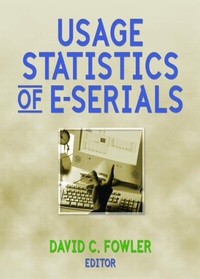
Usage Statistics of E-Serials
1st Edition
Published on 30. November 2007
Book
Hardback
328 pages
978-0-7890-2987-4 (ISBN)
Description
What are the potentials - and limitations - of usage statistics in libraries?
As libraries increase their use of electronic resources, the value of quality evaluation of usage statistics has gained greater importance. Usage Statistics of E-Serials tackles this difficult issue by exploring in detail the proper evaluation of the level of usage of electronic resources. Noted experts discuss their own experiences in the field from multiple viewpoints and backgrounds, providing the reader with a well-rounded view of the entire topic. Issues comprehensively examined include the gathering and processing of statistics, costs and benefits of e-journals, evaluation and interpretation of data, and the comparison of different types of data collection methods.
Usage Statistics of E-Serials reviews a range of situations and experiences of librarians and administrators in several different academic libraries. These authorities offer approaches and strategies to help readers more fully understand how to best manage those crucial resources. Multiple perspectives shine a needed spotlight on various challenges still facing academic librarians who attempt to measure and manage their library's electronic resources. This resource includes helpful screen captures, tables, and figures to fully explain ideas and data.
Topics in Usage Statistics of E-Serials include:
processing, standardizing, and dissemination of usage statistics
a case study examining the cost of selection, acquisition, maintenance, and renewal of subscription of e-journals
cost savings of canceling print journals
evaluation and interpretation of data about the content and use of databases in decision-making
the MaxData Project
results of the Council of Connecticut Academic Library Directors (CCALD) e-resource management survey
in-house current-awareness module MyCLICAPS
statistics options provided by Serials Solutions
the influence of usage statistics on collection development decisions
the tracking of electronic resources by San Jose State University from the Federal depository program
usage statistics as the basis for a usage-based pricing system
more!
Usage Statistics of E-Serials is a must-have resource for every academic librarian, particularly those in technical services, public services, and administration involved in gathering and utilizing usage statistics.
As libraries increase their use of electronic resources, the value of quality evaluation of usage statistics has gained greater importance. Usage Statistics of E-Serials tackles this difficult issue by exploring in detail the proper evaluation of the level of usage of electronic resources. Noted experts discuss their own experiences in the field from multiple viewpoints and backgrounds, providing the reader with a well-rounded view of the entire topic. Issues comprehensively examined include the gathering and processing of statistics, costs and benefits of e-journals, evaluation and interpretation of data, and the comparison of different types of data collection methods.
Usage Statistics of E-Serials reviews a range of situations and experiences of librarians and administrators in several different academic libraries. These authorities offer approaches and strategies to help readers more fully understand how to best manage those crucial resources. Multiple perspectives shine a needed spotlight on various challenges still facing academic librarians who attempt to measure and manage their library's electronic resources. This resource includes helpful screen captures, tables, and figures to fully explain ideas and data.
Topics in Usage Statistics of E-Serials include:
processing, standardizing, and dissemination of usage statistics
a case study examining the cost of selection, acquisition, maintenance, and renewal of subscription of e-journals
cost savings of canceling print journals
evaluation and interpretation of data about the content and use of databases in decision-making
the MaxData Project
results of the Council of Connecticut Academic Library Directors (CCALD) e-resource management survey
in-house current-awareness module MyCLICAPS
statistics options provided by Serials Solutions
the influence of usage statistics on collection development decisions
the tracking of electronic resources by San Jose State University from the Federal depository program
usage statistics as the basis for a usage-based pricing system
more!
Usage Statistics of E-Serials is a must-have resource for every academic librarian, particularly those in technical services, public services, and administration involved in gathering and utilizing usage statistics.
More details
Language
English
Place of publication
Bosa Roca
United States
Publishing group
Taylor & Francis Inc
Target group
College/higher education
Undergraduate
Dimensions
Height: 229 mm
Width: 152 mm
Weight
670 gr
ISBN-13
978-0-7890-2987-4 (9780789029874)
Copyright in bibliographic data and cover images is held by Nielsen Book Services Limited or by the publishers or by their respective licensors: all rights reserved.
Schweitzer Classification
Other editions
Additional editions
David Fowler
Usage Statistics of E-Serials
E-Book
02/2026
Taylor & Francis
€69.99
Available for download
David Fowler
Usage Statistics of E-Serials
E-Book
02/2026
Taylor & Francis
€69.99
Available for download
David Fowler
Usage Statistics of E-Serials
Book
11/2007
1st Edition
CRC Press
€85.66
Shipment within 10-20 days
Person
David Fowler
Content
Contributors Introduction (David C. Fowler) Chapter 1. Practical Considerations in the Standardization and Dissemination of Usage Statistics (Alea Henle and Donnice Cochenour) Chapter 2. Are We Really Balancing the Ledger with E-Journals? (Randle Gedeon) Chapter 3. Shared Purchase-Shared Responsibility: A Stewardship Tool for Consistent E-Usage Evaluation (Susanne K. Clement) Chapter 4. MaxData: A Project to Help Librarians Maximize E-Journal Usage Data (Carol Tenopir, Gayle Baker, Eleanor J. Read, Maribeth Manoff, Kitty McClanahan, David Nicholas, and Donald W. King) Chapter 5. E-Resource Management in Connecticut Academic Libraries: 2005 CCALD Survey Results (Carol Abatelli) Chapter 6. Deriving Usage Statistics from Local Library Management Software (Arun Kumar and Martin P. Braendle) Chapter 7. Serials Solutions and the Art of Statistics Gathering (David C. Fowler) Chapter 8. Application of Electronic Serial Usage Statistics in a National Laboratory (Christine F. Noonan and Melissa K. McBurney) Chapter 9. Usage Statistics of Electronic Government Resources (Susan L. Kendall and Celia Bakke) Chapter 10. The Implications of Usage Statistics As an Economic Factor in Scholarly Communications (Heather Morrison) Chapter 11. E-Journal Usage Statistics in Action: A Case Study from Cancer Research UK (Angela Boots, Julia Chester, Emma Shaw, and Chris Wilson) Chapter 12. Lies, Damn Lies, and Usage Statistics: What's a Librarian to Do? (Rickey Best) Chapter 13. Statistics Drive Marketing Efforts (Eleonora Dubicki) Chapter 14. Uses of Necessity, or Uses of Convenience? What Usage Statistics Reveal and Conceal About Electronic Serials (Norm Medeiros) Chapter 15. The Next Steps in Developing Usage Statistics for E-Serials (Elise Anderson) Chapter 16. Usage Statistics in Context: