

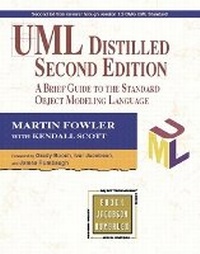
UML Distilled
A Brief Guide to the Standard Object Modeling Language
2nd Edition
Published on 13. September 1999
Book
Paperback/Softback
224 pages
978-0-201-65783-8 (ISBN)
Description
The award-winning first edition of UML Distilled was widely praised for being a concise guide to the core parts of the UML and has proved extremely successful in helping developers identify the most important parts of the language. UML Distilled, Second Edition, maintains the concise format with significantly updated coverage of use cases and activity diagrams, and expanded coverage of collaborations. It also includes a new appendix detailing the changes between UML versions. Beginning with a summary of UML's history, development, and rationale the book moves into a discussion of how the UML can be integrated into the object-oriented development process. The primary author profiles the various modeling techniques in the UML--such as use cases, class diagrams, and interaction diagrams--and describes the notation and semantics clearly and succinctly. He also outlines useful non-UML techniques such as CRC cards and patterns.
More details
Edition
2nd edition
Language
English
Place of publication
Boston
United States
Publishing group
Pearson Education (US)
Target group
College/higher education
Dimensions
Height: 234 mm
Width: 187 mm
Thickness: 11 mm
Weight
345 gr
ISBN-13
978-0-201-65783-8 (9780201657838)
Copyright in bibliographic data and cover images is held by Nielsen Book Services Limited or by the publishers or by their respective licensors: all rights reserved.
Schweitzer Classification
Other editions
New editions
Martin Fowler
UML Distilled: A Brief Guide to the Standard Object Modeling Language
A Brief Guide to the Standard Object Modeling Language
Book
10/2003
3rd Edition
Addison Wesley
€44.99
Shipment within 10-20 days
Previous edition

Book
08/1997
Addison Wesley
€32.18
Article exhausted; check different version
Persons
Martin Fowler is the Chief Scientist of ThoughtWorks, an enterprise-application development and delivery company. He's been applying object-oriented techniques to enterprise software development for over a decade. He is notorious for his work on patterns, the UML, refactoring, and agile methods. Martin lives in Melrose, Massachusetts, with his wife, Cindy, and a very strange cat. His homepage is http://martinfowler.com.
Kendall Scott is a UML trainer and consultant. With more than sixteen years of experience as a technical writer, he is skilled in converting complex, technical material into understandable and easy-to-use manuals.
Kendall Scott is a UML trainer and consultant. With more than sixteen years of experience as a technical writer, he is skilled in converting complex, technical material into understandable and easy-to-use manuals.
Content
Foreword xv.
Preface xvii.
1. Introduction.
What Is the UML?
How We Got Here.
Notations and Meta-Models.
Why Do Analysis and Design?
Looking for More Information.
2. An Outline Development Process.
Overview of the Process.
Inception.
Elaboration.
Planning the Construction Phase.
Construction.
Transition.
When to Use Iterative Development.
Where to Find Out More.
3. Use Cases.
Use Case Diagrams.
Business and System Use Cases.
When to Use Use Cases.
Where to Find Out More.
4. Class Diagrams: The Essentials.
Perspectives.
Associations.
Attributes.
Operations.
Generalization.
Constraint Rules.
When to Use Class Diagrams.
Where to Find Out More.
5. Interaction Diagrams.
Sequence Diagrams.
Collaboration Diagrams.
Comparing Sequence and Collaboration Diagrams.
When to Use Interaction Diagrams.
6. Class Diagrams: Advanced Concepts.
Stereotypes.
Object Diagram.
Class Scope Operations and Attributes.
Multiple and Dynamic Classification.
Aggregation and Composition.
Derived Associations and Attributes.
Interfaces and Abstract Classes.
Reference Objects and Value Objects.
Collections for Multivalued Association Ends.
Frozen.
Classification and Generalization.
Qualified Associations.
Association Class.
Parameterized Class.
Visibility.
7. Packages and Collaborations.
Packages.
Collaborations.
When to Use Package Diagrams and Collaborations.
Where to Find Out More.
8. State Diagrams.
Concurrent State Diagrams.
When to Use State Diagrams.
Where to Find Out More.
9. Activity Diagrams.
Decomposing an Activity.
Dynamic Concurrency.
Swimlanes.
When to Use Activity Diagrams.
Where to Find Out More.
10. Physical Diagrams.
Deployment Diagrams.
Component Diagrams.
Combining Component and Deployment Diagrams.
When to Use Physical Diagrams.
11. UML and Programming.
Patient Observation: Domain Model.
Patient Observation: Specification Model.
Moving to Code.
Appendix A. Techniques and Their Uses.
Appendix B. Changes between UML Versions.
Revisions to the UML.
Scheduled Future Revisions.
Changes in UML Distilled.
Changes from UML 1.0 to 1.1.
Changes from UML 1.2 (and 1.1) to 1.3 (and 1.4).
Bibliography.
Index. 020165783XT04062001
Preface xvii.
1. Introduction.
What Is the UML?
How We Got Here.
Notations and Meta-Models.
Why Do Analysis and Design?
Looking for More Information.
2. An Outline Development Process.
Overview of the Process.
Inception.
Elaboration.
Planning the Construction Phase.
Construction.
Transition.
When to Use Iterative Development.
Where to Find Out More.
3. Use Cases.
Use Case Diagrams.
Business and System Use Cases.
When to Use Use Cases.
Where to Find Out More.
4. Class Diagrams: The Essentials.
Perspectives.
Associations.
Attributes.
Operations.
Generalization.
Constraint Rules.
When to Use Class Diagrams.
Where to Find Out More.
5. Interaction Diagrams.
Sequence Diagrams.
Collaboration Diagrams.
Comparing Sequence and Collaboration Diagrams.
When to Use Interaction Diagrams.
6. Class Diagrams: Advanced Concepts.
Stereotypes.
Object Diagram.
Class Scope Operations and Attributes.
Multiple and Dynamic Classification.
Aggregation and Composition.
Derived Associations and Attributes.
Interfaces and Abstract Classes.
Reference Objects and Value Objects.
Collections for Multivalued Association Ends.
Frozen.
Classification and Generalization.
Qualified Associations.
Association Class.
Parameterized Class.
Visibility.
7. Packages and Collaborations.
Packages.
Collaborations.
When to Use Package Diagrams and Collaborations.
Where to Find Out More.
8. State Diagrams.
Concurrent State Diagrams.
When to Use State Diagrams.
Where to Find Out More.
9. Activity Diagrams.
Decomposing an Activity.
Dynamic Concurrency.
Swimlanes.
When to Use Activity Diagrams.
Where to Find Out More.
10. Physical Diagrams.
Deployment Diagrams.
Component Diagrams.
Combining Component and Deployment Diagrams.
When to Use Physical Diagrams.
11. UML and Programming.
Patient Observation: Domain Model.
Patient Observation: Specification Model.
Moving to Code.
Appendix A. Techniques and Their Uses.
Appendix B. Changes between UML Versions.
Revisions to the UML.
Scheduled Future Revisions.
Changes in UML Distilled.
Changes from UML 1.0 to 1.1.
Changes from UML 1.2 (and 1.1) to 1.3 (and 1.4).
Bibliography.
Index. 020165783XT04062001