

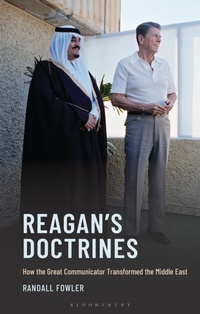
Reagan's Doctrines
How the Great Communicator Transformed the Middle East
Will be published approx. on 4. February 2027
Book
Hardback
208 pages
978-1-6669-7259-7 (ISBN)
Description
Ronald Reagan's pivotal role in reshaping norms of U.S. conduct, engagement, and intervention in the Middle East comprises a crucial and, until now, underappreciated element of his presidential legacy.
Encountering a region on the cusp of political change, Reagan sent troops into warzones, secured access to oil, passed trade deals, bombed terrorist facilities, bickered with allies, sold advanced weapons, fought radical insurgents, and did much else to create the modern Middle East. He was in constant dialogue with leaders from Lebanon, Israel, Egypt, Saudi Arabia, and other regional powers. As the most influential president of the second half of the twentieth century, Reagan employed his uncommon communicative gifts to interpret these happenings for his fellow citizens as he guided U.S. policy in the region.
Reagan articulated and instituted three principles that have guided U.S. defense strategy in the Middle East for decades. These doctrines are (1) Israel is a strategic ally, (2) state-sponsored terrorism is an act of war, and (3) the United States is holistically committed to Persian Gulf security. In bringing these elements together, this book reconsiders Reagan's inimitable legacy on U.S. politics and international affairs.
Readers curious about how presidential rhetoric shapes foreign policy will find a persuasive case that Reagan did as much as any leader since World War II to cement U.S. power in the Arabic-speaking world.
Encountering a region on the cusp of political change, Reagan sent troops into warzones, secured access to oil, passed trade deals, bombed terrorist facilities, bickered with allies, sold advanced weapons, fought radical insurgents, and did much else to create the modern Middle East. He was in constant dialogue with leaders from Lebanon, Israel, Egypt, Saudi Arabia, and other regional powers. As the most influential president of the second half of the twentieth century, Reagan employed his uncommon communicative gifts to interpret these happenings for his fellow citizens as he guided U.S. policy in the region.
Reagan articulated and instituted three principles that have guided U.S. defense strategy in the Middle East for decades. These doctrines are (1) Israel is a strategic ally, (2) state-sponsored terrorism is an act of war, and (3) the United States is holistically committed to Persian Gulf security. In bringing these elements together, this book reconsiders Reagan's inimitable legacy on U.S. politics and international affairs.
Readers curious about how presidential rhetoric shapes foreign policy will find a persuasive case that Reagan did as much as any leader since World War II to cement U.S. power in the Arabic-speaking world.
More details
Language
English
Place of publication
United States
Publishing group
Bloomsbury Publishing Plc
Target group
Professional and scholarly
Product notice
sewn/stitched
Cloth over boards
With dust jacket
Illustrations
5 tables
Dimensions
Height: 229 mm
Width: 152 mm
Thickness: 25 mm
Weight
454 gr
ISBN-13
978-1-6669-7259-7 (9781666972597)
Copyright in bibliographic data and cover images is held by Nielsen Book Services Limited or by the publishers or by their respective licensors: all rights reserved.
Schweitzer Classification
Person
Randall Fowler is Director of Undergraduate Research and Assistant Professor of Political Rhetoric at Abilene Christian University. He is a former Fulbright grantee to Jordan and the author of four books, most recently Securing the Prize: Presidential Metaphor and U.S. Intervention in the Persian Gulf.
Content
Timeline
Introduction: The Great Communicator, the Cold War and the Middle East
1. Israel: Reagan's Heroic Democracy in the Holy Land
2. Hero's Foil: Reagan on Palestine
3. Jonathan Pollard, Free Trade, and The Extra Special Relationship
4. The Problem of Terrorism: Lebanon, Hezbollah, and the PLO
5. Conditional Preemption: Israel, Tunisia, and Operation Wooden Leg
6. Operation El Dorado Canyon: Libya, Qaddafi, and the Shultz Doctrine Applied
7. From Carter Doctrine to Reagan Corollary: Selling AWACS to Saudi Arabia
8. Reagan in the Gulf: The Tilt Toward Iraq, Tanker War, and Iran-Contra
9. Operator Reagan: Earnest Will, Praying Mantis, and a Gulf Remade
Conclusion: Reagan's Doctrines
Bibliography
Index
About the Author
Introduction: The Great Communicator, the Cold War and the Middle East
1. Israel: Reagan's Heroic Democracy in the Holy Land
2. Hero's Foil: Reagan on Palestine
3. Jonathan Pollard, Free Trade, and The Extra Special Relationship
4. The Problem of Terrorism: Lebanon, Hezbollah, and the PLO
5. Conditional Preemption: Israel, Tunisia, and Operation Wooden Leg
6. Operation El Dorado Canyon: Libya, Qaddafi, and the Shultz Doctrine Applied
7. From Carter Doctrine to Reagan Corollary: Selling AWACS to Saudi Arabia
8. Reagan in the Gulf: The Tilt Toward Iraq, Tanker War, and Iran-Contra
9. Operator Reagan: Earnest Will, Praying Mantis, and a Gulf Remade
Conclusion: Reagan's Doctrines
Bibliography
Index
About the Author