

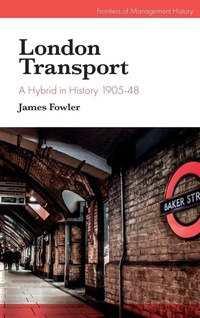
London Transport
A Hybrid in History 1905-48
Published on 16. September 2019
Book
Hardback
207 pages
978-1-78973-954-1 (ISBN)
Description
The London Passenger Transport Board (LPTB) was a unique hybrid public body accountable only to a small number of stakeholders, yet it delivered substantial improvements in public services and provided good working conditions for its employees at the cost of its investors.
London Transport: A Hybrid in History 1905-48 innovatively combines a revisionist historical narrative with a systematic analysis of quantitative and qualitative research to explore how and why the LPTB achieved rare popularity amongst its customers. Divided into three sections, the book explores the financial operations of the Board, the Board as a system of governance and the leadership and management within the LPTB. Using the extensive Transport for London archives, James Fowler conducts a timely assessment of the public network utility that once made London transport domestically popular and internationally admired.
With debates about British transport policy ongoing, this book is an illuminating read for scholars and students researching within the areas of business management history, transport and public sector governance and administration.
London Transport: A Hybrid in History 1905-48 innovatively combines a revisionist historical narrative with a systematic analysis of quantitative and qualitative research to explore how and why the LPTB achieved rare popularity amongst its customers. Divided into three sections, the book explores the financial operations of the Board, the Board as a system of governance and the leadership and management within the LPTB. Using the extensive Transport for London archives, James Fowler conducts a timely assessment of the public network utility that once made London transport domestically popular and internationally admired.
With debates about British transport policy ongoing, this book is an illuminating read for scholars and students researching within the areas of business management history, transport and public sector governance and administration.
Reviews / Votes
The author provides a systematic analysis of the history of London transport from 1905 to 1948, focusing on whose financial interests it operated in, its governance, and its leadership and the implications of these aspects. He concentrates on why events occurred and business, organizational, and management history and the present service and theories of quasi-public or hybrid organizations, rather than what and how events happened. He describes the historical development of London transport through the themes of finance, governance, and management; the transport's investors, employees, and passengers; governance and the lack of accountability of the London Passenger Transport Board; and how inefficiencies and temptations of unaccountable power were avoided through management by Lord Ashfield and Frank Pick. -- Copyright 2019 * Portland, OR *More details
Series
Language
English
Place of publication
Bingley
United Kingdom
Target group
Professional and scholarly
Dimensions
Height: 235 mm
Width: 157 mm
Thickness: 14 mm
Weight
403 gr
ISBN-13
978-1-78973-954-1 (9781789739541)
Copyright in bibliographic data and cover images is held by Nielsen Book Services Limited or by the publishers or by their respective licensors: all rights reserved.
Schweitzer Classification
Other editions
Additional editions
E-Book
09/2019
Emerald Publishing Limited
€90.99
Available for download
Persons
James Fowler is a lecturer at The University of Essex, UK. His academic interests are in the fields of business, management and organisational history, having published work on the performance of quasi-public organisations, organisational responses to crises and the purposes of statistical accounting. Prior to his academic career he was an Officer in the armed forces for 16 years.
Content
Chapter One: Modern Relevance Chapter Two: The Historical Development of London Transport
Chapter Three: Follow the Money: The investors, passengers and employee
Chapter Four: Who shall Guard the Guards? The Governance of London's Transport
Chapter Five: Solving the London Transport Problem
Chapter Six: Conclusions for Theory and Public Debate
Chapter Three: Follow the Money: The investors, passengers and employee
Chapter Four: Who shall Guard the Guards? The Governance of London's Transport
Chapter Five: Solving the London Transport Problem
Chapter Six: Conclusions for Theory and Public Debate