

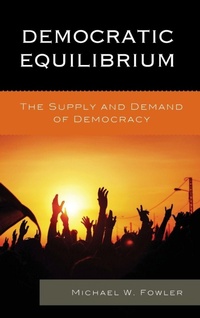
Democratic Equilibrium
The Supply and Demand of Democracy
Published on 12. November 2015
Book
Hardback
234 pages
978-1-4985-0501-7 (ISBN)
Description
Democratic Equilibrium: The Supply and Demand of Democracy defines a model for political change, change that results in either an increase or decrease in democracy. The book presents a model that builds upon the existing literature to bridge several major gaps in political change theory.
This book provides a holistic supply and demand model that draws upon works from political science, economics, and history. The work conducts an econometric test of the model and validates the results with field research cases from Mexico, the Philippines, and Senegal. The econometric chapter is a rare quantitative analysis of the effects of violence and development upon democracy. This topic is central to contemporary academic and policy debates about how to create democracies, consolidate democracies, achieve development and improve security, especially within developing countries. This topic is especially timely as the Arab Spring represents a unique opportunity and challenge for democratic change across the Middle East and North Africa. Recent events in Tunisia and Egypt demonstrate that democracy studies remain just as relevant today as they were twenty years ago.
The findings indicate that common structural explanations of democracy are incomplete since the structural relationships are not stable or constant over time. Instead, democratic change (or lack thereof) can be explained using a supply and demand model. Key actors (including the military, political parties, NGOs, the ruling regime, and civil society) are the suppliers and consumers that determine a country's resulting level of democracy. However, stating that actors are important is a major over-simplification. Each key actor builds preferences based upon a variety of factors, most importantly: security, income, and the adoption of democratic norms. It is this key dynamic that explains why insurgency, poverty, and under-development do not have a linearly negative effect on democracy. Instead, these factors have a centripetal effect on political development, pulling a country's government towards an intermediate state of political transition in which regimes stagnate in a partially democratic, partially autocratic regime type. Conversely, the model also explains why high income, democratic norms, and security do not necessarily lead to democratization in all cases.
This book provides a holistic supply and demand model that draws upon works from political science, economics, and history. The work conducts an econometric test of the model and validates the results with field research cases from Mexico, the Philippines, and Senegal. The econometric chapter is a rare quantitative analysis of the effects of violence and development upon democracy. This topic is central to contemporary academic and policy debates about how to create democracies, consolidate democracies, achieve development and improve security, especially within developing countries. This topic is especially timely as the Arab Spring represents a unique opportunity and challenge for democratic change across the Middle East and North Africa. Recent events in Tunisia and Egypt demonstrate that democracy studies remain just as relevant today as they were twenty years ago.
The findings indicate that common structural explanations of democracy are incomplete since the structural relationships are not stable or constant over time. Instead, democratic change (or lack thereof) can be explained using a supply and demand model. Key actors (including the military, political parties, NGOs, the ruling regime, and civil society) are the suppliers and consumers that determine a country's resulting level of democracy. However, stating that actors are important is a major over-simplification. Each key actor builds preferences based upon a variety of factors, most importantly: security, income, and the adoption of democratic norms. It is this key dynamic that explains why insurgency, poverty, and under-development do not have a linearly negative effect on democracy. Instead, these factors have a centripetal effect on political development, pulling a country's government towards an intermediate state of political transition in which regimes stagnate in a partially democratic, partially autocratic regime type. Conversely, the model also explains why high income, democratic norms, and security do not necessarily lead to democratization in all cases.
Reviews / Votes
Professor Fowler's work informs us of the determinants of the nuances of democracy, an overlooked aspect of regime change, in the context of a clever supply and demand model of democracy. Of equivalent importance in the model are societal structure, political agents' norms diffusion, and state security. Both quantitative and qualitative evidence, well-chosen in both respects, is marshaled to test the model. This is a wonderfully integrative work on democratization-highly recommended reading! -- Ross E. Burkhart, Boise State UniversityMore details
Language
English
Place of publication
United States
Publishing group
Bloomsbury Publishing Plc
Target group
Professional and scholarly
Illustrations
16 tables; 12 graphs
Dimensions
Height: 235 mm
Width: 157 mm
Thickness: 18 mm
Weight
537 gr
ISBN-13
978-1-4985-0501-7 (9781498505017)
Copyright in bibliographic data and cover images is held by Nielsen Book Services Limited or by the publishers or by their respective licensors: all rights reserved.
Schweitzer Classification
Other editions
Additional editions
E-Book
11/2015
1st Edition
Lexington Books
€107.99
Available for download
E-Book
11/2015
1st Edition
Lexington Books
€107.99
Available for download
Person
Mike Fowler is assistant professor in the Department of Military and Strategic Studies at the United States Air Force Academy.
Content
IIntroduction
IIProposing a Model of Political Change
IIIQuantitative Analysis: Testing Structural Determinants of Democracy
IVMexico: Democratic Evolution Despite Violence
VPhilippines: A Resurgence of Democracy Overcomes Insurgency and Poverty
VISenegal: The Case of a Poor, Under-Developed Democracy
VIIConclusion: The Supply and Demand of Democracy
IIProposing a Model of Political Change
IIIQuantitative Analysis: Testing Structural Determinants of Democracy
IVMexico: Democratic Evolution Despite Violence
VPhilippines: A Resurgence of Democracy Overcomes Insurgency and Poverty
VISenegal: The Case of a Poor, Under-Developed Democracy
VIIConclusion: The Supply and Demand of Democracy