

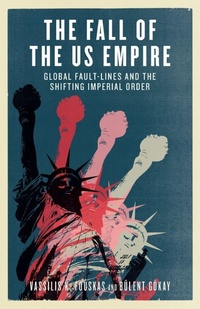
The Fall of the US Empire
Global Fault-Lines and the Shifting Imperial Order
Published on 14. June 2012
Book
Paperback/Softback
216 pages
978-0-7453-2643-6 (ISBN)
Description
Despite Washington's military supremacy, its economic foundations have been weakening since the Vietnam war - accelerated by the great recession and credit-rating downgrade - and its global authority dented by the quagmires in Iraq and Afghanistan.
This book intervenes in the debates surrounding America's status as an empire. It analyses Immanuel Wallerstein and others who argue that the US is in decline, to those who maintain that it remains a robust superpower. By explaining how America's neo-imperial system of governance has been working since WWII, it links the US's domestic and foreign vulnerabilities.
The Fall of the US Empire argues that the time has come to understand the US empire not by its power but by its systemic vulnerabilities of financialisation, resource depletion and environmental degradation.
This book intervenes in the debates surrounding America's status as an empire. It analyses Immanuel Wallerstein and others who argue that the US is in decline, to those who maintain that it remains a robust superpower. By explaining how America's neo-imperial system of governance has been working since WWII, it links the US's domestic and foreign vulnerabilities.
The Fall of the US Empire argues that the time has come to understand the US empire not by its power but by its systemic vulnerabilities of financialisation, resource depletion and environmental degradation.
Reviews / Votes
'This absorbing book makes a remarkable contribution to the current version of this very important debate, while revisiting its previous versions ... stimulating reading' -- Gilbert Achcar, Professor of Development Studies and International Relations at the School of Oriental and African Studies (SOAS) of the University of London 'A major addition to the literature on the decline of US hegemony' -- Donald Sassoon, Professor of Comparative European History, Queen Mary University of London 'Stimulating and challenging' -- Mike Newman, Emeritus Professor of Politics and Jean Monnet Professor of European Studies, London Metropolitan University 'The authors display an impressive mastery of the relevant theoretical literature without ignoring the factual details of the current financial and economic crisis' -- Ben Fowkes 'A coherent and theoretically informed account of the changing balance of global power' -- Professor Costas Lapavitsas, SOAS, University of London 'Ambitious... offers an historically informed alternative to mainstream readings of the crisis' -- Engelbert Stockhammer, Professor of Economics, Kingston UniversityMore details
Language
English
Place of publication
London
United Kingdom
Target group
College/higher education
Product notice
Paperback (UK-trade)
Illustrations
6 b&w figures, 1 b&w map
Dimensions
Height: 216 mm
Width: 140 mm
Thickness: 13 mm
Weight
314 gr
ISBN-13
978-0-7453-2643-6 (9780745326436)
Copyright in bibliographic data and cover images is held by Nielsen Book Services Limited or by the publishers or by their respective licensors: all rights reserved.
Schweitzer Classification
Other editions
Additional editions
Vassilis K. Fouskas | Buelent Goekay
The Fall of the US Empire
Global Fault-Lines and the Shifting Imperial Order
E-Book
06/2012
1st Edition
Pluto Press
€14.49
Available for download
Vassilis K. Fouskas | Buelent Goekay
The Fall of the US Empire
Global Fault-Lines and the Shifting Imperial Order
E-Book
06/2012
1st Edition
Pluto Press
€25.09
Available for download
Persons
Vassilis K. Fouskas is Professor of International Relations at Richmond University, London and the founding editor of the Journal of Balkan and Near Eastern Studies. He is the author of Cyprus (Pluto, 2009), The Fall of the US Empire (Pluto, 2012) and Zones of Conflict (Pluto, 2003).
Bulent Gokay is Professor of International Relations and Head of the School of Politics, International Relations and Philosophy at Keele University. He is the author of The Politics of Caspian Oil (2001), Eastern Europe Since 1970 (2005, 2006), Soviet Eastern Policy and Turkey, 1920-1991 (2006), Politics of Oil: A Survey (2007), and Muslims and Communists in Post-Transition States (with Ben Fowkes, 2011). He is the founder of globalfaultlines.com.
Bulent Gokay is Professor of International Relations and Head of the School of Politics, International Relations and Philosophy at Keele University. He is the author of The Politics of Caspian Oil (2001), Eastern Europe Since 1970 (2005, 2006), Soviet Eastern Policy and Turkey, 1920-1991 (2006), Politics of Oil: A Survey (2007), and Muslims and Communists in Post-Transition States (with Ben Fowkes, 2011). He is the founder of globalfaultlines.com.
Content
Acknowledgements
List of Abbreviations
List of Tables, Graphs and Maps
Introduction
1. Global Fault-lines
2. Bretton Woods to the Abyss of Globalisation, 1944-1971
3. The Failure of Financial Statecraft [1], 1971-1991
4. The Failure of Financial Statecraft [2], 1991-2011
5. The Power-Shift to the Global East
6. Resources Depletion and Environmental Degradation
Conclusion
Bibliography
Index
List of Abbreviations
List of Tables, Graphs and Maps
Introduction
1. Global Fault-lines
2. Bretton Woods to the Abyss of Globalisation, 1944-1971
3. The Failure of Financial Statecraft [1], 1971-1991
4. The Failure of Financial Statecraft [2], 1991-2011
5. The Power-Shift to the Global East
6. Resources Depletion and Environmental Degradation
Conclusion
Bibliography
Index