

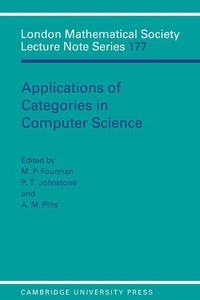
Applications of Categories in Computer Science
Proceedings of the London Mathematical Society Symposium, Durham 1991
Published on 26. June 1992
Book
Paperback/Softback
352 pages
978-0-521-42726-5 (ISBN)
Description
Category theory and related topics of mathematics have been increasingly applied to computer science in recent years. This book contains selected papers from the London Mathematical Society Symposium on the subject which was held at the University of Durham. Participants at the conference were leading computer scientists and mathematicians working in the area and this volume reflects the excitement and importance of the meeting. All the papers have been refereed and represent some of the most important and current ideas. Hence this book will be essential to mathematicians and computer scientists working in the applications of category theory.
More details
Series
Language
English
Place of publication
Cambridge
United Kingdom
Target group
Professional and scholarly
Product notice
Paperback (trade)
Illustrations
1 Halftones, unspecified
Dimensions
Height: 229 mm
Width: 152 mm
Thickness: 21 mm
Weight
572 gr
ISBN-13
978-0-521-42726-5 (9780521427265)
Copyright in bibliographic data and cover images is held by Nielsen Book Services Limited or by the publishers or by their respective licensors: all rights reserved.
Schweitzer Classification
Other editions
Additional editions
M. P. Fourman | P. T. Johnstone | A. M. Pitts
Applications of Categories in Computer Science
Proceedings of the London Mathematical Society Symposium, Durham 1991
E-Book
01/2011
1st Edition
Cambridge University Press
€66.49
Available for download
Persons
Andrew Pitts FACM FBCS is Professor of Theoretical Computer Science at the University of Cambridge and a Fellow of Darwin College.
Content
Preface; Computational comonads and intensional semantics S. Brookes and S. Geva; Weakly distributed categories J. R. B. Cockett and R. A. G. Seely; Sequentiality and full abstraction P.-L. Curien; Remarks on algebraically compact categories P. J. Freyd; Dinaturality for free P. J. Freyd, E. P. Robinson and G. Rosolini; Simply typed and untyped l-calculus revisited B. Jacobs; Modelling reduction in confluent categories C. B. Jay; On clubs and data-type constructors G. M. Kelly; Penrose diagrams and 2-dimensional rewriting Y. Lafont; Strong monads, algebras and fixed points P. S. Mulry; Semantics of local variables P. W. O'Hearn and R. D. Tennant; Using fibrations to understand subtypes W. Phoa; Reasoning about sequential functions via logical relations K. Sieber; I-categories and duality M. B. Smyth; Geometric theories and databases S. Vickers; Partial products, bagdomains and hyperlocal toposes P. T. Johnstone.