

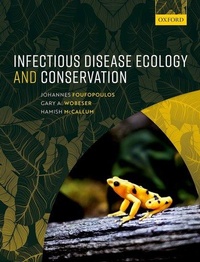
Infectious Disease Ecology and Conservation
Published on 15. February 2022
Book
Hardback
304 pages
978-0-19-958350-8 (ISBN)
Description
Emerging infectious diseases pose an increasingly serious threat to a number of endangered or sensitive species and are increasingly recognized as one of the major factors driving species extinction. Despite the significant impact of pathogens on conservation, no single book has yet integrated the theoretical principles underlying disease transmission with the practical health considerations for helping wildlife professionals and conservation biologists to manage disease outbreaks and conserve biodiversity.
This novel and accessible book starts with a foundational section focusing on the role of pathogens in natural ecosystems, the dynamics of transmission in different environments, and the factors driving wildlife disease outbreaks. It then moves on to more applied issues concerned with the acquisition of field data including sampling, experimental design and analysis, as well as diagnostic analyses in both the laboratory and field. Guidelines for effective modelling and data analysis follow, before a final section is devoted to disease prevention and control including the prevention of novel outbreaks, the use of diseases as biocontrol agents, and the associated issues of ethics, public communication, and outreach.
Infectious Disease Ecology and Conservation is primarily aimed at advanced undergraduates, graduate students, and established researchers in the fields of conservation biology, disease ecology, population ecology, and veterinary science. It will also be a valuable reference for conservation practitioners, land managers, and wildlife professionals who are required to deal with disease outbreak problems.
This novel and accessible book starts with a foundational section focusing on the role of pathogens in natural ecosystems, the dynamics of transmission in different environments, and the factors driving wildlife disease outbreaks. It then moves on to more applied issues concerned with the acquisition of field data including sampling, experimental design and analysis, as well as diagnostic analyses in both the laboratory and field. Guidelines for effective modelling and data analysis follow, before a final section is devoted to disease prevention and control including the prevention of novel outbreaks, the use of diseases as biocontrol agents, and the associated issues of ethics, public communication, and outreach.
Infectious Disease Ecology and Conservation is primarily aimed at advanced undergraduates, graduate students, and established researchers in the fields of conservation biology, disease ecology, population ecology, and veterinary science. It will also be a valuable reference for conservation practitioners, land managers, and wildlife professionals who are required to deal with disease outbreak problems.
Reviews / Votes
Recent events surrounding the SARS-CoV-2-caused COVID-19 pandemic show the need for a comprehensive approach to research on and management of emerging infectious diseases affecting humans and other living populations. [This book] provides a comprehensive overview of the convergence of conservation biology, theoretical ecology, and veterinary science in the study of emerging infectious diseases and their respective impacts on natural populations. Of particular interest are discussions on modeling, data analysis, and epidemiological concepts associated with population-level impacts and outcomes from emerging infectious diseases and parasites in animals and other natural populations. * Dr. Kip R. Thompson, Associate Professor, Missouri State University, Department of Public Health and Sports Science * I would like to congratulate the authors on creating a first-rate volume that should be widely used by anyone interested in developing a career in this area. It could easily be used as a textbook for a graduate student or upper-level undergraduatecourse. Members of the ecological society wondering why there are now so many sessions about parasites and pathogens at annual meetings should also browse a copy and realize there may be fundamental pieces of biology missing from their long term studies of plants and animals. Parasites and pathogens are everywhere. This volume explains why more people need to be aware of this and provides a cogent set of recipes for how you can set about studying these problem. * Andy Dobson, The Quarterly Review of Biology *More details
Language
English
Place of publication
Oxford
United Kingdom
Target group
Professional and scholarly
Product notice
sewn/stitched
Cloth over boards
Illustrations
80 colour line figures/illustrations/photographs and 13 tables
Dimensions
Height: 251 mm
Width: 193 mm
Thickness: 21 mm
Weight
828 gr
ISBN-13
978-0-19-958350-8 (9780199583508)
Copyright in bibliographic data and cover images is held by Nielsen Book Services Limited or by the publishers or by their respective licensors: all rights reserved.
Schweitzer Classification
Other editions
Additional editions
Johannes Foufopoulos | Gary A. Wobeser | Hamish McCallum
Infectious Disease Ecology and Conservation
Book
02/2022
Oxford University Press
€59.00
Shipment within 15-20 days
Johannes Foufopoulos | Gary A. Wobeser | Hamish McCallum
Infectious Disease Ecology and Conservation
E-Book
02/2022
1st Edition
OUP eBook
€43.49
Available for download
Persons
Johannes Foufopoulos is Associate Professor at the School for Environment and Sustainability, University of Michigan, USA. He runs the Foufopoulos Lab, where his research is focused on fundamental conservation biology questions and on issues related to the ecology and evolution of infectious diseases. His major research projects examine how habitat fragmentation, invasive organisms and global climate change result in species extinction. Other projects address questions regarding the impact of diseases on wildlife populations and the environmental causes leading to disease emergence.
Gary A. Wobeser is Professor Emeritus at the Department of Veterinary Pathology, Western College of Veterinary Science, University of Saskatchewan, Canada. He was one of the original founders of the Canadian Cooperative Wildlife Health Centre. His research interests involve environmental contaminants related to pathology and toxicology in wildlife.
Hamish McCallum is a Professor and Director of the Centre for Planetary Health and Food Security, Griffith University, Australia and a Member of the Environmental Futures Research Institute, Australia. His core area of research interest is in disease ecology, with a particular interest in infectious diseases in free ranging wildlife populations. He also has broader interests in quantitative population dynamics and conservation biology.
Gary A. Wobeser is Professor Emeritus at the Department of Veterinary Pathology, Western College of Veterinary Science, University of Saskatchewan, Canada. He was one of the original founders of the Canadian Cooperative Wildlife Health Centre. His research interests involve environmental contaminants related to pathology and toxicology in wildlife.
Hamish McCallum is a Professor and Director of the Centre for Planetary Health and Food Security, Griffith University, Australia and a Member of the Environmental Futures Research Institute, Australia. His core area of research interest is in disease ecology, with a particular interest in infectious diseases in free ranging wildlife populations. He also has broader interests in quantitative population dynamics and conservation biology.
Author
Associate ProfessorAssociate Professor, School for Environment and Sustainability, University of Michigan, USA
Professor EmeritusProfessor Emeritus, Department of Veterinary Pathology, University of Saskatchewan, Canada
Professor and DirectorProfessor and Director, Centre for Planetary Health and Food Security, Griffith University and Environmental Futures Research Institute, Australia
Content
Acknowledgements
Glossary
Introduction
I: Epidemiological Background
1: Conservation Biology and Parasitism
2: Disease Epidemiology in Natural Systems
3: Anthropogenic Effects and Wildlife Diseases
II: Acquisition of Field Data
4: Sampling, Experimental Design, and Analysis
5: Capture, Restraint, and Euthanasia of Target Species
6: Disease and Agent Detection in the Field
7: The Environmental Context of Wildlife Disease
8: Agent and Disease Detection: Laboratory Methods
III: Modeling and Data Analysis
9: Disease Modeling
10: Estimating Basic Epidemiological Parameters
IV: Epidemiological Control and Prevention
11: Disease Management: Introduction and Planning
12: Preventing New Disease Occurrences
13: Disease Elimination and Eradication
14: Disease Control: How to Live with Infection
15: Infectious Diseases as Biocontrol Agents
16: Ethical and Public Outreach Considerations
Glossary
Introduction
I: Epidemiological Background
1: Conservation Biology and Parasitism
2: Disease Epidemiology in Natural Systems
3: Anthropogenic Effects and Wildlife Diseases
II: Acquisition of Field Data
4: Sampling, Experimental Design, and Analysis
5: Capture, Restraint, and Euthanasia of Target Species
6: Disease and Agent Detection in the Field
7: The Environmental Context of Wildlife Disease
8: Agent and Disease Detection: Laboratory Methods
III: Modeling and Data Analysis
9: Disease Modeling
10: Estimating Basic Epidemiological Parameters
IV: Epidemiological Control and Prevention
11: Disease Management: Introduction and Planning
12: Preventing New Disease Occurrences
13: Disease Elimination and Eradication
14: Disease Control: How to Live with Infection
15: Infectious Diseases as Biocontrol Agents
16: Ethical and Public Outreach Considerations