

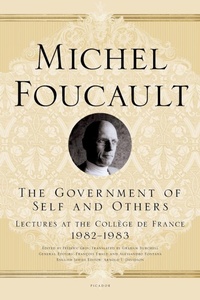
The Government of Self and Others
Description
More details
Persons
Content
Foreword: François Ewald and Alessandro Fontana
Translator's Note
One: 5 January 1983: First Hour
Remarks on method. - Study of Kant's text: What is Enlightenment? - Conditions of publication: journals. - The encounter between Christian Aufklärung and Jewish Haskala: freedom of conscience. - Philosophy and present reality. - The question of the Revolution. - Two critical filiations.
Two: 5 January 1983: Second Hour
The idea of tutelage ( minorité ): neither natural powerlessness nor authoritarian deprivation of rights. - Way out from the condition of tutelage and critical activity. - The shadow of three Critiques. - The difficulty of emancipation: laziness and cowardice; the predicted failure of liberators. - Motivations of the condition of tutelage: superimposition of obedience and absence of reasoning; confusion between the private and public use of reason. - The problematic turn at the end of Kant's text.
Three: 12 January 1983: First Hour
Reminds of method. - Definition of the subject to be studied this year. - Parresia: difficulty in defining the notion; bibliographical reference points. - An enduring, plural, and ambiguous notion. - Plato faced with the tyrant of Syracuse: an exemplary scene of parresia. - The echo of Oedipus. - Parresia versus demonstration, teaching, and discussion. - The element of risk.
Four: 12 January 1983: Second Hour
Irreducibility of the parrhesiastic to the performative utterance: opening up of an unspecified risk/public expression of a personal conviction/bringing a free courage into play. - Pragmatics and dramatics of discourse. - Classical use of the notion of parresia: democracy ( Polybius ) and citizenship ( Euripides ).
Five: 19 January 1983: First Hour
Ion in the mythology and history of Athens. - Political context of Euripides' tragedy: the Nicias peace. - History of Ion's birth. - Alethurgic schema of the tragedy. - The implication of the three truth-tellings: oracle, confession ( l'aveu ), and political discourse. - Structural comparison of Ion and Oedipus the King. - The adventures of truth-telling in Ion: the double half-life.
Six: 19 January 1983: Second Hour
Ion: A nobody, son of nobody. -Three categories of citizen. - Consequences of political intrusion by Ion: private hatreds and public tyranny. - In search of a mother. - Parresia irreducible to the actual exercise of power and to the citizen's status. - The agnostic game of truth-telling: free and risky. - Historical context: the Cleon/Nicias debate. - Creusa's anger.
Seven: 26 January 1983: First Hour
Continuation and end of the comparison between Ion and Oedipus: the truth does not arise from an investigation but from the clash of passions. - The rule of illusions and passions. - The cry of confession and accusation. - G. Dumézil's analyses of Apollo. - Dumézil's categories applied to Ion. - Tragic modulation of the theme of the voice. - Tragic modulation of the theme of gold.
Eight: 26 January 1983: Second Hour
Tragic modulation of the theme of fertility. - Parresia as imprecation: public denunciation by the weak of the injustice of the powerful. - Creusa's second confession ( aveu ): the voice of confession ( confession ). Final episodes: from murder plan to Athena's appearance.
Nine: 2 February 1983: First Hour
Reminder of the Polybius text. - Return to Ion: divine and human veridictions. - The three forms of parresia: statutory-political; judicial; moral. - Political parresia: its connections with democracy; its basis in an agnostic structure. - Return to the Polybius text isegoria/parresia relationship. Politeia and dunasteia: thinking of politics as experience. - Parresia in Euripides: The Phoenician Women; Hippolytus; The Baccahe; Orestes. - The Trial of Orestes.
Ten: 2 February 1983: Second Hour
The rectangle of parresia: formal condition, de facto condition, truth condition, and moral condition. - Example of the correct functioning of democratic parresia in Thucydides: three discourse of Pericles. - Bad parresia in Isocrates.
Eleven: 9 February 1983: First Hour
Parresia: everyday usage; political usage. - Reminder of three exemplary scenes: Thucydides; Isocrates; Plutarch. - Lines of evolution of parresia. - The four great problems of ancient political philosophy: the ideal city; the respective merits of democracy and autocracy; addressing the Prince's soul; the philosophy/rhetoric relationship. - Study of three texts by Plato.
Twelve: 9 February 1983: Second Hour
Plato's Letters: the context. - Study of Letter V: the phone of constitutions; reasons for non-involvement. - Study of Letter VII. - Dion's history. - Plato's political autobiography. - The journey to Sicily. - Why Plato accepts: kairos; philia; ergon.
Thirteen: 16 February 1983: First Hour
Philosophical ergon. Comparison with the Alcibiades. - The reality of philosophy: the courageous address to power. - First condition of reality: listening, the first circle. - The philosophical oeuvre: a choice; a way; an application. - The reality of philosophy as work of self on self ( second circle ).
Fourteen: 16 February 1983: Second Hour
The failure of Dionysius. - The platonic rejection of writing. - Mathemata versus sunousia. - Philosophy as practice of the soul. - The philosophical digression of Letter VII: the five elements of knowledge. - The third circle: the circle of knowledge. - The philosopher and the legislator. - Final remarks on contemporary interpretations of Plato.
Fifteen: 23 February 1983: First Hour
The enigmatic blandness of Plato's political advice. - The advice of Dionysius. - The diagnosis, practice of persuasion, proposal of a regime. - Advice to Dion's friends. - Study of Letter VIII. - Parresia underpins political advice.
Sixteen: 23 February 1983: Second Hour
Philosophy and politics: necessary relationship but impossible coincidence. - Cynical and Platonic game with regard to politics. - The new historical conjuncture: thinking a new political unit beyond the city-state. - From the public square to the Prince's soul. - The Platonic theme of the philosopher-king.
Seventeen: 2 March 1983: First Hour
Reminders about political parresia. - Points in the evolution of political parresia. - The major questions of ancient philosophy. - Study of a text by Lucian. - Ontology of discourse of veridiction. - Socratic speech in Apology. - The paradox of the political non-involvement of Socrates.
Eighteen: 2 March 1983: Second Hour
End of study of Socrates' Apology: parresia/rhetoric opposition. - Study of the Phaedrus: general plan of the dialogue. - The conditions of good logos. - Truth as permanent function of discourse. - Dialectic and psychagogy. - Philosophical parresia.
Nineteen: 9 March 1983: First Hour
The historical turnaround of parresia: from the political game to the philosophical game. - Philosophy as practice of parresia: the example of Aristippus. - The philosophical life as manifestation of the truth. - The permanent address to power. - The interpellation of each. - Portrait of the Cynic in Epictetus. - Pericles and Socrates. - Modern philosophy and courage of the truth.
Twenty: 9 March 1983: Second Hour
Study of the Gorgias. - The obligation of confession ( aveu ) in Plato: the context of liquidation of rhetoric. - The three qualities of Callicles: episteme; parresia; eunoia. - Agnostic game against egalitarian system. - Socratic speech: basanos and homologia.
Course Context
Index of Names
Index of Concepts and Notions