

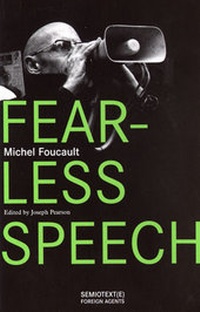
Fearless Speech
Published on 21. November 2001
Book
Paperback/Softback
192 pages
978-1-58435-011-8 (ISBN)
Description
This volume gathers a series of lectures Michel Foucault gave on the Greek notion of parrhesia, the speech of someone who has the moral qualities required to speak the truth, even if it differs from what the majority of people believes and one faces danger for speaking it.
I would like to distinguish between the 'history of ideas' and the 'history of thought.' The history of ideas involves the analysis of a notion from its birth, through its development, and in the setting of other ideas, which constitute its context. The history of thought is the analysis of the way an unproblematic field of experience becomes a problem, raises discussions and debate, incites new reactions, and induces crisis in the previously silent behaviors, practices, and institutions. It is the history of the way people become anxious, for example, about madness, about crime, about themselves, or about truth.
Comprised of six lectures delivered, in English, by Michel Foucault while teaching at Berkeley in the Fall of 1983, Fearless Speech was edited by Joseph Pearson and published in 2001. Reviewed by the author, it is the last book Foucault wrote before his death in 1984 and can be read as his last testament. Here, he positions the philosopher as the only person able to confront power with the truth, a stance that boldly sums up Foucault's project as a philosopher.
Still unpublished in France, Fearless Speech concludes the genealogy of truth that Foucault pursued throughout his life, starting with his investigations in Madness and Civilization, into the question of power and its technology. The expression 'fearless speech' is a rough translation of the Greek parrhesia, which designates those who take a risk to tell the truth; the citizen who has the moral qualities required to speak the truth, even if it differs from what the majority of people believe and faces danger for speaking it.
Parrhesia is a verbal activity in which a speaker expresses his personal relationship to truth through frankness instead of persuasion, truth instead of flattery, and moral duty instead of self-interest and moral apathy.
I would like to distinguish between the 'history of ideas' and the 'history of thought.' The history of ideas involves the analysis of a notion from its birth, through its development, and in the setting of other ideas, which constitute its context. The history of thought is the analysis of the way an unproblematic field of experience becomes a problem, raises discussions and debate, incites new reactions, and induces crisis in the previously silent behaviors, practices, and institutions. It is the history of the way people become anxious, for example, about madness, about crime, about themselves, or about truth.
Comprised of six lectures delivered, in English, by Michel Foucault while teaching at Berkeley in the Fall of 1983, Fearless Speech was edited by Joseph Pearson and published in 2001. Reviewed by the author, it is the last book Foucault wrote before his death in 1984 and can be read as his last testament. Here, he positions the philosopher as the only person able to confront power with the truth, a stance that boldly sums up Foucault's project as a philosopher.
Still unpublished in France, Fearless Speech concludes the genealogy of truth that Foucault pursued throughout his life, starting with his investigations in Madness and Civilization, into the question of power and its technology. The expression 'fearless speech' is a rough translation of the Greek parrhesia, which designates those who take a risk to tell the truth; the citizen who has the moral qualities required to speak the truth, even if it differs from what the majority of people believe and faces danger for speaking it.
Parrhesia is a verbal activity in which a speaker expresses his personal relationship to truth through frankness instead of persuasion, truth instead of flattery, and moral duty instead of self-interest and moral apathy.
More details
Series
Language
English
Place of publication
United Kingdom
Product notice
Paperback (trade)
Dimensions
Height: 234 mm
Width: 156 mm
Thickness: 6 mm
Weight
158 gr
ISBN-13
978-1-58435-011-8 (9781584350118)
Copyright in bibliographic data and cover images is held by Nielsen Book Services Limited or by the publishers or by their respective licensors: all rights reserved.
Schweitzer Classification
Person
Michel Foucault (1926?84) is widely considered to be one of the most influential academic voices of the twentieth century and has proven influential across disciplines.