

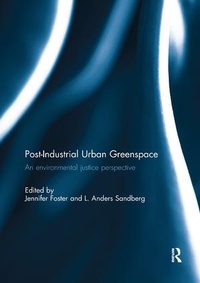
Post-Industrial Urban Greenspace
An Environmental Justice Perspective
1st Edition
Published on 7. June 2017
Book
Paperback/Softback
96 pages
978-1-138-08569-5 (ISBN)
Description
Post-industrial urban spaces typically include abandoned factories, disused rail lines, old pits and quarries, and de-commissioned landfills. In these places, different visions compete for dominance with respect to current and future land uses. Neighbours often view such urban greenspace as polluted, unkempt and weedy, harbouring undesirable biophysical features and people. These are spaces that often become the focus of some form of revitalization, reinvestment and restoration. From the perspective of civic authorities and urban planners, transforming post-industrial landscapes into disciplined and tended greenspace creates the urban conditions and signals of popular contemporary taste that attract investors, gentrifiers, and tourists. But post-industrial spaces are also places where unique and unpredictable human and ecological associations can emerge spontaneously. Such places may contain considerable ecological integrity and biodiversity and host human populations who find a home and respite in such ecologies. They also tell stories of an industrial and urban past that should be acknowledged, understood and (if suitable) celebrated. This volume explores the environmental justice and injustice dimensions of emerging urban post-industrial landscapes, including the ecological politics, cultural representations and aesthetics of these spaces.
This book was published as a special issue of Local Environment.
This book was published as a special issue of Local Environment.
More details
Language
English
Place of publication
London
United Kingdom
Publishing group
Taylor & Francis Ltd
Target group
Professional and scholarly
College/higher education
Dimensions
Height: 246 mm
Width: 174 mm
Weight
453 gr
ISBN-13
978-1-138-08569-5 (9781138085695)
Copyright in bibliographic data and cover images is held by Nielsen Book Services Limited or by the publishers or by their respective licensors: all rights reserved.
Schweitzer Classification
Other editions
Additional editions
Jennifer Foster | L. Anders Sandberg
Post-Industrial Urban Greenspace
An Environmental Justice Perspective
E-Book
10/2017
1st Edition
Routledge
€69.99
Available for download
Jennifer Foster | L. Anders Sandberg
Post-Industrial Urban Greenspace
An Environmental Justice Perspective
E-Book
10/2017
1st Edition
Routledge
€69.99
Available for download
Jennifer Foster | L. Anders Sandberg
Post-Industrial Urban Greenspace
An Environmental Justice Perspective
Book
07/2015
1st Edition
Routledge
€240.90
Shipment within 10-20 days
Persons
Jennifer Foster is an Associate Professor in the Faculty of Environmental Studies and Coordinator of the Urban Ecologies program at York University. She is a Registered Professional Planner (RPP) with the Canadian Institute of Planners. Recent projects include the contemporary art exhibition Land|Slide: Possible Futures and the critical urban ecology study From Rubble to Refuge.
L. Anders Sandberg is a Professor and former Associate Dean in the Faculty of Environmental Studies at York University, Toronto, Canada. His two most recent books are The Oak Ridges Moraine Battles: Development, Sprawl and Nature Conservation in the Toronto Region (2013) and Urban Trees, Forests, and Greenspace: A Political Ecology Perspective (2014).
L. Anders Sandberg is a Professor and former Associate Dean in the Faculty of Environmental Studies at York University, Toronto, Canada. His two most recent books are The Oak Ridges Moraine Battles: Development, Sprawl and Nature Conservation in the Toronto Region (2013) and Urban Trees, Forests, and Greenspace: A Political Ecology Perspective (2014).
Content
1. Post-Industrial Urban Greenspace: Justice, Quality of Life and Environmental Aesthetics in Rapidly Changing Urban Environments, 2. The Greening of Urban Post-Industrial Landscapes: Past Practices and Emerging Trends, 3. Environmental Gentrification in a Post-Industrial Landscape: The Case of the Limhamn Quarry, Malmoe, Sweden, 4. Buried Localities: Archaeological Exploration of a Toronto Dump and Wilderness Refuge, 5. Re-Presenting Transgressive Ecologies: Post-Industrial Sites as Contested Terrains,