

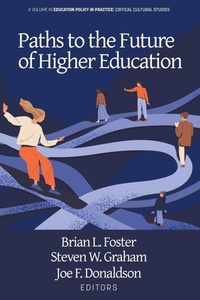
Paths to the Future of Higher Education
Published on 3. February 2021
Book
Paperback/Softback
286 pages
978-1-64802-406-1 (ISBN)
Description
The rapid change that higher education is undergoing is impacting all of the core mission elements: teaching and learning, research, service, and engagement with the external world (e.g., community engagement and health care delivery). Navigating this environment requires understanding of the underlying dynamics, with particular attention to how the issues are affecting the directions higher education will take. The main focus of the book is on teaching and learning, providing important context for understanding dynamics affecting how we can achieve our goals in teaching and learning.
The intended audience includes both academics and professionals (e.g., faculty and students in departments of higher education, anthropology, and education policy). Higher education leaders, administrators, governing board members, and many others will find the book helpful in providing insight into the future of higher education, especially as it concerns instruction and learning. The book will also be of use to professionals outside higher education who work on policy issues, on meeting the needs of employers, and on preparing students for applying knowledge in their personal lives.
The intended audience includes both academics and professionals (e.g., faculty and students in departments of higher education, anthropology, and education policy). Higher education leaders, administrators, governing board members, and many others will find the book helpful in providing insight into the future of higher education, especially as it concerns instruction and learning. The book will also be of use to professionals outside higher education who work on policy issues, on meeting the needs of employers, and on preparing students for applying knowledge in their personal lives.
More details
Series
Language
English
Place of publication
United States
Publishing group
Emerald Publishing Inc
Target group
Professional and scholarly
Dimensions
Height: 234 mm
Width: 156 mm
Thickness: 16 mm
Weight
439 gr
ISBN-13
978-1-64802-406-1 (9781648024061)
Copyright in bibliographic data and cover images is held by Nielsen Book Services Limited or by the publishers or by their respective licensors: all rights reserved.
Schweitzer Classification
Other editions
Additional editions
Brian L. Foster
Paths to the Future of Higher Education
E-Book
01/2021
1st Edition
Information Age Publishing
from
€62.33
Available for download
Content
Preface; Brian L. Foster.
Introduction: Active Learning Is Our Future; Brian L. Foster and Steven W. Graham.
Section I. Institutional Culture, Structure, And Public Engagement.
Chapter 1. Churning Forces in Higher Education: Are Nonprofits Becoming More Like For-Profits? Joe F. Donaldson and Steven W. Graham.
Chapter 2. Promotion and Tenure Rituals: Where They Have Taken Us and Where We Are Going; Brian L. Foster.
Chapter 3. Barriers to Research and Scientific Collaboration at Universities; Therese Kennelly Okraku and Christopher McCarty.
Chapter 4. Complexity, Collaboration, and Culture: Interdisciplinary Research Addressing Society's Challenges; Karen E. Downing.
Chapter 5. Archives, Libraries, Museums and Scholarly Publishing in an Age of Anxiety; Alex W. Barker.
Chapter 6. Rapid Ethnographic Assessment in Clinical Settings; Heather Schacht Reisinger, John Fortney, and Greg Reger.
Section II. Diversity, Equity, And Inclusion.
Chapter 7. Motivators and Influencers on Graduate School Enrollment for Undergraduate Students in the Liberal Arts and Sciences; Alissa Ruth and Janae Landers.
Chapter 8. Research at a Crossroads: The Need for Intersectionality in Higher Education Today; Jyl Wheaton-Abraham.
Chapter 9. The Problem with Parity in Participation: Representation is Both Culture and Practice; Monica D. Griffin.
Section III. Teaching And Learning.
Chapter 10. When One Teaches, Two Learn: The Value of Student Collaborated Research; Toni Copeland.
Chapter 11. How Personal Experiences of Teachers Affect Urban Students in Science Education; Kristen Vogt Veggeberg.
Chapter 12. Intended and Unintended: Transformative Learning in a Tanzanian Field Program; David Kozak.
Chapter 13. The Future Is Now? Methodological Approaches to Understanding the Implementation of Technology-Enhanced Learning; Lauren Herckis.
Chapter 14. Conclusion: Cultural and Structural Dynamics of Active Learning: Pros and Cons; Brian L. Foster and Joe F. Donaldson.
About the Contributors.
Introduction: Active Learning Is Our Future; Brian L. Foster and Steven W. Graham.
Section I. Institutional Culture, Structure, And Public Engagement.
Chapter 1. Churning Forces in Higher Education: Are Nonprofits Becoming More Like For-Profits? Joe F. Donaldson and Steven W. Graham.
Chapter 2. Promotion and Tenure Rituals: Where They Have Taken Us and Where We Are Going; Brian L. Foster.
Chapter 3. Barriers to Research and Scientific Collaboration at Universities; Therese Kennelly Okraku and Christopher McCarty.
Chapter 4. Complexity, Collaboration, and Culture: Interdisciplinary Research Addressing Society's Challenges; Karen E. Downing.
Chapter 5. Archives, Libraries, Museums and Scholarly Publishing in an Age of Anxiety; Alex W. Barker.
Chapter 6. Rapid Ethnographic Assessment in Clinical Settings; Heather Schacht Reisinger, John Fortney, and Greg Reger.
Section II. Diversity, Equity, And Inclusion.
Chapter 7. Motivators and Influencers on Graduate School Enrollment for Undergraduate Students in the Liberal Arts and Sciences; Alissa Ruth and Janae Landers.
Chapter 8. Research at a Crossroads: The Need for Intersectionality in Higher Education Today; Jyl Wheaton-Abraham.
Chapter 9. The Problem with Parity in Participation: Representation is Both Culture and Practice; Monica D. Griffin.
Section III. Teaching And Learning.
Chapter 10. When One Teaches, Two Learn: The Value of Student Collaborated Research; Toni Copeland.
Chapter 11. How Personal Experiences of Teachers Affect Urban Students in Science Education; Kristen Vogt Veggeberg.
Chapter 12. Intended and Unintended: Transformative Learning in a Tanzanian Field Program; David Kozak.
Chapter 13. The Future Is Now? Methodological Approaches to Understanding the Implementation of Technology-Enhanced Learning; Lauren Herckis.
Chapter 14. Conclusion: Cultural and Structural Dynamics of Active Learning: Pros and Cons; Brian L. Foster and Joe F. Donaldson.
About the Contributors.