

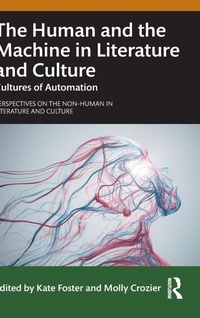
The Human and the Machine in Literature and Culture
Cultures of Automation
1st Edition
Published on 29. September 2025
Book
Hardback
204 pages
978-1-032-89587-1 (ISBN)
Description
Automation is everywhere: in the supermarket, in home appliances, and on our commutes. While we worry about what automation means for human autonomy now, human societies have long wondered about their replacement by machines. The Human and the Machine in Literature and Culture explores the pervasive - and long-standing - influence of automation on humanity by dismantling the prevalent future-oriented perspective of many automation debates. This collection examines how literature has conceptualized automation over centuries, from utopian visions of a world liberated from work and domestic labour to dystopian futures in which humans are surplus to requirements. We set out social and industrial developments which feed into discourses of automation and its mediation in literary cultures. By bringing together theoretical approaches to real-world automation with readings of its literary interpretations, this volume demonstrates literature's role as a space for hypothesizing alternate realities, making clear literature's propensity to inform our attitudes to real-world phenomena.
Reviews / Votes
The Human and the Machine in Literature and Culture highlights relationships between human agency and automation in literary imaginations. Its investigation of poetics and poetic production offers fresh insight into the value of the unruly and alive humanity that exists beyond the battery of the machines propelling us toward futurity.-Saba Syed Razvi, Associate Professor English and Creative Writing, University of Houston-Victoria, USA
More details
Series
Language
English
Place of publication
London
United Kingdom
Publishing group
Taylor & Francis Ltd
Target group
College/higher education
Postgraduate
Dimensions
Height: 235 mm
Width: 157 mm
Thickness: 16 mm
Weight
471 gr
ISBN-13
978-1-032-89587-1 (9781032895871)
Copyright in bibliographic data and cover images is held by Nielsen Book Services Limited or by the publishers or by their respective licensors: all rights reserved.
Schweitzer Classification
Other editions
Additional editions
Kate Foster | Molly Crozier
The Human and the Machine in Literature and Culture
Cultures of Automation
E-Book
09/2025
Routledge
€60.49
Available for download
Kate Foster | Molly Crozier
The Human and the Machine in Literature and Culture
Cultures of Automation
E-Book
09/2025
Routledge
€60.49
Available for download
Persons
Kate Foster is a Lecturer in French Studies at the University of Reading, UK. Her research focuses on intersections of human bodies and technology in late nineteenth and early twentieth-century cultures. She is working on a monograph on fictional androids and cyborgs, and developing a new project on technology, disease and cultural history.
Molly Crozier is an early career researcher in French and Comparative Literature. Her research focuses on embodiment, gender and disability in twentieth-century theatre. She is working on a monograph on disability in Samuel Beckett's drama. She holds an honorary fellowship at the Institute of Irish Studies, University of Liverpool.
Molly Crozier is an early career researcher in French and Comparative Literature. Her research focuses on embodiment, gender and disability in twentieth-century theatre. She is working on a monograph on disability in Samuel Beckett's drama. She holds an honorary fellowship at the Institute of Irish Studies, University of Liverpool.
Content
List of Contributors
Acknowledgements
Introduction. Automation: This Time It's (Probably Not) Different
Kate Foster
1.'What we need is more automation': Automation Debates in the Postwar Period
Ben Roberts
2. When the Clock Took the Floor: Technology as Non-Human Actor in Augusto De Angelis' Detective Novel Il Banchiere Assassinato (1935)
Emanuele Stefanori
3. On the Threshold of Life and Death: Guido Cavalcanti and the Medieval Automaton
Rebecca Reilly
4. Monsters, Mechanics, and Automatic Writing in E.T.A. Hoffman's 'The Sandman' and Gerard de Nerval's 'Aurelia'
Vanessa Weller
5. Forms of Computation in Hjalmar Soederberg's and Thomas Mann's Decadent Short Stories
Laura Alice Chapot
6. Prosthetic Verse: Technology, Embodiment, and Disability in French Poetry (1984-2024)
Leon Pradeau
7. Postcolonial Agency vs. 'French Automation' in Mounsi's Territoire d'Outre-Ville
David Spieser-Landes
8. Humans in the Loop as Post-Literary Ghosts: Discomfort and Disruption on Amazon Mechanical Turk
Bruno Ministro
9. Bricolage, Wild Thought, and the Automation of Knowledge
Madeleine Chalmers
Coda
Molly Crozier
Index
Acknowledgements
Introduction. Automation: This Time It's (Probably Not) Different
Kate Foster
1.'What we need is more automation': Automation Debates in the Postwar Period
Ben Roberts
2. When the Clock Took the Floor: Technology as Non-Human Actor in Augusto De Angelis' Detective Novel Il Banchiere Assassinato (1935)
Emanuele Stefanori
3. On the Threshold of Life and Death: Guido Cavalcanti and the Medieval Automaton
Rebecca Reilly
4. Monsters, Mechanics, and Automatic Writing in E.T.A. Hoffman's 'The Sandman' and Gerard de Nerval's 'Aurelia'
Vanessa Weller
5. Forms of Computation in Hjalmar Soederberg's and Thomas Mann's Decadent Short Stories
Laura Alice Chapot
6. Prosthetic Verse: Technology, Embodiment, and Disability in French Poetry (1984-2024)
Leon Pradeau
7. Postcolonial Agency vs. 'French Automation' in Mounsi's Territoire d'Outre-Ville
David Spieser-Landes
8. Humans in the Loop as Post-Literary Ghosts: Discomfort and Disruption on Amazon Mechanical Turk
Bruno Ministro
9. Bricolage, Wild Thought, and the Automation of Knowledge
Madeleine Chalmers
Coda
Molly Crozier
Index