

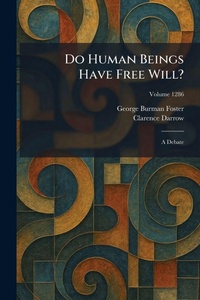
Do Human Beings Have Free Will?
Description
"Do Human Beings Have Free Will?: A Debate" captures a stimulating intellectual confrontation between two of the early 20th century's most formidable minds: the theologian George Burman Foster and the celebrated defense attorney Clarence Darrow. This work delves into one of the most enduring questions in philosophy and ethics-the existence of human agency versus the influence of determinism.
Within these pages, the authors explore the moral, religious, and legal implications of free will. Darrow, famously known for his deterministic views and his role in landmark legal cases, challenges the traditional concept of individual choice, arguing that human behavior is fundamentally shaped by heredity and environment. In contrast, Foster provides a nuanced philosophical and theological perspective that seeks to preserve the notion of personal responsibility and the spiritual significance of the human soul.
This dialogue offers readers a concise yet comprehensive overview of the arguments surrounding volition and predestination. As a significant document of public discourse, the text remains highly relevant for those interested in the intersections of law, religion, and the fundamental nature of the human experience. It serves as an excellent introduction to the classic arguments that continue to define the debate over human freedom.
This work has been selected by scholars as being culturally important, and is part of the knowledge base of civilization as we know it. This work was reproduced from the original artifact, and remains as true to the original work as possible. Therefore, you may see the original copyright references, library stamps (as most of these works have been housed in our most important libraries around the world), and other notations in the work.
This work is in the public domain in the United States of America, and possibly other nations. Within the United States, you may freely copy and distribute this work, as no entity (individual or corporate) has a copyright on the body of the work.
As a reproduction of a historical artifact, this work may contain missing or blurred pages, poor pictures, errant marks, etc. Scholars believe, and we concur, that this work is important enough to be preserved, reproduced, and made generally available to the public. We appreciate your support of the preservation process, and thank you for being an important part of keeping this knowledge alive and relevant.