

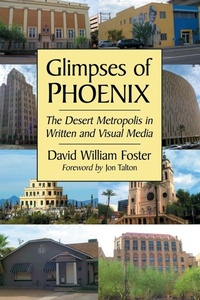
Glimpses of Phoenix
The Desert Metropolis in Written and Visual Media
Published on 1. May 2013
Book
Paperback/Softback
208 pages
978-0-7864-7364-9 (ISBN)
Description
Part of the self-image of Phoenix is that the city has no history and that anything of importance happened yesterday. Also that Phoenix, the Arizona state capital, is a "clean" city (despite a past of police corruption and social oppression). The "real" Phoenix, easygoing, sun-drenched, a place of ever-expanding development and economic growth, guarantees, it is said, an enviable lifestyle, low taxes, and unfettered personal freedom and opportunity.
Little of this is true. Phoenix has been described as one of the least sustainable cities in the country. This sixth largest urban area of the United States has an alarmingly superficial and tourism-oriented discourse among its leaders. This book examines a series of narrative works (novels, theater, chronicles, investigative reporting, personal accounts, editorial cartooning, even a children's television program) that question this discourse in a frequently stinging fashion. The works examined are anchored in a critical understanding of the dominant urban myths of Greater Phoenix, and an awareness of how all the newness, modernity and fun-in-the-sun mentality mask a uniquely dystopian human experience.
Little of this is true. Phoenix has been described as one of the least sustainable cities in the country. This sixth largest urban area of the United States has an alarmingly superficial and tourism-oriented discourse among its leaders. This book examines a series of narrative works (novels, theater, chronicles, investigative reporting, personal accounts, editorial cartooning, even a children's television program) that question this discourse in a frequently stinging fashion. The works examined are anchored in a critical understanding of the dominant urban myths of Greater Phoenix, and an awareness of how all the newness, modernity and fun-in-the-sun mentality mask a uniquely dystopian human experience.
More details
Language
English
Place of publication
Jefferson, NC
United States
Target group
Professional and scholarly
Interest Age: From 18 years
Product notice
Paperback (trade)
Illustrations
26 photos, appendices, notes, bibliography, index
Dimensions
Height: 229 mm
Width: 152 mm
Thickness: 12 mm
Weight
346 gr
ISBN-13
978-0-7864-7364-9 (9780786473649)
Copyright in bibliographic data and cover images is held by Nielsen Book Services Limited or by the publishers or by their respective licensors: all rights reserved.
Schweitzer Classification
Person
David William Foster is Regents' Professor of Spanish and Women and Gender Studies at Arizona State University in Tempe.
Content
Table of Contents
Foreword: Writing Phoenix, by Jon Talton
Introduction
Erma Bombeck: The Phoenix Suburban Underbelly
Wallace and Ladmo: Dark Shadows of Irreverent Humor in the Valley of the Sun
Truthful Misrepresentations: Steve Benson Draws Phoenix
Phoenix, Say What? Urban Landscapes in the Chronicles of Laurie Notaro
Desert Noir: The Detective Novels of Jon Talton
Jana Bommersbach on Winnie Ruth Judd: Woman as Scapegoat for the Dirty Secrets of the City
Out of the Barrio: Stella Pope Duarte's Let Their Spirits Dance
Phoenix in Guillermo Reyes's Places to Touch Him
Phoenix as Dystopia in Cherrie Moraga's Hungry Woman
Cecilia Esquer: Establishing a Public Voice for a Chicana Activist
Conclusions
Appendix I: Glendon Swarthout and The Cadillac Cowboys
Appendix II: The Matter of Jack Swilling
Chapter Notes
References
Index
Foreword: Writing Phoenix, by Jon Talton
Introduction
Erma Bombeck: The Phoenix Suburban Underbelly
Wallace and Ladmo: Dark Shadows of Irreverent Humor in the Valley of the Sun
Truthful Misrepresentations: Steve Benson Draws Phoenix
Phoenix, Say What? Urban Landscapes in the Chronicles of Laurie Notaro
Desert Noir: The Detective Novels of Jon Talton
Jana Bommersbach on Winnie Ruth Judd: Woman as Scapegoat for the Dirty Secrets of the City
Out of the Barrio: Stella Pope Duarte's Let Their Spirits Dance
Phoenix in Guillermo Reyes's Places to Touch Him
Phoenix as Dystopia in Cherrie Moraga's Hungry Woman
Cecilia Esquer: Establishing a Public Voice for a Chicana Activist
Conclusions
Appendix I: Glendon Swarthout and The Cadillac Cowboys
Appendix II: The Matter of Jack Swilling
Chapter Notes
References
Index