

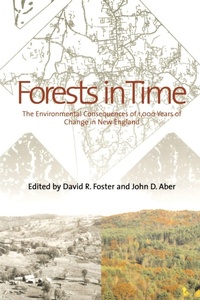
Forests in Time
The Environmental Consequences of 1,000 Years of Change in New England
Will be published approx. on 1. April 2006
Book
Paperback/Softback
496 pages
978-0-300-11537-6 (ISBN)
Description
The Eastern Hemlock, massive and majestic, has played a unique role in structuring northeastern forest environments, from Nova Scotia to Wisconsin and through the Appalachian Mountains to North Carolina, Tennessee, and Alabama. A "foundation species" influencing all the species in the ecosystem surrounding it, this iconic North American tree has long inspired poets and artists as well as naturalists and scientists.
Five thousand years ago, the hemlock collapsed as a result of abrupt global climate change. Now this iconic tree faces extinction once again because of an invasive insect, the hemlock woolly adelgid. Drawing from a century of studies at Harvard University's Harvard Forest, one of the most well-regarded long-term ecological research programs in North America, the authors explore what hemlock's modern decline can tell us about the challenges facing nature and society in an era of habitat changes and fragmentation, as well as global change.
Five thousand years ago, the hemlock collapsed as a result of abrupt global climate change. Now this iconic tree faces extinction once again because of an invasive insect, the hemlock woolly adelgid. Drawing from a century of studies at Harvard University's Harvard Forest, one of the most well-regarded long-term ecological research programs in North America, the authors explore what hemlock's modern decline can tell us about the challenges facing nature and society in an era of habitat changes and fragmentation, as well as global change.
Reviews / Votes
"An important and timely addition to a growing literature that documents change and, by implication, underlines our responsibilities to that thing out there that we call 'nature.'" Michael Williams, Science "A must-read for anyone interested in the study of historical forest ecology and anthropogenic impacts on ecosystem dynamics." Marc D. Abrams, BioScience "With excellent writing and editing, this book synthesizes nearly 100 years of ecological research conducted at Harvard Forest. Much more than a description of research, it provides a framework for ecological studies that is based on an understanding of historical influences on forest structure, composition, and function... It is one of a few select works that documents how the history of land use, climate, physiography and ecology interact to shape the contemporary landscape. It should therefore be on every forest ecologist's bookshelf. Highly recommended." Choice"More details
Language
English
Place of publication
United States
Target group
College/higher education
Professional and scholarly
Product notice
Paperback (trade)
Dimensions
Height: 234 mm
Width: 156 mm
Thickness: 28 mm
Weight
751 gr
ISBN-13
978-0-300-11537-6 (9780300115376)
Copyright in bibliographic data and cover images is held by Nielsen Book Services Limited or by the publishers or by their respective licensors: all rights reserved.
Schweitzer Classification
Persons
David Foster, Audrey Barker Plotkin, Anthony D'Amato, Ben Baiser, Aaron Ellison, David Orwig, Wyatt Oswald, and Jonathan Thompson are scientific collaborators and colleagues at Harvard University's Harvard Forest.