

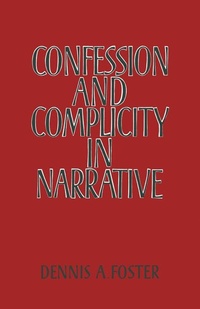
Confession and Complicity in Narrative
Published on 3. March 2011
Book
Paperback/Softback
158 pages
978-0-521-17732-0 (ISBN)
Description
What is the precise relationship between the writer of a text and the reader? Contributions to reader-response theory have suggested that the reader is relatively passive. In this 1987 text, Professor Foster argues that the relationship is more complex than that: readers enter into complicity with writers and create the illusion of the writer's mastery over meaning in order to imagine themselves as masters and become writers in their own place. This dynamic model of the reading process is revealed most tellingly in 'confessional' narratives and so Professor Foster explores the complex patterns of the reader/writer symbiosis in texts by Augustine, Kierkegaard, Henry James, Hawthorne, Faulkner, and Beckett. What emerges is a fresh theory of reading literature: the engagement between writer and reader as a struggle for power in which the reader is actively complicit and self-conscious in his or her interpretations.
More details
Language
English
Place of publication
Cambridge
United Kingdom
Target group
College/higher education
Product notice
Paperback (trade)
Illustrations
Worked examples or Exercises
Dimensions
Height: 216 mm
Width: 140 mm
Thickness: 9 mm
Weight
208 gr
ISBN-13
978-0-521-17732-0 (9780521177320)
Copyright in bibliographic data and cover images is held by Nielsen Book Services Limited or by the publishers or by their respective licensors: all rights reserved.
Schweitzer Classification
Other editions
Additional editions
Dennis A. Foster
Confession and Complicity in Narrative
Book
05/1987
Cambridge University Press
€121.80
Shipment within 15-20 days
Content
Abbreviations; Acknowledgements; 1. The confessional turn; 2. Three exemplary readings: the endless confession: Augustine's Confessions, a paradigm of passion: Kierkegaard's Diary of a Seducer, confession and revenge: James's 'Figure in the Carpet'; 3. The embroidered sin: confessional evasion in The Scarlet Letter; 4. Love's androgynous advocates: design and desire in Absalom, Absalom!; 5. All here is sin: the obligation in The Unnamable; 6. Conclusion: the web; Notes; Index.