

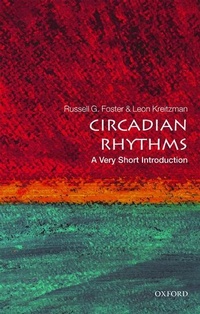
Circadian Rhythms
A Very Short Introduction
Published on 23. March 2017
Book
Paperback/Softback
176 pages
978-0-19-871768-3 (ISBN)
Description
The earth's daily rotation affects just about every living creature. From dawn through to dusk, there are changes in light, temperature, humidity, and rainfall. However, these changes are regular, rhythmic and, therefore, predictable. Thus, the near 24 hour circadian rhythm is innate: a genetically programmed clock that essentially ticks of its own accord.
This Very Short Introduction explains how organisms can "know" the time and reveals what we now understand of the nature and operation of chronobiological processes. Covering variables such as light, the metabolism, human health, and the seasons, Foster and Kreitzman illustrate how jet lag and shift work can impact on human well-being, and consider circadian rhythms alongside a wide range of disorders, from schizophrenia to obesity.
ABOUT THE SERIES: The Very Short Introductions series from Oxford University Press contains hundreds of titles in almost every subject area. These pocket-sized books are the perfect way to get ahead in a new subject quickly. Our expert authors combine facts, analysis, perspective, new ideas, and enthusiasm to make interesting and challenging topics highly readable.
This Very Short Introduction explains how organisms can "know" the time and reveals what we now understand of the nature and operation of chronobiological processes. Covering variables such as light, the metabolism, human health, and the seasons, Foster and Kreitzman illustrate how jet lag and shift work can impact on human well-being, and consider circadian rhythms alongside a wide range of disorders, from schizophrenia to obesity.
ABOUT THE SERIES: The Very Short Introductions series from Oxford University Press contains hundreds of titles in almost every subject area. These pocket-sized books are the perfect way to get ahead in a new subject quickly. Our expert authors combine facts, analysis, perspective, new ideas, and enthusiasm to make interesting and challenging topics highly readable.
Reviews / Votes
Circadian Rhythms is an ideal companion to Sleep, another excellent book in the same series and co-authored by Foster ... Foster and Kreitzman delve into the molecular biology that underlies the circadian rhythms, but they do so clearly and gradually. So even if you're not a biologist you'll be able to follow the discussions. * Mark Greener, Fortean Times * excellent * David Lorimer, Network Review *More details
Series
Language
English
Place of publication
Oxford
United Kingdom
Target group
College/higher education
Illustrations
20 black and white halftones
Dimensions
Height: 174 mm
Width: 113 mm
Thickness: 15 mm
Weight
133 gr
ISBN-13
978-0-19-871768-3 (9780198717683)
Copyright in bibliographic data and cover images is held by Nielsen Book Services Limited or by the publishers or by their respective licensors: all rights reserved.
Schweitzer Classification
Other editions
Additional editions
E-Book
03/2017
OUP eBook
€9.49
Available for download
E-Book
03/2017
OUP eBook
€9.49
Available for download
Persons
Russell Foster is Professor of Circadian Neuroscience and the Head of the Department of Ophthalmology at Oxford University. His research spans basic and applied circadian and photoreceptor biology. For his discovery of non-rod, non-cone ocular photoreceptors he has been awarded the Honma prize (Japan), Cogan award (USA), and Zoological Society Scientific & Edride-Green Medals (UK). He has also written several books, such as Rhythms of Life , co-authored with Leon Kreitzman (Profile Books, 2004) and Sleep: A Very Short Introduction (Oxford University Press, 2012).
Leon Kreitzman is an esteemed author, biologist and broadcaster who is currently a visiting consultant at the Nuffield Health Centre at Oxford University. He has written numerous articles and books on the social and scientific factors of chronobiology, including The 24 Hour Society (Profile Books, 1999).
Leon Kreitzman is an esteemed author, biologist and broadcaster who is currently a visiting consultant at the Nuffield Health Centre at Oxford University. He has written numerous articles and books on the social and scientific factors of chronobiology, including The 24 Hour Society (Profile Books, 1999).
Content
1: Introduction
2: How the clock works
3: Light and the clock
4: Synchronising the clock
5: Day/night cycle
6: Clocks and metabolism
7: Clocks and human health
8: The seasonal clock
9: Where did the clocks come from
Further reading
Index
2: How the clock works
3: Light and the clock
4: Synchronising the clock
5: Day/night cycle
6: Clocks and metabolism
7: Clocks and human health
8: The seasonal clock
9: Where did the clocks come from
Further reading
Index