

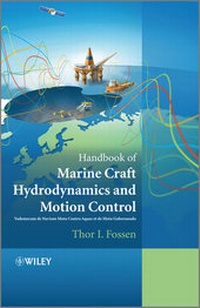
Handbook of Marine Craft Hydrodynamics and Motion Control
Published on 23. May 2011
Book
Hardback
596 pages
978-1-119-99149-6 (ISBN)
Description
The technology of hydrodynamic modeling and marine craft motion control systems has progressed greatly in recent years. This timely survey includes the latest tools for analysis and design of advanced guidance, navigation and control systems and presents new material on underwater vehicles and surface vessels. Each section presents numerous case studies and applications, providing a practical understanding of how model-based motion control systems are designed.
Key features include:
* a three-part structure covering Modeling of Marine Craft; Guidance, Navigation and Control Systems; and Appendices, providing all the supporting theory in a single resource
* kinematics, kinetics, hydrostatics, seakeeping and maneuvering theory, and simulation models for marine craft and environmental forces
* guidance systems, sensor fusion and integrated navigation systems, inertial measurement units, Kalman filtering and nonlinear observer design for marine craft
* state-of-the-art methods for feedback control
* more advanced methods using nonlinear theory, enabling the user to compare linear design techniques before a final implementation is made.
* linear and nonlinear stability theory, and numerical methods
* companion website that hosts links to lecture notes and download information for the Marine Systems Simulator (MSS) which is an open source Matlab/Simulink(r) toolbox for marine systems. The MSS toolbox includes hydrodynamic models and motion control systems for ships, underwater vehicles and floating structures
With an appropriate balance between mathematical theory and practical applications, academic and industrial researchers working in marine and control engineering aspects of manned and unmanned maritime vehicles will benefit from this comprehensive handbook. It is also suitable for final year undergraduates and postgraduates, lecturers, development officers, and practitioners in the areas of rigid-body modeling, hydrodynamics, simulation of marine craft, control and estimation theory, decision-support systems and sensor fusion. www.wiley.com/go/fossen_marine
More details
Other editions
New editions
Thor I. Fossen
Handbook of Marine Craft Hydrodynamics and Motion Control
Book
03/2021
Wiley-Blackwell
€192.50
Shipment within 15-20 days
Additional editions
Thor I. Fossen
Handbook of Marine Craft Hydrodynamics and Motion Control
E-Book
05/2011
Wiley
€144.99
Available for download
Person
Professor Thor Fossen, Department of Engineering Cybernetics, Norwegian University of Science and Technology (NTNU), Norway
Thor Fossen was appointed Professor in Guidance, Navigation and Control at the Department of Engineering Cybernetics, NTNU in 1993, and now teaches mathematical modeling of marine craft and control theory. He is one of the founders of the company Marine Cybernetics, where he was Vice President in R&D between 2002 and 2007.
Professor Fossen was a senior scientific advisor for ABB, Kongsberg and MARINTEK in 2002. He was involved in the design of nonlinear and passive state estimators for marine vessels, autopilots, trajectory tracking and maneuvering control, identification of ship dynamics from sea-trials and strapdown DGPS/INS navigation systems. He was granted a patent for weather optimal positioning control of marine vessels in 1998 and in 2002 this work won the Automatica Prize Paper Award. Professor Fossen has authored 250 scientific papers and three international textbooks, one of which being the John Wiley and Sons publication Guidance and Control of Ocean Vehicles in 1994. In 2008 his paper entitled 'Nonlinear Observer for Vehicle Estimation' won the Arch T. Colwell Merit Award at the SAE 2008 World Congress.
Thor Fossen was appointed Professor in Guidance, Navigation and Control at the Department of Engineering Cybernetics, NTNU in 1993, and now teaches mathematical modeling of marine craft and control theory. He is one of the founders of the company Marine Cybernetics, where he was Vice President in R&D between 2002 and 2007.
Professor Fossen was a senior scientific advisor for ABB, Kongsberg and MARINTEK in 2002. He was involved in the design of nonlinear and passive state estimators for marine vessels, autopilots, trajectory tracking and maneuvering control, identification of ship dynamics from sea-trials and strapdown DGPS/INS navigation systems. He was granted a patent for weather optimal positioning control of marine vessels in 1998 and in 2002 this work won the Automatica Prize Paper Award. Professor Fossen has authored 250 scientific papers and three international textbooks, one of which being the John Wiley and Sons publication Guidance and Control of Ocean Vehicles in 1994. In 2008 his paper entitled 'Nonlinear Observer for Vehicle Estimation' won the Arch T. Colwell Merit Award at the SAE 2008 World Congress.
Content
About the Author.
Preface.
List of Tables.
I Marine Craft Hydrodynamics.
1 Introduction.
1.1 Classification of Models.
1.2 The Classical Models in Naval Architecture.
1.3 Fossen's Robot-Like Vectorial Model for Marine Craft.
2 Kinematics.
2.1 Reference Frames.
2.2 Transformations between BODY and NED.
2.3 Transformations between ECEF and NED.
2.4 Transformations between BODY and FLOW.
3 Rigid-Body Kinetics.
3.1 Newton-Euler Equations of Motion about CG.
3.2 Newton-Euler Equations of Motion about CO.
3.3 Rigid-Body Equations of Motion.
4 Hydrostatics.
4.1 Restoring Forces for Underwater Vehicles.
4.2 Restoring Forces for Surface Vessels.
4.3 Load Conditions and Natural Periods.
4.4 Ballast Systems.
5 Seakeeping Theory.
5.1 Hydrodynamic Concepts and Potential Theory.
5.2 Seakeeping and Maneuvering Kinematics.
5.3 The Classical Frequency-Domain Model.
5.4 Time-Domain Models including Fluid Memory Effects.
5.5 Case Study: Identification of Fluid Memory Effects.
6 Maneuvering Theory.
6.1 Rigid-Body Kinetics.
6.2 Potential Coefficients.
6.3 Nonlinear Coriolis Forces due to Added Mass in a Rotating Coordinate System.
6.4 Viscous Damping and Ocean Current Forces.
6.5 Maneuvering Equations.
7 Models for Ships, Offshore Structures and Underwater Vehicles.
7.1 Maneuvering Models (3 DOF).
7.2 Autopilot Models for Heading Control (1 DOF).
7.3 DP Models (3 DOF).
7.4 Maneuvering Models including Roll (4 DOF).
7.5 Equations of Motion (6 DOF).
8 Environmental Forces and Moments.
8.1 Wind Forces and Moments.
8.2 Wave Forces and Moments.
8.3 Ocean Current Forces and Moments.
II Motion Control.
9 Introduction.
9.1 Historical Remarks.
9.2 The Principles of Guidance, Navigation and Control.
9.3 Setpoint Regulation,Trajectory-Tracking and Path-Following Control.
9.4 Control of Underactuated and Fully Actuated Craft.
10 Guidance Systems.
10.1 Target Tracking.
10.2 Trajectory Tracking.
10.3 Path Following for Straight-Line Paths.
10.4 Path Following for Curved Paths.
11 Sensor and Navigation Systems.
11.1 Low-Pass and Notch Filtering.
11.2 Fixed Gain Observer Design.
11.3 Kalman Filter Design.
11.4 Nonlinear Passive Observer Designs.
11.5 Integration Filters for IMU and Global Navigation Satellite Systems.
12 Motion Control Systems.
12.1 Open-Loop Stability and Maneuverability.
12.2 PID Control and Acceleration Feedback.
12.3 Control Allocation.
13 Advanced Motion Control Systems.
13.1 Linear-Quadratic Optimal Control.
13.2 State Feedback Linearization.
13.3 Integrator Backstepping.
13.4 Sliding-Mode Control.
Appendices.
A Nonlinear Stability Theory.
A.1 Lyapunov Stability for Autonomous Systems.
A.2 Lyapunov Stability of Nonautonomous Systems.
B Numerical Methods.
B.1 Discretization of Continuous-Time Systems.
B.2 Numerical Integration Methods.
B.3 Numerical Differentiation.
References.
Index.