

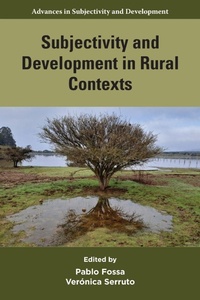
Subjectivity and Development in Rural Contexts
Will be published approx. on 12. December 2025
Book
Paperback/Softback
300 pages
978-1-80592-300-8 (ISBN)
Description
Subjectivity and Development in Rural Contexts presents a compilation of chapters that explore different phenomena of ruralness. Through a collection of theoretical and empirical works, the book attempts to show the role of the social-cultural environment in the subjective experience and processes of human development.
Psychology has historically been an urban science. However, rural psychology has experienced significant growth in recent decades. Rurality has historically been observed and analyzed through the "lenses" of the urban, sub-dimensioning its own characteristics and its psychological richness. Following a cultural approach, it can be understood that subjectivity is the result of the internalization of cultural artifacts and that it depends on the contextual frameworks in which its development takes place. Therefore, it is possible to think that ruralness has the potential to generate processes of subjectivation that are specific and typical of its social and cultural context. On the other hand, there is a need to explore development processes in rural contexts to counterbalance the urbanization of psychology taught in universities and research centers.
This book brings together works from philosophy, anthropology, cultural psychology, cognitive psychology, social psychology, developmental psychology, and education. Each chapter examines the processes of subjectivation and development in rural areas. Likewise, the role of the social and cultural context in cognitive, affective, and identity development is explored.
Subjectivity and Development in Rural Contexts is an invaluable resource for educators, psychologists, teachers, researchers, undergraduate and graduate students, and anyone who wants to know more about subjectivity and psychological development in ruralness.
Psychology has historically been an urban science. However, rural psychology has experienced significant growth in recent decades. Rurality has historically been observed and analyzed through the "lenses" of the urban, sub-dimensioning its own characteristics and its psychological richness. Following a cultural approach, it can be understood that subjectivity is the result of the internalization of cultural artifacts and that it depends on the contextual frameworks in which its development takes place. Therefore, it is possible to think that ruralness has the potential to generate processes of subjectivation that are specific and typical of its social and cultural context. On the other hand, there is a need to explore development processes in rural contexts to counterbalance the urbanization of psychology taught in universities and research centers.
This book brings together works from philosophy, anthropology, cultural psychology, cognitive psychology, social psychology, developmental psychology, and education. Each chapter examines the processes of subjectivation and development in rural areas. Likewise, the role of the social and cultural context in cognitive, affective, and identity development is explored.
Subjectivity and Development in Rural Contexts is an invaluable resource for educators, psychologists, teachers, researchers, undergraduate and graduate students, and anyone who wants to know more about subjectivity and psychological development in ruralness.
More details
Series
Language
English
Place of publication
Bingley
United Kingdom
Target group
Professional and scholarly
Dimensions
Height: 234 mm
Width: 156 mm
Thickness: 15 mm
Weight
418 gr
ISBN-13
978-1-80592-300-8 (9781805923008)
Copyright in bibliographic data and cover images is held by Nielsen Book Services Limited or by the publishers or by their respective licensors: all rights reserved.
Schweitzer Classification
Persons
Pablo Fossa is director of the Cognition & Culture Laboratory (C&C Lab) of Instituto de Bienestar Socioemocional (IBEM) at the Universidad del Desarrollo, Chile.
Veronica Serruto is is a professor at the Pontifical Catholic University of Peru.
Veronica Serruto is is a professor at the Pontifical Catholic University of Peru.
Content
Chapter 1. Sowing Ideas: Foundations of Subjectivity and Development in Rural Contexts; Pablo Fossa and Veronica Serruto
PART I. Subjectivity and Development in Rural Education
Chapter 2. From the countryside to the city: Subjectivities about educational transitions; Pablo Fossa, Veronica Serruto, and Cristobal Rochet
Chapter 3. Life projects of young rural students in the northeast of Brazil; Cassio Clayton Martins Andrade and Jader Ferreira Leite
Chapter 4. Family farm schools in Brazil: A dialogic education experience for rural youth; Catarina Prado Sakai and Giuseppina Marsico
Chapter 5. Recovery and Significance cultural practices as a scenario for the education of preschool children in rural areas; Hernan Sanchez Rios, Monica Reyes Rojas, Diana Bejarano, and Javier Norena Salas
Chapter 6. Socioemotional Skills in Rural Contexts: Reflections and evidence from rural secondary schools in Peru; Alex Rios
PART II. Subjectivity and Development in Ruralness
Chapter 7. "The viejos are stubborn". Reflections from an experience of design and implementation of learning dispositifs for goat production in times of change; Christian Sebastian, Ivan Grudechut, Joaquin Zamorano, and Oscar Cayul
Chapter 8. Subjective senses of political participation among rural youth associated with the landless rural workers movement in Brazil; Rafael Silva dos Santos, Maria da Graca Silveira Gomes da Costa, and Jader Ferreira Leite
Chapter 9. The Rural Area: A special plea for studying interconnected actions; Enno von Fircks
Chapter 10. Dialogical Self in the Research Process: Autoethnography on Rurality and the Subjective Sense of Furusato in Japan; Teppei Tsuchimoto and Aya Hayasaki
PART III. Final Remarks
Chapter 11. Subjectivity and Rural Development: Challenges and Opportunities; Pablo Fossa and Veronica Serruto
PART IV. Final Commentary
Final words: A critical look at the different approaches to addressing rural areas; Susana Frisancho
PART I. Subjectivity and Development in Rural Education
Chapter 2. From the countryside to the city: Subjectivities about educational transitions; Pablo Fossa, Veronica Serruto, and Cristobal Rochet
Chapter 3. Life projects of young rural students in the northeast of Brazil; Cassio Clayton Martins Andrade and Jader Ferreira Leite
Chapter 4. Family farm schools in Brazil: A dialogic education experience for rural youth; Catarina Prado Sakai and Giuseppina Marsico
Chapter 5. Recovery and Significance cultural practices as a scenario for the education of preschool children in rural areas; Hernan Sanchez Rios, Monica Reyes Rojas, Diana Bejarano, and Javier Norena Salas
Chapter 6. Socioemotional Skills in Rural Contexts: Reflections and evidence from rural secondary schools in Peru; Alex Rios
PART II. Subjectivity and Development in Ruralness
Chapter 7. "The viejos are stubborn". Reflections from an experience of design and implementation of learning dispositifs for goat production in times of change; Christian Sebastian, Ivan Grudechut, Joaquin Zamorano, and Oscar Cayul
Chapter 8. Subjective senses of political participation among rural youth associated with the landless rural workers movement in Brazil; Rafael Silva dos Santos, Maria da Graca Silveira Gomes da Costa, and Jader Ferreira Leite
Chapter 9. The Rural Area: A special plea for studying interconnected actions; Enno von Fircks
Chapter 10. Dialogical Self in the Research Process: Autoethnography on Rurality and the Subjective Sense of Furusato in Japan; Teppei Tsuchimoto and Aya Hayasaki
PART III. Final Remarks
Chapter 11. Subjectivity and Rural Development: Challenges and Opportunities; Pablo Fossa and Veronica Serruto
PART IV. Final Commentary
Final words: A critical look at the different approaches to addressing rural areas; Susana Frisancho