

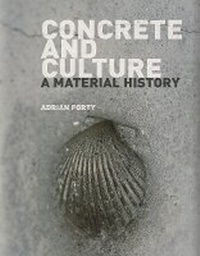
Concrete and Culture
A Material History
Published on 1. April 2012
Book
Hardback
336 pages
978-1-86189-897-5 (ISBN)
Description
Despite its ancient Roman origins, concrete is considered the ultimate modern material, used everywhere in construction today: the equivalent of three tonnes of concrete per person on the planet is produced each year. Used in our pavements, roads, tunnels and walls, concrete surrounds us wherever we go and polarizes opinion, provoking intense loathing in some and fervent passion in others.
Concrete and Culture breaks new ground by charting concrete's effects on culture since its reinvention in the modern period, examining the ways it has changed our understanding of nature, of time and of materiality. This book discusses architects' responses to and uses of concrete while also taking into account the role it has played in politics, literature, cinema and labour-relations, as well as in present day arguments about sustainability.
Crucial to the construction of some of the world's most avant-garde buildings but also blamed for making all places look alike, concrete continues to be as controversial as ever. In this book Adrian Forty takes the reader across Europe, North and South America and the Far East, reflecting on the global consequences of the material. Concrete and Culture is a uniquely innovative historical account of the part played by an often despised substance in people's relationships to their physical surroundings.
Concrete and Culture breaks new ground by charting concrete's effects on culture since its reinvention in the modern period, examining the ways it has changed our understanding of nature, of time and of materiality. This book discusses architects' responses to and uses of concrete while also taking into account the role it has played in politics, literature, cinema and labour-relations, as well as in present day arguments about sustainability.
Crucial to the construction of some of the world's most avant-garde buildings but also blamed for making all places look alike, concrete continues to be as controversial as ever. In this book Adrian Forty takes the reader across Europe, North and South America and the Far East, reflecting on the global consequences of the material. Concrete and Culture is a uniquely innovative historical account of the part played by an often despised substance in people's relationships to their physical surroundings.
Reviews / Votes
Winner of RIBA President's Award 2013 * Award * Concrete and Culture is divided into thematic chapters, focusing on the materials conjunctions with history, nature, religion, politics, photography, labour and labour relations, and its putative renaissance. Each is full of insights conveyed with a sharp political and architectural intelligence . . . Its hard to imagine a better book on the subject. * Owen Hatherley, <i>Building Design</i> * Concrete and Culture is a good read, rich in enlivening and enlightening detail but with a breadth rarely attempted. Everyone with an interest in architecture since 1900 ought to read it, and everyone who reads it will be left with new knowledge and new challenges to some of their most fundamental architectural assumptions. * Barnabas Calder, <i>Journal of Architecture</i> * This book will change your life if you spend any of it wandering past concrete buildings and hardly noticing them . . . Fortys worldwide research as thorough as his analysis is brilliant leads him to fascinating stories of designers, builders, clients, cultures and politics. The history is well illustrated with photographs in black-and-white or, rather, in delicious tones of concrete grey. * <i>Context</i> * concrete is the quintessential material of architecture. Demanding meticulous pre-planning and design, it forgives nothing and answers only to gravity . . . Concrete is for architects. Without mastering this medium not only technically, but also culturally no architect can surely ever be complete. Concrete and Culture is therefore required reading. * <i>Architects<i></i>Journal</i> * This account of concrete spans centuries and continents, professions and, indeed, media. He considers concrete through film, photography and broader cultural imaginaries, although he does ultimately remain focused on recognisably architectural artefacts . . . Fortys readings of buildings which range from churches to bunkers, east European housing to lost-in-time memorials are always insightful, and sometimes brilliant. * <i>Architectural Review</i> * Concrete and Culture is a study for the ages, as rich and enduring as its subject. * <i>Journal of Architectural Education</i> * The book is carefully knit together, giving a rich sense of the changing status of and associations with concrete over time without being organised in a straightforwardlychronological manner. Nothing is taken for granted in terms of historical development. * <i>Oxford Art Journal</i> * By taking into account the role concrete has played in areas like politics, literature, cinema, and sustainability, [Forty] gives readers a new viewpoint about this material. The book features over 100 black-and-white illustrations portraying a range of concrete edifices from all over the world. Recommended. * <i>Choice</i> * This book fully succeeds in portraying the most emblematic material of modern culture. Concrete is seemingly condemned to transformations, easily slipping into the role of timber or stone, with no clear identity of its own. With his engaging scholarship, Adrian Forty takes us beyond the merely concrete, showing a material that does not fit into pre-cast categories, as a projection screen of Japanese, Brazilian or Swiss identities, of fears and pleasures, a source of dislike and fascination since its invention. * Ákos Moravánszky, Professor of Architectural Theory, ETH Zurich * This erudite, insightful and wide-ranging study takes the field of material history in new directions. By focusing on concrete the ubiquitous marker of modernity we are taken through a labyrinth of intersecting cultural and political developments that range across architecture, cinema, photography, planning, and a host of other fields. * Professor Matthew Gandy, Department of Geography, University College London *More details
Language
English
Place of publication
London
United Kingdom
Illustrations
127 illustrations
Dimensions
Height: 171 mm
Width: 220 mm
ISBN-13
978-1-86189-897-5 (9781861898975)
Copyright in bibliographic data and cover images is held by Nielsen Book Services Limited or by the publishers or by their respective licensors: all rights reserved.
Schweitzer Classification
Other editions
New editions
Book
07/2016
Reaktion Books
€51.00
Shipment within 10-20 days
Additional editions
E-Book
02/2013
Reaktion Books
€26.99
Available for download
Person
Adrian Forty is Professor Emeritus of Architectural History at the Bartlett School of Architecture, UCL. He is the author of many books including Concrete and Culture: A Material History (2012).