

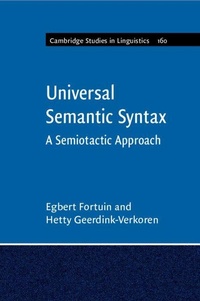
Universal Semantic Syntax
A Semiotactic Approach
Published on 7. October 2021
Book
Paperback/Softback
210 pages
978-1-108-70158-7 (ISBN)
Description
Syntactic theory has been dominated in the last decades by theories that disregard semantics in their approach to syntax. Presenting a truly semantic approach to syntax, this book takes as its primary starting point the idea that syntax deals with the relations between meanings expressed by form-meaning elements and that the same types of relations can be found cross-linguistically. The theory provides a way to formalize the syntactic relations between meanings so that each fragment of grammar can be analyzed in a clear-cut way. A comprehensive introduction into the theoretical concepts of the theory is provided, with analyzes of numerous examples in English and various other languages, European and non-European, to illustrate the concepts. The theory discussed will enable linguists to look for similarities between languages, while at the same time acknowledging important language specific features.
More details
Series
Language
English
Place of publication
Cambridge
United Kingdom
Target group
Professional and scholarly
Product notice
Paperback (trade)
Illustrations
Worked examples or Exercises
Dimensions
Height: 229 mm
Width: 152 mm
Thickness: 12 mm
Weight
312 gr
ISBN-13
978-1-108-70158-7 (9781108701587)
Copyright in bibliographic data and cover images is held by Nielsen Book Services Limited or by the publishers or by their respective licensors: all rights reserved.
Schweitzer Classification
Other editions
Additional editions
Book
05/2019
Cambridge University Press
€140.30
Shipment within 15-20 days
Persons
Egbert Fortuin is Associate Professor of Russian Linguistics at Universiteit Leiden. He has published numerous articles in journals such as Lingua, Cognitive Linguistics and Russian Linguistics. He is currently editor of the book series Studies in General and Slavic Linguistics.
Content
Part I. The Semiotactic Theory: 1. Basic theoretical principles; 2. Semiotactic relations and symbols; 3. Nexus: subject-predicate relation; 4. Valences; 5. Set expression 'SE'; 6. Nexus relation as entity (Bahuvrihi); 7. Negation; 8. The auxiliary verb 'do'; 9. Appositions; 10. Formal and syntactic sentences; 11. Abstraction; 12. The basic principles of the formalization; Part II. Application of the Theory: 1. Noun modifications; 2. Verb constructions; 3. Impersonal constructions; 4. Other constructions in non-European languages; 5. Word order and propositional contents; Conclusion: the syntactic theory from a semantic perspective.