

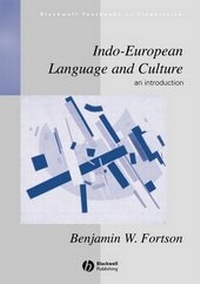
Indo-European Language and Culture
An Introduction
1st Edition
Published on 15. September 2004
Book
Paperback/Softback
488 pages
978-1-4051-0316-9 (ISBN)
Description
Indo-European Language and Culture: An Introduction provides a comprehensive overview of comparative Indo-European linguistics and the branches of the Indo-European language family, covering both linguistic and cultural material. The book opens by introducing the comparative method of linguistic reconstruction and discussing the culture and homeland of the Indo-Europeans. There follow thorough overviews of the phonology, morphology, and syntax of reconstructed Proto-Indo-European. Each branchs development from ancient to modern times is outlined, and illustrative text samples given along with translations and etymological commentary. All chapters contain exercises and suggestions for further reading, and the volume closes with a glossary, bibliography, and comprehensive word and subject indexes.
Reviews / Votes
If you ever thought about teaching an undergraduate introduction to Indo-European linguistics and had gotten so far in your planning as to examine the available course-books, you would have been in for a nasty surprise. Prior to 2004 there was no suitable book available Finally, there is a reliable, engaging and accessible presentation of the communis opinio. And there are even exercises! Fortson has produced an excellent book that fulfills its goals admirably. I hope it will inspire a renaissance of Indo-European linguistics in English speaking countries. Journal of the American Oriental SocietyThe perfect book for an introductory Indo-European course, lively and engaging throughout, yet detailed, accurate, and authoritative. The hands-on exercises at the end of each chapter are a unique and valuable feature.Jay Jasanoff, Harvard University "This is an excellent introduction to Proto-Indo-European and its study. Both the chapters on various aspects of PIE grammar and those describing the various Indo-European branches are masterly précis of their subjects. As a Tocharianist Im pleased to see that all branches of Indo-European are given the same thoughtful, substantial treatment. Both novices and the experienced Indo-Europeanists will read this book with profit; more than one of the latter group will wish he had written himself." Douglas Q. Adams, University of Idaho"I would like to conclude by stressing that this is an excellent textbook. I have taught from it, and the students in my class not only learned a great deal from it, they also seemed to enjoy the book almost as much as I did."Bryn MawrMore details
Series
Edition
1., Auflage
Language
English
Place of publication
Oxford
United Kingdom
Publishing group
John Wiley and Sons Ltd
Target group
Professional and scholarly
advanced undergraduates and graduate students studying historical linguistics, comparative Greek or Latin, and comparative philology
Illustrations
16
Dimensions
Height: 24.8 cm
Width: 17.5 cm
Thickness: 26 mm
Weight
834 gr
ISBN-13
978-1-4051-0316-9 (9781405103169)
Schweitzer Classification
Other editions
New editions
Book
07/2009
2nd Edition
Wiley
€50.00
Shipment within 3-4 weeks
Person
Benjamin W. Fortson IV is Assistant Professor of Greek and Latin Language, Literature, and Historical Linguistics in the Department of Classical Studies at the University of Michigan. His research interests include the history of Greek and Latin, comparative Indo-European linguistics, metrics and poetics, and Roman comedy.
Content
List of Illustrations.
Preface.
Aknowledgements.
Guide to the Reader.
1. Introduction: The Comparative Method and the Indo-European Family.
2. Proto-Indo-European Culture and Archaeology.
3. Proto-Indo-European Phonology.
4. Proto-Indo-European Morphology: Introduction.
5. The Verb.
6. The Noun.
7. Pronouns and Other Parts of Speech.
8. Proto-Indo-European Syntax.
9. Anatolian.
10. Indo-Iranian I: Indic.
11. Indo-Iranian II: Iranian.
12. Greek.
13. Italic.
14. Celtic.
15. Germanic.
16. Armenian.
17. Tocharian.
18. Balto-Slavic.
19. Albanian.
20. Fragmentary Languages.