

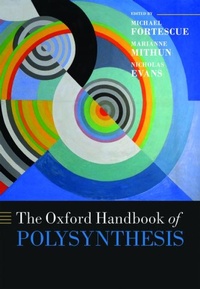
The Oxford Handbook of Polysynthesis
Published on 21. September 2017
Book
Hardback
1090 pages
978-0-19-968320-8 (ISBN)
Description
This handbook offers an extensive crosslinguistic and cross-theoretical survey of polysynthetic languages, in which single multi-morpheme verb forms can express what would be whole sentences in English. These languages and the problems they raise for linguistic analyses have long featured prominently in language descriptions, and yet the essence of polysynthesis remains under discussion, right down to whether it delineates a distinct, coherent type, rather than an assortment of frequently co-occurring traits.
Chapters in the first part of the handbook relate polysynthesis to other issues central to linguistics, such as complexity, the definition of the word, the nature of the lexicon, idiomaticity, and to typological features such as argument structure and head marking. Part two contains areal studies of those geographical regions of the world where polysynthesis is particularly common, such as the Arctic and Sub-Arctic and northern Australia. The third part examines diachronic topics such as language contact and language obsolence, while part four looks at acquisition issues in different polysynthetic languages. Finally, part five contains detailed grammatical descriptions of over twenty languages which have been characterized as polysynthetic, with special attention given to the presence or absence of potentially criterial features.
Chapters in the first part of the handbook relate polysynthesis to other issues central to linguistics, such as complexity, the definition of the word, the nature of the lexicon, idiomaticity, and to typological features such as argument structure and head marking. Part two contains areal studies of those geographical regions of the world where polysynthesis is particularly common, such as the Arctic and Sub-Arctic and northern Australia. The third part examines diachronic topics such as language contact and language obsolence, while part four looks at acquisition issues in different polysynthetic languages. Finally, part five contains detailed grammatical descriptions of over twenty languages which have been characterized as polysynthetic, with special attention given to the presence or absence of potentially criterial features.
More details
Series
Language
English
Place of publication
Oxford
United Kingdom
Target group
College/higher education
Product notice
sewn/stitched
Cloth over boards
Dimensions
Height: 249 mm
Width: 170 mm
Thickness: 61 mm
Weight
1497 gr
ISBN-13
978-0-19-968320-8 (9780199683208)
Copyright in bibliographic data and cover images is held by Nielsen Book Services Limited or by the publishers or by their respective licensors: all rights reserved.
Schweitzer Classification
Other editions
Additional editions
Michael Fortescue | Marianne Mithun | Nicholas Evans
The Oxford Handbook of Polysynthesis
E-Book
09/2017
1st Edition
OUP eBook
€93.49
Available for download
Michael Fortescue | Marianne Mithun | Nicholas Evans
The Oxford Handbook of Polysynthesis
E-Book
09/2017
1st Edition
OUP eBook
€93.49
Available for download
Persons
Michael Fortescue is Emeritus Professor of Linguistics at the University of Copenhagen, now associated with St Hugh's College, Oxford. His special area of interest is Arctic and Sub-Arctic languages, principally Eskimo-Aleut, but also Chukotko-Kamchatkan and Wakashan languages. He has also published extensively in the more general fields of comparative, typological, cognitive, and functional linguistics.
Marianne Mithun is Professor of Linguistics at the University of California, Santa Barbara. Much of her work has been in the areas of morphology, syntax, discourse, prosody, and their interrelations; language contact and language change; typology and universals; and language documentation. She has worked with numerous typologically diverse languages including Mohawk, Central Alaskan Yup'ik, Navajo, and Selayarese.
Nicholas Evans is ARC Laureate Fellow and Distinguished Professor of Linguistics at the Australian National University, and Director of the ARC Centre of Excellence for the Dynamics of Language. He has carried out wide-ranging fieldwork on traditional languages of northern Australia and southern Papua New Guinea, including Bininj Gun-wok, Dalabon, and Kayardild. He has also worked as a linguist, interpreter, and anthropologist in Native Title claims.
Marianne Mithun is Professor of Linguistics at the University of California, Santa Barbara. Much of her work has been in the areas of morphology, syntax, discourse, prosody, and their interrelations; language contact and language change; typology and universals; and language documentation. She has worked with numerous typologically diverse languages including Mohawk, Central Alaskan Yup'ik, Navajo, and Selayarese.
Nicholas Evans is ARC Laureate Fellow and Distinguished Professor of Linguistics at the Australian National University, and Director of the ARC Centre of Excellence for the Dynamics of Language. He has carried out wide-ranging fieldwork on traditional languages of northern Australia and southern Papua New Guinea, including Bininj Gun-wok, Dalabon, and Kayardild. He has also worked as a linguist, interpreter, and anthropologist in Native Title claims.
Editor
Emeritus ProfessorEmeritus Professor, University of Copenhagen
Professor of LinguisticsProfessor of Linguistics, University of California, Santa Barbara
ARC Laureat Fellow and Distinguished Professor of LinguisticsARC Laureat Fellow and Distinguished Professor of Linguistics, Australian National University
Content
PART I: THE NATURE OF POLYSYNTHESIS; PART II: AREAL PERSPECTIVES; PART III: THE DIACHRONIC PERSPECTIVE; PART IV: ACQUISITION; PART V: GRAMMATICAL SKETCHES