

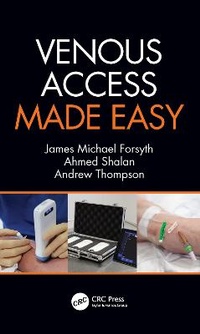
Venous Access Made Easy
1st Edition
Published on 8. April 2019
Book
Hardback
144 pages
978-1-138-33536-3 (ISBN)
Description
This book provides simple and practical instructions on how to perform safe and easy venous cannulation, and how to insert midlines and PICC lines using ultrasound. It aidsunderstanding of the relevant anatomy, shows how to use the ultrasound machine, and how to insert such lines using ultrasound guidance. Readers will feel confident and well prepared to deal with patients requiring difficult venous access, giving them simple solutions that can be learned very quickly. These skills will also be globally beneficial for patients and healthcare institutions alike.
Follows the trends of the NHS and riding the wave of the midline/PICC line revolution
Compact and affordable
highly relevant to daily practice
Useful for specialists and generalists alike, truly multi-disciplinary
Follows the trends of the NHS and riding the wave of the midline/PICC line revolution
Compact and affordable
highly relevant to daily practice
Useful for specialists and generalists alike, truly multi-disciplinary
Reviews / Votes
'...written in short, concise chapters that are easy to read. The bestaspect ... is the amount and quality of the pictures used to help
familiarize readers... 4 Stars!
- Michael Nooromid, MD, Northwestern University Feinberg School of Medicine '...written in short, concise chapters that are easy to read. The best
aspect ... is the amount and quality of the pictures used to help
familiarize readers... 4 Stars!
- Michael Nooromid, MD, Northwestern University Feinberg School of Medicine
More details
Language
English
Place of publication
London
United Kingdom
Publishing group
Taylor & Francis Ltd
Target group
Professional and scholarly
Professional and Professional Practice & Development
Illustrations
11 s/w Abbildungen, 91 farbige Abbildungen, 5 farbige Zeichnungen, 2 s/w Tabellen
2 Tables, black and white; 5 Line drawings, color; 91 Illustrations, color; 11 Illustrations, black and white
Dimensions
Height: 216 mm
Width: 138 mm
Weight
430 gr
ISBN-13
978-1-138-33536-3 (9781138335363)
Copyright in bibliographic data and cover images is held by Nielsen Book Services Limited or by the publishers or by their respective licensors: all rights reserved.
Schweitzer Classification
Other editions
Additional editions
James Forsyth | Ahmed Shalan | Andrew Thompson
Venous Access Made Easy
Book
04/2019
1st Edition
CRC Press
€63.32
Shipment within 10-20 days
James Forsyth | Ahmed Shalan | Andrew Thompson
Venous Access Made Easy
E-Book
03/2019
1st Edition
CRC Press
€45.99
Available for download
James Forsyth | Ahmed Shalan | Andrew Thompson
Venous Access Made Easy
E-Book
03/2019
1st Edition
CRC Press
€45.99
Available for download
Persons
James Michael Forsyth MBBS MRCS PGDip (HPE) is a vascular and endovascular surgery registrar completing his specialist training in the Yorkshire Deanery, England. He qualified from St George's Hospital Medical School (University of London) in 2011. He has a passion for medical education and service improvement, and has specific interests in diabetic foot disease and vascular access.
Ahmed Shalan MBBS MRCS ChM is a vascular surgery trainee in the West Midlands, England. He graduated from Cairo Medical School 2007. He moved to England in 2013 as speciality doctor of vascular and endovascular surgery in York Teaching Hospital for 5 years where he developed and coordinated the assisted venous access service. He has passion for patient and medical education.
Andrew Thompson MBBS BMedSci MD(Res) FRCS(Gen) is a consultant vascular surgeon and the lead clinician for North Yorkshire Vascular Unit. He qualified from The Royal London and St Bartholomew Hospitals Medical School in 1998, wrote his thesis on abdominal aortic aneurysm genetics at University College London for the British Heart Foundation in 2007, and completed his training with the Oxford postgraduate deanery in 2010. He spent a year (2011) as the Vascular Society of Great Britain and Ireland Endovascular Fellow at St Mary's Hospital, London. He is currently a consultant vascular and endovascular surgeon at York Teaching Hospital NHS Foundation Trust where he manages all major vascular pathology as part of a team of surgeons and radiologists, for a population of 800,000. His interests include distal reconstruction, renal access, complex abdominal aortic surgery and thoracic outlet syndrome.
Ahmed Shalan MBBS MRCS ChM is a vascular surgery trainee in the West Midlands, England. He graduated from Cairo Medical School 2007. He moved to England in 2013 as speciality doctor of vascular and endovascular surgery in York Teaching Hospital for 5 years where he developed and coordinated the assisted venous access service. He has passion for patient and medical education.
Andrew Thompson MBBS BMedSci MD(Res) FRCS(Gen) is a consultant vascular surgeon and the lead clinician for North Yorkshire Vascular Unit. He qualified from The Royal London and St Bartholomew Hospitals Medical School in 1998, wrote his thesis on abdominal aortic aneurysm genetics at University College London for the British Heart Foundation in 2007, and completed his training with the Oxford postgraduate deanery in 2010. He spent a year (2011) as the Vascular Society of Great Britain and Ireland Endovascular Fellow at St Mary's Hospital, London. He is currently a consultant vascular and endovascular surgeon at York Teaching Hospital NHS Foundation Trust where he manages all major vascular pathology as part of a team of surgeons and radiologists, for a population of 800,000. His interests include distal reconstruction, renal access, complex abdominal aortic surgery and thoracic outlet syndrome.
Content
PART 1 VENOUS ACCESS PLANNING. 1. Venous Access Glossary. 2. Venous Anatomy. 3. Basic Ultrasound Use. 4. Venous Access Assessment 5. Choosing the Right Venous Access Approach. PART 2. VENOUS ACCESS PROCEDURES. 6. Peripheral Venous Cannulation. 7. Ultrasound-Guided Peripheral Venous Cannulation. 8. Midline Insertion. 9. PICC Line Insertion. PART 3. VENOUS ACCESS AFTERCARE/OVERVIEW. 10. Care & Maintenance of Venous Lines. 11. Complications. 12. Single Best Answer Assessment.