

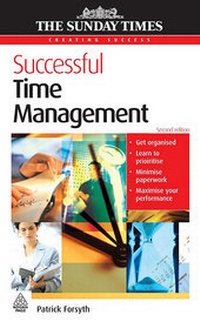
Successful Time Management
2nd Edition
Published on 3. January 2007
Book
Paperback/Softback
160 pages
978-0-7494-4834-9 (ISBN)
Description
In business, the increasing pressure to achieve makes time management a vital skill. It is necessary to be able to work efficiently and effectively to ensure that one's desired results are achieved - both in one's job, and in one's career. Successful Time Management sets out practical guidelines to help readers do just that.
Packed with proven tips and techniques, it helps anyone to review and assess their own time management and adopt new work practices to improve it.
Includes great advice on: controlling paperwork; getting and staying organized; delegating and working with others; prioritizing to focus on key issues and prompt the best results. The appendices include a brief assessment of various time management systems such as day, year or meeting planners, action sheets and more
Whether under pressure or not, this essential guide will help your readers to reduce time wasting and interruptions, and focus on the priority tasks that lead to success - it could just change their life!
Packed with proven tips and techniques, it helps anyone to review and assess their own time management and adopt new work practices to improve it.
Includes great advice on: controlling paperwork; getting and staying organized; delegating and working with others; prioritizing to focus on key issues and prompt the best results. The appendices include a brief assessment of various time management systems such as day, year or meeting planners, action sheets and more
Whether under pressure or not, this essential guide will help your readers to reduce time wasting and interruptions, and focus on the priority tasks that lead to success - it could just change their life!
Reviews / Votes
"easy-to-access, practical guidelines, tips and techniques to help readers assess their own time management and adopt new practices to improve it. very useful." desk demon express "patrick has a lucid and elegant style of writing, which allows him to present information in a way that is organised, focused and easy to apply." professional marketing "more tips on staying organized." publishing news "helps everyone to review their own time management and adopt new work practices to improve it." making moneyMore details
Series
Edition
2nd Revised edition
Language
English
Place of publication
London
United Kingdom
Target group
Professional and scholarly
Edition type
Revised edition
Product notice
Paperback (trade)
Dimensions
Height: 216 mm
Width: 135 mm
ISBN-13
978-0-7494-4834-9 (9780749448349)
Copyright in bibliographic data and cover images is held by Nielsen Book Services Limited or by the publishers or by their respective licensors: all rights reserved.
Schweitzer Classification
Other editions
New editions
Patrick Forsyth
Successful Time Management
Book
03/2010
2nd Edition
Kogan Page Ltd
€32.37
Article exhausted; check for reprint
Previous edition
Patrick Forsyth
Successful Time Management
Book
05/2003
1st Edition
Kogan Page Ltd
€29.89
Article exhausted; check for reprint
Person
Patrick Forsyth runs Touchstone Training & Consultancy, which specialises in training in various personal skills necessary to marketing, communications and management. He is the author of many books, including Marketing Stripped Bare, Powerful Reports and Proposals, Successful Time Management, Getting a Top Job in Marketing and Marketing (all published by Kogan Page).
Content
1. time: a key resource - opportunities and difficulties making it work; a personal approach; the productivity gain; speculate to accumulate; perfect time 2. first steps towards effective time management your work mix; assessing your current working practice; plan the work and work the plan; what kind of system?; setting clear objectives; thinking ahead; spend time to save time; taking time to think; be prepared to say 'no'; to be, or not to be (perfect); work smarter not longer; reward yourself 3. getting (and staying) organised work the plan; batch your tasks; use your diary effectively; schedule appointments with care; clear your desk; avoid 'cherry picking'; use abstracts; the internet; highlight key facts; insist on quality; action or investment; a good personal assistant (or secretary); use a 'document parking' system; make use of checklists; directing the techniques at particular result areas; intermission... take a break 4. combating the time wasters the greatest time waster?; handling personal interruptions; handling telephone interruptions; save time getting through; make messages accurate; e-mail; on the move 5. first things first pareto's law; make the miscellaneous a priority; schedule - backwards; be honest about deadlines; review task methodology; eliminate the unnecessary; danger - keep your distance; be confident of your priorities 6. controlling the paperwork aim to minimise paperwork; make a habit of brevity; minimal memos; minimise your paper handling; do not let files and filing waste time; keep papers neat; computerise it - but carefully; do not duplicate information unnecessarily; do not proliferate information unnecessarily; do not put it in writing; write faster; wpb - the most time-saving object in your office 7. working with other people the socialising organisation; informal contact; making a working lunch work; consider a day out; no conflict - no wasted time; the right people; the need for clear instructions; don't do it - delegate; swap tasks to save time; develop your people; simply the most time-saving phrase in the language; do not hover; motivate your people; provide specific time management help for staff; make and keep some firm rules; meetings - danger or opportunity
1. Time: a key resource - opportunities and difficulties
making it work; A personal approach; The
productivity gain; Speculate to accumulate;
Perfect time
2. First steps towards effective time management
Your work mix; Assessing your current
working practice; Plan the work and work the
plan; What kind of system?; Setting clear
objectives; Thinking ahead; Spend time to
save time; Taking time to think; Be prepared
to say 'no'; To be, or not to be (perfect);
Work smarter not longer; reward yourself
3. Getting (and staying) organised
Work the plan; Batch your tasks; Use your
diary effectively; Schedule appointments with
care; Clear your desk; Avoid 'cherry
picking'; Use abstracts; The Internet;
Highlight key facts; Insist on quality;
Action or investment; A good personal assistant
(or secretary); Use a 'document parking'
system; Make use of checklists; Directing
the techniques at particular result areas;
Intermission. take a break
4. Combating the time wasters
The greatest time waster?; Handling personal
interruptions; Handling telephone
interruptions; Save time getting through;
Make messages accurate; E-mail; On the
move
5. First things first
Pareto's law; Make the miscellaneous a
priority; Schedule - backwards; Be honest
about deadlines; Review task methodology;
Eliminate the unnecessary; Danger - keep your
distance; Be confident of your priorities
6. Controlling the paperwork
Aim to minimise paperwork; Make a habit of
brevity; Minimal memos; Minimise your
paper handling; Do not let files and filing waste
time; Keep papers neat; Computerise it - but
carefully; Do not duplicate information
unnecessarily; Do not proliferate information
unnecessarily; Do not put it in writing;
Write faster; WPB - the most time-saving
object in your office
7. Working with other people
The socialising organisation; Informal
contact; Making a working lunch work;
Consider a day out; No conflict - no wasted
time; The right people; The need for clear
instructions; Don't do it - delegate; Swap
tasks to save time; Develop your people;
Simply the most time-saving phrase in the
language; Do not hover; Motivate your
people; Provide specific time management help
for staff; Make and keep some firm rules;
Meetings - danger or opportunity
8. Final words
making it work; A personal approach; The
productivity gain; Speculate to accumulate;
Perfect time
2. First steps towards effective time management
Your work mix; Assessing your current
working practice; Plan the work and work the
plan; What kind of system?; Setting clear
objectives; Thinking ahead; Spend time to
save time; Taking time to think; Be prepared
to say 'no'; To be, or not to be (perfect);
Work smarter not longer; reward yourself
3. Getting (and staying) organised
Work the plan; Batch your tasks; Use your
diary effectively; Schedule appointments with
care; Clear your desk; Avoid 'cherry
picking'; Use abstracts; The Internet;
Highlight key facts; Insist on quality;
Action or investment; A good personal assistant
(or secretary); Use a 'document parking'
system; Make use of checklists; Directing
the techniques at particular result areas;
Intermission. take a break
4. Combating the time wasters
The greatest time waster?; Handling personal
interruptions; Handling telephone
interruptions; Save time getting through;
Make messages accurate; E-mail; On the
move
5. First things first
Pareto's law; Make the miscellaneous a
priority; Schedule - backwards; Be honest
about deadlines; Review task methodology;
Eliminate the unnecessary; Danger - keep your
distance; Be confident of your priorities
6. Controlling the paperwork
Aim to minimise paperwork; Make a habit of
brevity; Minimal memos; Minimise your
paper handling; Do not let files and filing waste
time; Keep papers neat; Computerise it - but
carefully; Do not duplicate information
unnecessarily; Do not proliferate information
unnecessarily; Do not put it in writing;
Write faster; WPB - the most time-saving
object in your office
7. Working with other people
The socialising organisation; Informal
contact; Making a working lunch work;
Consider a day out; No conflict - no wasted
time; The right people; The need for clear
instructions; Don't do it - delegate; Swap
tasks to save time; Develop your people;
Simply the most time-saving phrase in the
language; Do not hover; Motivate your
people; Provide specific time management help
for staff; Make and keep some firm rules;
Meetings - danger or opportunity
8. Final words