

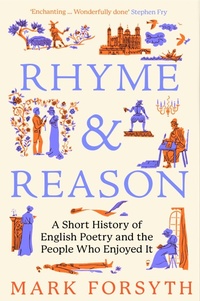
Rhyme and Reason
Will be published approx. on 3. September 2026
Book
Paperback/Softback
368 pages
978-1-80546-530-0 (ISBN)
Description
'Enchanting' Stephen Fry
'Unconventional, surprising and provocative from the first page' Times Literary Supplement
Did you know:
- Lord Byron sold more books in a day than Jane Austen did in her lifetime
- During the First World War there were more women poets published than soldier poets
- A kitchen-maid became one of the most popular poets of the 18th century
Some people worry that they don't appreciate poetry; but English poetry wasn't written to be appreciated, it was written to be enjoyed. For six centuries people have been reading poetry for enjoyment - for fun, romance, religion and entertainment - and this is a book about those people.
Rhyme & Reason takes you from a medieval accountant (called Chaucer) trying to entertain his lord, past a doomed love affair in the Tower of London, through adoring sonnets and notebooks filled with dirty poems, and into the heart of Byromania and the Victorian hearth, to help you understand why poetry has had such an enduring hold on the British psyche.
From the poems of housemaids to the rhymes of kings, it's the history of Britain through the poems that people read, recited and loved.
'Unconventional, surprising and provocative from the first page' Times Literary Supplement
Did you know:
- Lord Byron sold more books in a day than Jane Austen did in her lifetime
- During the First World War there were more women poets published than soldier poets
- A kitchen-maid became one of the most popular poets of the 18th century
Some people worry that they don't appreciate poetry; but English poetry wasn't written to be appreciated, it was written to be enjoyed. For six centuries people have been reading poetry for enjoyment - for fun, romance, religion and entertainment - and this is a book about those people.
Rhyme & Reason takes you from a medieval accountant (called Chaucer) trying to entertain his lord, past a doomed love affair in the Tower of London, through adoring sonnets and notebooks filled with dirty poems, and into the heart of Byromania and the Victorian hearth, to help you understand why poetry has had such an enduring hold on the British psyche.
From the poems of housemaids to the rhymes of kings, it's the history of Britain through the poems that people read, recited and loved.
Reviews / Votes
An enchanting and highly readable achievement that reminds us that poetry was always for everyone, not just for academics, intellectuals and bohemians. Wonderfully done. * Stephen Fry * At last! The poetry book that tells us why it's the greatest, most magical form of human expressionMakes poetry sexy. At last
I love poetry, and I love this book * Jeremy Vine * Here is history that rhymes and scans and where each stanza has an unexpected twist and each image is more multilayered than it first appears; this is a glorious poetry/real life interface! * Ian McMillan * Unconventional, surprising and provocative from the first page... I often found it very funny. * Times Literary Supplement *
More details
Edition
Main
Language
English
Place of publication
London
United Kingdom
Dimensions
Height: 198 mm
Width: 129 mm
ISBN-13
978-1-80546-530-0 (9781805465300)
Copyright in bibliographic data and cover images is held by Nielsen Book Services Limited or by the publishers or by their respective licensors: all rights reserved.
Schweitzer Classification
Person
Born in London in 1977, Mark Forsyth (aka The Inky Fool) was given a copy of the Oxford English Dictionary as a christening present and has never looked back. His book The Etymologicon was a Sunday Times #1 bestseller and was followed by The Horologicon and The Elements of Eloquence. He has written A Christmas Cornucopia on the origins of Christmas traditions and A Short History of Drunkenness. He has also penned a specially commissioned introduction for the new edition of the Collins English Dictionary, and written a novel for children called A Riddle for a King. His books have been translated into more than twenty languages. He lives in London with his dictionaries, and blogs at blog.inkyfool.com
Content
1: The First English Poem 2: For Engelonde's Sake 3: The Fifteenth Century, Which Is Mainly Rubbish 4: Down on the Farm 5: The Early Tudors 6: Tottely Different 7: The Iambic Pentameter: An Interlude 8: Elizabethan Drama 9: Jacobean Theatre 10: Metaphysical Poetry 11: The Civil War and Commonwealth 12: The Restoration 13: The Epic 14: An Interlude Concerning the World 15: Heroic Couplets: The Truth in Twenty Syllables 16: Ossian and Others 17: Regency Poetry 18: Byromania 19: The Romantic Myth of the Romantic Movement 20: The Deification of William Wordsworth 21: Dramatic Victorians 22: Anapaests, Dactyls and Other Strange Feet 23: Uttered Nonsense 24: The Nineteenth-Century Ballad 25: Empire and England, England, England 26: War Poetry 27: New Things Under the Sun 28: Poetry Goes to School 29: Old-Fashioned Modernism 30: Moderner Modernism 31: A Valediction Requiring Mourning Postscript: The Other Fellow