

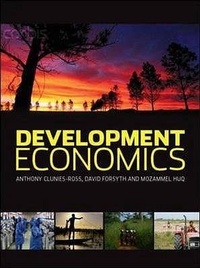
Development Economics
Will be published approx. on 16. April 2009
Book
Paperback/Softback
664 pages
978-0-07-711453-4 (ISBN)
Description
Broad beliefs about the economics of 'developing countries' and of the development process have changed considerably since the subject became of wide interest in the 1950s; due largely to changes in the world and in the application of economic policies within developing countries. Subjects such as environment, gender, poverty, famine and globalization have come to be of increasingly important public interest. The extreme divergence of experience among regions of the world has also made it more and more questionable whether it even makes sense to think of a single and distinctive 'economics of developing countries'.
This textbook presents a concise and up-to-date examination of the field of development economics, bringing together historical perspectives, current issues and policy implications. Each chapter can be read as a stand-alone unit, or as part of the wider economic debates presented throughout the book.
This textbook presents a concise and up-to-date examination of the field of development economics, bringing together historical perspectives, current issues and policy implications. Each chapter can be read as a stand-alone unit, or as part of the wider economic debates presented throughout the book.
More details
Persons
Professor David Forsyth is a Development Economist who has worked in a wide range of Third World countries over the last three decades and has published extensively. His academic career includes periods at Strathclyde University (as Professor and Head of Department of Economics), the University of Ghana, Carleton University, the University of Virginia and, most recently, at the University of the South Pacific (as Professor and HoD Economics). (His work experience includes employment as a staff member of the United Nations (ILO -- as an expert in Technology Transfer to developing countries) and the Commonwealth Secretariat (as the Multilateral Trade Policy Adviser guiding negotiations between the EU, WTO and the South Pacific nations). He is now Professor Emeritus in Economics at the University of Strathclyde in Glasgow. Anthony Clunies-Ross, an Australian by birth and citizenship, is also Professor Emeritus in Economics at the University of Strathclyde. He has degrees from Melbourne and Cambridge. He taught at the University of Melbourne, Monash University, the University of Papua New Guinea (1967-74), and from 1975 at the University of Strathclyde, as well as part-time for some years at the University of Glasgow. He has also taught on short courses in India and Tanzania. Mozammel Huq is Senior Lecturer and Associate Director of the Developing Countries Research Unit, Department of Economics, University of Strathclyde. Prior to joining the Economics Department of the University of Strathclyde in 1987, he was actively involved in carrying out primary research at the David Livingstone Institute of Overseas Development Studies of the same University. He has thus been able to combine his teaching with practical research, analysing data collected from the field, thanks to his many involvements in various Asian and African countries.
Content
PART 1 History, ideologies and methods
1. Recognizing the development imperative
2. Economic development: the story over fifty years
3. Ideologies and methods of development economics
4. Macroeconomic theories of economic growth
5. The development process: landmark theoriesPART 2 Governance
6. Governance questions 1: corruption
7. Governance questions 2: public-sector scope, enhancement and reform
8. Civil society: role and potential
PART 3 Central global questions
9. Globalization: trade, trade policy, international economic relations
10. Poverty, equity and well-being
11. Sustainable development, environmental evaluation, natural resources
12. Stabilization in developing countries
PART 4 Real resources and sectoral considerations
13.Population and labour supply
14. Migration and urbanization
15. Gender and development
16. Agricultural development, food supply and rural transformation
17. Industrialization and development
18. Building technological capability
PART 5 Finance
19. Domestic finance
20. Elaboration of economic project-appraisal
21. Foreign aid
22. Loans and debt
23. Foreign direct investment
24. International migration and remittances
PART 6 Conclusion
25. Guidelines, judgements and possibilities
1. Recognizing the development imperative
2. Economic development: the story over fifty years
3. Ideologies and methods of development economics
4. Macroeconomic theories of economic growth
5. The development process: landmark theoriesPART 2 Governance
6. Governance questions 1: corruption
7. Governance questions 2: public-sector scope, enhancement and reform
8. Civil society: role and potential
PART 3 Central global questions
9. Globalization: trade, trade policy, international economic relations
10. Poverty, equity and well-being
11. Sustainable development, environmental evaluation, natural resources
12. Stabilization in developing countries
PART 4 Real resources and sectoral considerations
13.Population and labour supply
14. Migration and urbanization
15. Gender and development
16. Agricultural development, food supply and rural transformation
17. Industrialization and development
18. Building technological capability
PART 5 Finance
19. Domestic finance
20. Elaboration of economic project-appraisal
21. Foreign aid
22. Loans and debt
23. Foreign direct investment
24. International migration and remittances
PART 6 Conclusion
25. Guidelines, judgements and possibilities