

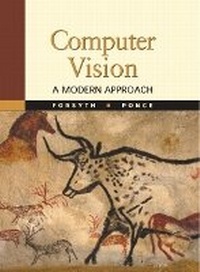
Computer Vision
A Modern Approach: United States Edition
Published on 26. September 2002
Book
Hardback
693 pages
978-0-13-085198-7 (ISBN)
Description
Appropriate for upper-division undergraduate- and graduate-level courses in computer vision found in departments of Computer Science, Computer Engineering and Electrical Engineering.
This long anticipated book is the most complete treatment of modern computer vision methods by two of the leading authorities in the field. This accessible presentation gives both a general view of the entire computer vision enterprise and also offers sufficient detail for students to be able to build useful applications. Students will learn techniques that have proven to be useful by first-hand experience and a wide range of mathematical methods.
This long anticipated book is the most complete treatment of modern computer vision methods by two of the leading authorities in the field. This accessible presentation gives both a general view of the entire computer vision enterprise and also offers sufficient detail for students to be able to build useful applications. Students will learn techniques that have proven to be useful by first-hand experience and a wide range of mathematical methods.
More details
Language
English
Place of publication
United States
Publishing group
Pearson Education (US)
Target group
College/higher education
Dimensions
Height: 207 mm
Width: 263 mm
Thickness: 40 mm
Weight
1596 gr
ISBN-13
978-0-13-085198-7 (9780130851987)
Copyright in bibliographic data and cover images is held by Nielsen Book Services Limited or by the publishers or by their respective licensors: all rights reserved.
Schweitzer Classification
Other editions
New editions
Book
02/2012
2nd Edition
Pearson
€217.87
Article exhausted; check different version
Persons
David A. Forsyth received the D.Phil. degree in computer science from Oxford University. He is currently a Professor in the Computer Science Division at the University of California at Berkeley. He has co-authored over eighty technical papers on computer vision, computer graphics and machine learning and has co-edited two books.
Jean Ponce received the Ph.D. degree in Computer Science from the University of Paris Orsay. He is currently a Professor in the Department of Computer Science and the Beckman Institute at the University of Illinois at Urbana Champaign. Professor Ponce has written over a hundred conference and journal papers and co-edited two books on a range of subjects including computer vision and robotics.
Jean Ponce received the Ph.D. degree in Computer Science from the University of Paris Orsay. He is currently a Professor in the Department of Computer Science and the Beckman Institute at the University of Illinois at Urbana Champaign. Professor Ponce has written over a hundred conference and journal papers and co-edited two books on a range of subjects including computer vision and robotics.
Content
I. IMAGE FORMATION AND IMAGE MODELS.
1. Cameras.
2. Geometric Camera Models.
3. Geometric Camera Calibration.
4. Radiometry - Measuring Light.
5. Sources, Shadows and Shading.
6. Color.
II. EARLY VISION: JUST ONE IMAGE.
7. Linear Filters.
8. Edge Detection.
9. Texture.
III. EARLY VISION: MULTIPLE IMAGES.
10. The Geometry of Multiple Views.
11. Stereopsis.
12. Affine Structure from Motion.
13. Projective Structure from Motion.
IV. MID-LEVEL VISION.
14. Segmentation By Clustering.
15. Segmentation By Fitting a Model.
16. Segmentation and Fitting Using Probabilistic Methods.
17. Tracking with Linear Dynamic Models.
V. HIGH-LEVEL VISION: GEOMETRIC MODELS.
18. Model-Based Vision.
19. Smooth Surfaces and Their Outlines.
20. Aspect Graphs.
21. Range Data.
VI. HIGH-LEVEL VISION: PROBABILISTIC AND INFERENTIAL METHODS.
22. Finding Templates Using Classifiers.
23. Recognition By Relations Between Templates.
24. Geometric Templates From Spatial Relations.
VII. APPLICATIONS.
25. Application: Finding in Digital Libraries.
26. Application: Image-Based Rendering.
1. Cameras.
2. Geometric Camera Models.
3. Geometric Camera Calibration.
4. Radiometry - Measuring Light.
5. Sources, Shadows and Shading.
6. Color.
II. EARLY VISION: JUST ONE IMAGE.
7. Linear Filters.
8. Edge Detection.
9. Texture.
III. EARLY VISION: MULTIPLE IMAGES.
10. The Geometry of Multiple Views.
11. Stereopsis.
12. Affine Structure from Motion.
13. Projective Structure from Motion.
IV. MID-LEVEL VISION.
14. Segmentation By Clustering.
15. Segmentation By Fitting a Model.
16. Segmentation and Fitting Using Probabilistic Methods.
17. Tracking with Linear Dynamic Models.
V. HIGH-LEVEL VISION: GEOMETRIC MODELS.
18. Model-Based Vision.
19. Smooth Surfaces and Their Outlines.
20. Aspect Graphs.
21. Range Data.
VI. HIGH-LEVEL VISION: PROBABILISTIC AND INFERENTIAL METHODS.
22. Finding Templates Using Classifiers.
23. Recognition By Relations Between Templates.
24. Geometric Templates From Spatial Relations.
VII. APPLICATIONS.
25. Application: Finding in Digital Libraries.
26. Application: Image-Based Rendering.