

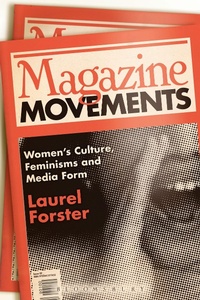
Magazine Movements
Women's Culture, Feminisms and Media Form
Published on 23. April 2015
Book
Paperback/Softback
304 pages
978-1-4411-7745-2 (ISBN)
Description
All women's magazines are not the same: content, outlook, and format combine to shape publications quite distinctively. While magazines in general have long been understood as a significant force in women's lives, many critiques have limited themselves to discussions of mainstream printed publications that engage with narrowly stereotypical representations of femininity. Looking at a range of women's magazines (Cooperative Correspondence Club and Housewife) and magazine programmes (Woman's Hour and Houseparty), Magazine Movements not only extends our definition of a magazine, but most importantly, unearths the connections between women's cultures, specific magazines and the implied reader.
The author first outlines the existing field of magazine studies, and analyzes the methodologies employed in accessing and assessing the cultural competence of magazines. Each chapter then provides a case study of a different kind of magazine: different in media form or style of presentation or audience connection, or all three. Forster not only extends our definition of a magazine, but most importantly, unearths the connections between women's cultures, specific magazines and the implied reader. In this way, fresh insights are provided into the long-standing importance of the magazine to the variety of feminisms on offer in Britain, from the mid twentieth century to the present day.
The author first outlines the existing field of magazine studies, and analyzes the methodologies employed in accessing and assessing the cultural competence of magazines. Each chapter then provides a case study of a different kind of magazine: different in media form or style of presentation or audience connection, or all three. Forster not only extends our definition of a magazine, but most importantly, unearths the connections between women's cultures, specific magazines and the implied reader. In this way, fresh insights are provided into the long-standing importance of the magazine to the variety of feminisms on offer in Britain, from the mid twentieth century to the present day.
Reviews / Votes
Ever since the publication of Betty Friedan's The Feminine Mystique in 1963, academic studies have sought to gauge the extent to which mass-market commercial magazines directed toward female readers in the US and UK have either contributed to gender stereotyping or offered arenas in which women could contest stifling gender roles. Forster (media studies, Univ. of Portsmouth, UK) makes a solid, important contribution to this ongoing debate by investigating a group of British "magazines" published from the mid-20th century to the present that have been almost entirely overlooked by scholars. These include not only print magazines-Arena Three (1964-71), the first openly lesbian magazine in Britain; Mukti (1983-87), aimed at South Asian women; and a number of overtly feminist magazines-but also the television magazine Houseparty (1972-81) and various radio magazines. The most fascinating chapter examines the history and significance of the Cooperative Correspondence Club (1935-90), a small group of women with diverse geographic, religious, and class affiliation, which twice monthly hand-produced a copy of a magazine, comprising individual women's letters, that circulated among the group's members. Forster's extensive archival research, incisive analysis, and jargon-free writing makes this book a pleasurable as well as an educational experience. Summing Up: Highly recommended. Lower-division undergraduates through faculty. * CHOICE * An enjoyable read. * Journal of Magazine Media * Magazine Movements significantly broadens and deepens the historical treatment of women's magazines, and refuses easy generalisation about their meaning and role. Juxtaposing experimental, political and niche-audience titles to mainstream commercial products enables Forster to trace an inclusive, provocative history of British feminism across the second half of the twentieth century. Her innovative discussion of magazine formats, spanning print and broadcast media, charts the persistence and influence of the magazine genre for both commercial and counter-cultural negotiations of gender, race, sexuality and modernity. This is an authoritative and critical media history that makes important contributions to understanding women's lives and political engagement. * Lucy Delap, Fellow of Murray Edwards College, University of Cambridge, UK * Laurel Forster's wide-ranging and thought-provoking case studies remind us that the 'magazine' format has not been confined to print. She reveals how the magazine has proven to be a highly adaptable mode for communicating and interacting with a range of audiences. * Maria DiCenzo, Professor of English and Film Studies, Wilfrid Laurier University, Canada *More details
Language
English
Place of publication
New York
United States
Publishing group
Bloomsbury Publishing Plc
Target group
Professional and scholarly
Product notice
Paperback (trade)
Unsewn / adhesive bound
Illustrations
37 bw illus
Dimensions
Height: 228 mm
Width: 154 mm
Thickness: 20 mm
Weight
470 gr
ISBN-13
978-1-4411-7745-2 (9781441177452)
DOI
CBID167102
Copyright in bibliographic data and cover images is held by Nielsen Book Services Limited or by the publishers or by their respective licensors: all rights reserved.
Schweitzer Classification
Other editions
Additional editions
E-Book
02/2015
1st Edition
Bloomsbury Academic USA
€40.49
Available for download
E-Book
02/2015
1st Edition
Bloomsbury Academic USA
€40.49
Available for download
Person
Laurel Forster is Senior Lecturer in Media Studies at the University of Portsmouth, UK. Her research interests and her range of publications contextualize the portrayal of women and women's cultures in magazines, women's writing and on television.
Content
Introduction
Chapter 1: Writing Friendship and Support in CCC
Chapter 2: Refashioning Femininity in Wartime Housewife
Chapter 3: Linking Private and Public Over the Airwaves in Woman's Hour
Chapter 4: Exploring Sexuality in Arena 3
Chapter 5: Politicising the Personal in Shrew
Chapter 6: Networking the Magazine Format in Houseparty
Chapter 7: Mukti: A Magazine 'Against Oppression as Women, Black People, and Workers'
Chapter 8: Feminism on the Internet in the f-word
Bibliography
Index
Chapter 1: Writing Friendship and Support in CCC
Chapter 2: Refashioning Femininity in Wartime Housewife
Chapter 3: Linking Private and Public Over the Airwaves in Woman's Hour
Chapter 4: Exploring Sexuality in Arena 3
Chapter 5: Politicising the Personal in Shrew
Chapter 6: Networking the Magazine Format in Houseparty
Chapter 7: Mukti: A Magazine 'Against Oppression as Women, Black People, and Workers'
Chapter 8: Feminism on the Internet in the f-word
Bibliography
Index