

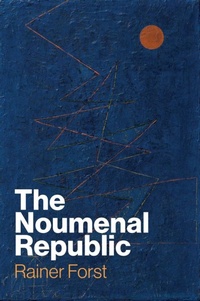
The Noumenal Republic
Critical Constructivism After Kant
Published on 26. April 2024
Book
Paperback/Softback
256 pages
978-1-5095-6226-8 (ISBN)
Description
All human beings are born with equal dignity and possess equal rights. This statement appears normatively just as irrefutable as it is empirically refuted every day. But what are the grounds of this principle, and how should we think about its realization? Its philosophical truth can best be explained by going back to (and beyond) Kant's notion of a 'noumenal republic' in which every person is an equal co-author of the laws that bind all. At the same time, a critical analysis of society and politics must show the extent to which the reality of power and ideology makes a mockery of this constructivist conception of dignity. To bridge the gap between unworldly idealism and practical hopelessness, we need a critical theory after Kant. Rainer Forst, one of the world's most influential political philosophers, works to develop just such a theory in this powerful and illuminating volume. It contains no less than a new systematic account of concepts such as alienation, progress and regression, solidarity, human rights, justice, power and non-domination.
More details
Edition
1
Language
English
Place of publication
Oxford
United Kingdom
Publishing group
John Wiley and Sons Ltd
Target group
Professional and scholarly
Dimensions
Height: 228 mm
Width: 154 mm
Thickness: 27 mm
Weight
490 gr
ISBN-13
978-1-5095-6226-8 (9781509562268)
Copyright in bibliographic data and cover images is held by Nielsen Book Services Limited or by the publishers or by their respective licensors: all rights reserved.
Schweitzer Classification
Other editions
Additional editions
Book
04/2024
Polity Press
€65.50
Shipment within 15-20 days
E-Book
04/2024
1st Edition
Wiley-Blackwell
€20.99
Available for download
E-Book
04/2024
1st Edition
Wiley-Blackwell
€20.99
Available for download
Person
Rainer Forst is Professor of Political Theory and Philosophy at Johann Wolfgang Goethe University in Frankfurt.
Content
Preface
Sources
Introduction: Between Two Worlds: Critical Constructivism after Kant
I. Autonomy, Progress and Solidarity: Basic Questions of Social Philosophy
1. Noumenal Alienation: Rousseau, Kant and Marx on the Dialectics of Self-Determination
2. The Justification of Progress and the Progress of Justification
3. The Rule of Unreason: Analyzing (Anti-)Democratic Regression
4. Solidarity: Concept, Conceptions and Contexts
5. Social Cohesion: On the Analysis of a Difficult Concept
II. Justice, Rights and Non-Domination in a New Key: Critical Political Theory
6. Normativity and Reality: Toward a Critical and Realistic Theory of Politics
7. The Point and Ground of Human Rights: A Kantian Constructivist View
8. A Critical Theory of Transnational (In-)Justice: Realistic in the Right Way
9. Structural Injustice with a Name, Structural Domination without a Face?
10. Kantian Republicanism versus the Neo-Republican Machine: The Meaning and Practice of Political Autonomy
III. Debates: Political Liberalism, Luck Egalitarianism, Contractualism and Discourse Ethics
11. Political Liberalism: A Kantian View
12. The Point of Justice: On the Paradigmatic Incompatibility between Rawlsian "Justice as Fairness" and Luck Egalitarianism
13. Justification Fundamentalism: A Discourse-Theoretical Interpretation of Scanlon's Contractualism
14. The Autonomy of Autonomy: On Juergen Habermas's Auch eine Geschichte der Philosophie
Notes
References
Index
Sources
Introduction: Between Two Worlds: Critical Constructivism after Kant
I. Autonomy, Progress and Solidarity: Basic Questions of Social Philosophy
1. Noumenal Alienation: Rousseau, Kant and Marx on the Dialectics of Self-Determination
2. The Justification of Progress and the Progress of Justification
3. The Rule of Unreason: Analyzing (Anti-)Democratic Regression
4. Solidarity: Concept, Conceptions and Contexts
5. Social Cohesion: On the Analysis of a Difficult Concept
II. Justice, Rights and Non-Domination in a New Key: Critical Political Theory
6. Normativity and Reality: Toward a Critical and Realistic Theory of Politics
7. The Point and Ground of Human Rights: A Kantian Constructivist View
8. A Critical Theory of Transnational (In-)Justice: Realistic in the Right Way
9. Structural Injustice with a Name, Structural Domination without a Face?
10. Kantian Republicanism versus the Neo-Republican Machine: The Meaning and Practice of Political Autonomy
III. Debates: Political Liberalism, Luck Egalitarianism, Contractualism and Discourse Ethics
11. Political Liberalism: A Kantian View
12. The Point of Justice: On the Paradigmatic Incompatibility between Rawlsian "Justice as Fairness" and Luck Egalitarianism
13. Justification Fundamentalism: A Discourse-Theoretical Interpretation of Scanlon's Contractualism
14. The Autonomy of Autonomy: On Juergen Habermas's Auch eine Geschichte der Philosophie
Notes
References
Index