

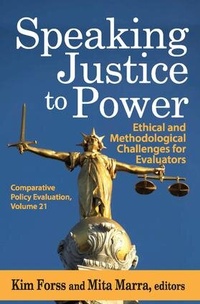
Speaking Justice to Power
Ethical and Methodological Challenges for Evaluators
1st Edition
Published on 30. September 2014
Book
Hardback
316 pages
978-1-4128-5476-4 (ISBN)
Description
Efficiency, economy, and equity are policy goals pursued by governments around the world, but analysts and evaluators have devoted more effort to measuring and evaluating the first two. In Speaking Justice to Power, contributors examine the concept of equity, the role it plays, and its application in policy evaluation.
Here some of the most valuable thinkers in the area of policy studies address key questions: How should evaluators develop criteria for measuring equity as they analyze both program and policy implementation as well as their impacts? What distinctions among people should be taken into account when measuring and valuing impacts? What sorts of data should be used to analyze processes and impacts in different settings? How might such data be validated?
The contributors employ grounded-theory thinking as they translate key ethical principles into their work and draw important lessons from their experiences. The work discusses equity in interventions addressing a variety of social and environmental problems. This volume continues the fine tradition of Transaction's Comparative Policy Evaluation series.
Here some of the most valuable thinkers in the area of policy studies address key questions: How should evaluators develop criteria for measuring equity as they analyze both program and policy implementation as well as their impacts? What distinctions among people should be taken into account when measuring and valuing impacts? What sorts of data should be used to analyze processes and impacts in different settings? How might such data be validated?
The contributors employ grounded-theory thinking as they translate key ethical principles into their work and draw important lessons from their experiences. The work discusses equity in interventions addressing a variety of social and environmental problems. This volume continues the fine tradition of Transaction's Comparative Policy Evaluation series.
More details
Series
Language
English
Place of publication
New York
United States
Publishing group
Taylor & Francis Inc
Target group
Professional and scholarly
Dimensions
Height: 229 mm
Width: 152 mm
Weight
544 gr
ISBN-13
978-1-4128-5476-4 (9781412854764)
Copyright in bibliographic data and cover images is held by Nielsen Book Services Limited or by the publishers or by their respective licensors: all rights reserved.
Schweitzer Classification
Other editions
Additional editions

Book
09/2017
1st Edition
Routledge
€77.03
Shipment within 10-20 days

E-Book
09/2017
Routledge
€64.49
Available for download

E-Book
09/2017
Routledge
€64.49
Available for download
Persons
Kim Forss holds a PhD from the Stockholm School of Economics. His research has concerned comparative studies of evaluation, the design of inquiring systems and organizational learning, utilization of results, as well as process use of evaluation. He works as an independent researcher out of his firm Andante - tools for thinking AB.
Mitta Marra is Visiting Professor of Comparative Public Policy at The George Washington University. She is Associate Editor of Evaluation and Program Planning (EPP) and Editor in Chief of RIV - Rassena Italiana di Valutazione.
Mitta Marra is Visiting Professor of Comparative Public Policy at The George Washington University. She is Associate Editor of Evaluation and Program Planning (EPP) and Editor in Chief of RIV - Rassena Italiana di Valutazione.
Content
Foreword
Kathryn Newcomer
1. Introduction
Kim Forss and Mita Marra
Part I: Equity in Theory: Implications for Evaluation
2. Thinking about Equity: From Philosophy to Social Science
Mita Marra and Kim Forss
3. How Much Equity Do We Need? A Decision-Making Tool Reconciling Utilitarian and Rawlsian Approaches to Collective Efficiency
Barbara Befani
4. Inequality, Institutions, and Change-The Case of Senegal
Jens Andersson
Part II: Equity in Evaluation Approaches: Challenges for Evaluators
5. Renewing Democratic Evaluation-The Case of a Progressive Evaluation Model
Robert Picciotto
6. Beyond Feminist and Gender-Based Approaches: Evaluating Cooperation between Men and Women for Gender Equity
Mita Marra
7. Equity versus (Gender) Equality: Complexities and Implications in Programming, Monitoring, and Evaluation
Lydia Ruprecht and Sara Callegari
8. Using Th eories of Reach to Enhance Equity Considerations in Evaluation
John Mayne
9. Achieving Equality at Scale through System Transformation: Evaluating System Change
Tom Ling
10. Monitoring Equity and the Evaluation of Equity Monitoring Systems
Peter Wilkins
Part III: Equity in Program Evaluation: Lessons Learnt
11. Supporting Vulnerable Communities to Adapt to Climate Change: Defi ning Vulnerability and Evaluating Outcomes
Alison Pollard
12. Evaluations of the Impact of Fair Trade on Development: Th e Case of Coffee
Steve Jacob
13. Impact for Whom? Analyzing and Valuing the Distribution of Benefi ts from Sexual and Reproductive Health Interventions
Kim Forss
14. Evaluating Equity within a Heterogeneous Group: The Challenges Faced by Child Rights Programming and Their Evaluation
Ananda S. Millard
15. Getting Good Data to Evaluate Employment Equity Initiatives: An Example from Canada
Maria Barrados
16. Equity-Oriented Interventions and Defining the Populations of Aboriginal Peoples and National Minorities: Experiences from Sweden, Canada, and Australia
Maria Barrados, Kim Forss, and Peter Wilkins
Contributors
Index
Kathryn Newcomer
1. Introduction
Kim Forss and Mita Marra
Part I: Equity in Theory: Implications for Evaluation
2. Thinking about Equity: From Philosophy to Social Science
Mita Marra and Kim Forss
3. How Much Equity Do We Need? A Decision-Making Tool Reconciling Utilitarian and Rawlsian Approaches to Collective Efficiency
Barbara Befani
4. Inequality, Institutions, and Change-The Case of Senegal
Jens Andersson
Part II: Equity in Evaluation Approaches: Challenges for Evaluators
5. Renewing Democratic Evaluation-The Case of a Progressive Evaluation Model
Robert Picciotto
6. Beyond Feminist and Gender-Based Approaches: Evaluating Cooperation between Men and Women for Gender Equity
Mita Marra
7. Equity versus (Gender) Equality: Complexities and Implications in Programming, Monitoring, and Evaluation
Lydia Ruprecht and Sara Callegari
8. Using Th eories of Reach to Enhance Equity Considerations in Evaluation
John Mayne
9. Achieving Equality at Scale through System Transformation: Evaluating System Change
Tom Ling
10. Monitoring Equity and the Evaluation of Equity Monitoring Systems
Peter Wilkins
Part III: Equity in Program Evaluation: Lessons Learnt
11. Supporting Vulnerable Communities to Adapt to Climate Change: Defi ning Vulnerability and Evaluating Outcomes
Alison Pollard
12. Evaluations of the Impact of Fair Trade on Development: Th e Case of Coffee
Steve Jacob
13. Impact for Whom? Analyzing and Valuing the Distribution of Benefi ts from Sexual and Reproductive Health Interventions
Kim Forss
14. Evaluating Equity within a Heterogeneous Group: The Challenges Faced by Child Rights Programming and Their Evaluation
Ananda S. Millard
15. Getting Good Data to Evaluate Employment Equity Initiatives: An Example from Canada
Maria Barrados
16. Equity-Oriented Interventions and Defining the Populations of Aboriginal Peoples and National Minorities: Experiences from Sweden, Canada, and Australia
Maria Barrados, Kim Forss, and Peter Wilkins
Contributors
Index