

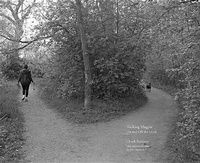
Walking Magpie
On and off the Leash
Published on 1. November 2013
Book
Hardback
136 pages
978-1-938086-11-3 (ISBN)
Description
People love dogs, and dogs love people. Walking a dog is one of the most visible and mutually beneficial manifestations of that bond. It is a ritual steeped in affection and obligation. It doesn't have a day off. It doesn't pay the bills or clean the dishes or do the laundry. Still, people and dogs alike gain the benefits of exercise, socialization, shared experiences and observations. Another benefit, often overlooked, is the pleasure of mutually indulging a trait that ordinary dogs share with extraordinary people: curiosity. This book is, in many ways, an ode to curiosity.
Walking Magpie is about a dog and what a dog sees. It is also a work of serious photography by a well-known and pioneering landscape artist: Chuck Forsman, who, for more than forty years, has been a keen observer of the interface between landscape and culture as expressed through his paintings and photographic art. As a result, Forsman often goes to places that might not be on everyone's radar screen.
In this book, Forsman took a camera with him during his walks with Magpie, the family dog. Often, these walks are in the neighborhood and surrounding hills where Forsman lives: near the Flatirons in Boulder. But Magpie joins Forsman on other adventures, from Alaska and the Northwest Territories of Canada to Florida, Ohio, and New York City. The intent is to turn these experiences into art. With each picture we sense mystery rather than clarity, questions about place rather than answers. We hardly can know what a dog knows, but with this book we can appreciate better what a dog sees and senses and experiences, helping the human and canine imagination to meld, at least a little.
Walking Magpie is published in conjunction with a retrospective of Chuck Forsman's photographs at the Denver Art Museum in October 2013. Published in association with the Denver Museum of Art.
Walking Magpie is about a dog and what a dog sees. It is also a work of serious photography by a well-known and pioneering landscape artist: Chuck Forsman, who, for more than forty years, has been a keen observer of the interface between landscape and culture as expressed through his paintings and photographic art. As a result, Forsman often goes to places that might not be on everyone's radar screen.
In this book, Forsman took a camera with him during his walks with Magpie, the family dog. Often, these walks are in the neighborhood and surrounding hills where Forsman lives: near the Flatirons in Boulder. But Magpie joins Forsman on other adventures, from Alaska and the Northwest Territories of Canada to Florida, Ohio, and New York City. The intent is to turn these experiences into art. With each picture we sense mystery rather than clarity, questions about place rather than answers. We hardly can know what a dog knows, but with this book we can appreciate better what a dog sees and senses and experiences, helping the human and canine imagination to meld, at least a little.
Walking Magpie is published in conjunction with a retrospective of Chuck Forsman's photographs at the Denver Art Museum in October 2013. Published in association with the Denver Museum of Art.
More details
Language
English
Place of publication
VA
United States
Target group
Professional and scholarly
Product notice
sewn/stitched
Paper over boards
With dust jacket
Dimensions
Height: 234 mm
Width: 287 mm
Thickness: 20 mm
Weight
1066 gr
ISBN-13
978-1-938086-11-3 (9781938086113)
Copyright in bibliographic data and cover images is held by Nielsen Book Services Limited or by the publishers or by their respective licensors: all rights reserved.
Schweitzer Classification
Persons
Chuck Forsman was born in Idaho in 1944 and raised in eastern Oregon and northern California. He received his B.A. in art in 1967 and his M.F.A. in painting 1971 from the University of California at Davis. Forsman was drafted into the U.S. Army in 1967 and sent to Vietnam in 1968-1969, where he served as an illustrator and photo correspondent and earned a Bronze Star Medal. After Vietnam he attended the Skowhegan School of Painting and Sculpture in Maine in 1970 and in 1971 began to teach painting at the University of Colorado at Boulder, where he received three Faculty Fellowships and retired in 2008 as a professor of art. He has also received three National Endowment for the Arts grants, an American Academy of Arts and Letters Award, and numerous other awards and honors. Forsman's work is included in more than twenty permanent collections, including the Colorado Springs Fine Arts Center, Denver Art Museum, Kemper Museum of Contemporary Art, Knoxville Museum of Art, Metropolitan Museum of Art, Nevada Museum of Art, Phoenix Art Museum, Princeton University Museum of Art, University of Wyoming Art Museum, Wichita Art Museum, and Yellowstone Art Museum, among others. He has three published books: Arrested Rivers (University Press of Colorado, 1994), a book of his paintings that are critical of the over-damming of the West; Western Rider: Views from a Car Window (Center for American Places, 2003), a book of black-and-white photographs taken throughout the West; and Along Buddha's River (2011), a self-published book of color photographs taken by Forsman and his daughter, Shannon Forsman, while they followed the Mekong River from near its source on the Tibetan Plateau to the South China Sea. Chuck Forsman continues to produce paintings and photographs from his home in Boulder, Colorado, based on travels primarily in the American West and Southeast Asia. Mr. Forsman is credited with being among the first artists to link landscape painting and environmental issues. ERIC PADDOCK since 2008, has been Curator of Photography at the Denver Art Museum, where he has organized solo exhibitions by Edward Ranney, Robert Benjamin, Garry Winogrand, Laura Letinsky, and Chuck Forsman, among others. From 1982 to 2008 he was Curator of Photography and Film at the Colorado Historical Society, where he curated more than two dozen exhibitions of seminal historical photographs. He is the author of Belonging to the West, and his photographs are held in the permanent collections of the Amon Carter Museum, Bibliotheque Nationale de France, Museum of Modern Art, San Francisco Museum of Modern Art, and Smithsonian American Art Museum.