

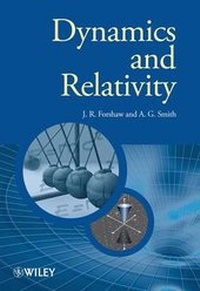
Dynamics and Relativity
Published on 13. February 2009
Book
Hardback
338 pages
978-0-470-01459-2 (ISBN)
Description
A new title in the Manchester Physics Series, this introductory text emphasises physical principles behind classical mechanics and relativity. It assumes little in the way of prior knowledge, introducing relevant mathematics and carefully developing it within a physics context. Designed to provide a logical development of the subject, the book is divided into four sections, introductory material on dynamics, and special relativity, which is then followed by more advanced coverage of dynamics and special relativity. Each chapter includes problems ranging in difficulty from simple to challenging with solutions for solving problems.
Includes solutions for solving problems
Numerous worked examples included throughout the book
Mathematics is carefully explained and developed within a physics environment
Sensitive to topics that can appear daunting or confusing
Includes solutions for solving problems
Numerous worked examples included throughout the book
Mathematics is carefully explained and developed within a physics environment
Sensitive to topics that can appear daunting or confusing
More details
Series
Language
English
Place of publication
New York
United States
Target group
Professional and scholarly
Dimensions
Height: 252 mm
Width: 175 mm
Thickness: 23 mm
Weight
712 gr
ISBN-13
978-0-470-01459-2 (9780470014592)
Copyright in bibliographic data and cover images is held by Nielsen Book Services Limited or by the publishers or by their respective licensors: all rights reserved.
Schweitzer Classification
Other editions
Additional editions
Jeffrey Forshaw | Gavin Smith
Dynamics and Relativity
E-Book
05/2014
1st Edition
Wiley
€44.99
Available for download
Jeffrey Forshaw | Gavin Smith
Dynamics and Relativity
E-Book
02/2009
1st Edition
Wiley
€44.99
Available for download
Jeffrey Forshaw | Gavin Smith
Dynamics and Relativity
Book
02/2009
1st Edition
Wiley
€54.41
Shipment within 10-20 days
Persons
Dr Jeff Forshaw, Department of Physics & Astronomy, University of Manchester, Oxford Road, Manchester, UK.
Dr Gavin Smith, Department of Physics & Astronomy, University of Manchester, Oxford Road, Manchester, UK.
Dr Gavin Smith, Department of Physics & Astronomy, University of Manchester, Oxford Road, Manchester, UK.
Content
Preface. I. INTRODUCTORY DYNAMICS.
1. SPACE, TIME AND MOTION.
1.1 Defining Space and Time.
1.2 Vectors and Co-ordinate Systems.
1.3 Velocity and Acceleration.
1.4 Standards and Units.
2. FORCE, MOMENTUM AND NEWTON'S LAWS.
2.1 Force and Static Equilibrium.
2.2 Force and Motion.
2.3 Applications of Newton's Laws.
3. ENERGY.
3.1 Work, Power and Kinetic Energy.
3.2 Potential Energy.
3.3 Collisions.
3.4 Energy Conservation in Complex Systems.
4. ANGULAR MOMENTUM.
4.1 Angular Momentum of a Particle.
4.2 Conservation of Angular Momentum in Systems of Particles.
4.3 Angular Momentum and Rotation About a Fixed Axis.
4.4 Sliding and Rolling.
4.5 Angular Impulse and the Centre of Percussion.
4.6 Kinetic Energy of Rotation.
II. INTRODUCTORY SPECIAL RELATIVITY.
5. THE NEED FOR A NEW THEORY OF SPACE AND TIME.
5.1 Space and Time Revisited.
5.2 Experimental Evidence.
5.3 Einstein's Postulates.
6. RELATIVISTIC KINEMATICS.
6.1 Time Dilation, Length Contraction and Simultaneity.
6.2 Lorentz Transformations.
6.3 Velocity Transformations.
7. RELATIVISTIC ENERGY AND MOMENTUM.
7.1 Momentum and Energy.
7.2 Applications in Particle Physics.
III ADVANCED DYNAMICS.
8. NON-INERTIAL FRAMES.
8.1 Linearly Accelerating Frames.
8.2 Rotating Frames.
9. GRAVITATION.
9.1 Newton's Law of Gravity.
9.2 The Gravitational Potential.
9.3 Reduced Mass.
9.4 Motion in a central force.
9.5 Orbits.
10. RIGID BODY MOTION.
10.1 The angular momentum of a rigid body.
10.2 The moment of inertia tensor.
10.3 Principal axes.
10.4 Fixed-axis rotation in the lab frame.
10.5 Euler's equations.
10.6 The free rotation of a symmetric top.
10.7 The stability of free rotation.
10.8 Gyroscopes.
IV. ADVANCED SPECIAL RELATIVITY.
11. THE SYMMETRIES OF SPACE AND TIME.
11.1 Symmetry in Physics.
11.2 Lorentz Symmetry.
12. FOUR-VECTORS AND LORENTZ INVARIANTS.
12.1 The Velocity Four-vector.
12.2 The Wave Four-vector.
12.3 The Energy-momentum Four-vector.
12.4 Electric and Magnetic Fields.
13. SPACE-TIME DIAGRAMS AND CAUSALITY.
13.1 Relativity Preserves Causality.
13.2 An Alternative Approach.
14. ACCELERATION AND GENERAL RELATIVITY.
14.1 Acceleration in Special Relativity.
14.2 A glimpse of General Relativity.
A DERIVING THE GEODESIC EQUATION.
B SOLUTIONS TO PROBLEMS.
1. SPACE, TIME AND MOTION.
1.1 Defining Space and Time.
1.2 Vectors and Co-ordinate Systems.
1.3 Velocity and Acceleration.
1.4 Standards and Units.
2. FORCE, MOMENTUM AND NEWTON'S LAWS.
2.1 Force and Static Equilibrium.
2.2 Force and Motion.
2.3 Applications of Newton's Laws.
3. ENERGY.
3.1 Work, Power and Kinetic Energy.
3.2 Potential Energy.
3.3 Collisions.
3.4 Energy Conservation in Complex Systems.
4. ANGULAR MOMENTUM.
4.1 Angular Momentum of a Particle.
4.2 Conservation of Angular Momentum in Systems of Particles.
4.3 Angular Momentum and Rotation About a Fixed Axis.
4.4 Sliding and Rolling.
4.5 Angular Impulse and the Centre of Percussion.
4.6 Kinetic Energy of Rotation.
II. INTRODUCTORY SPECIAL RELATIVITY.
5. THE NEED FOR A NEW THEORY OF SPACE AND TIME.
5.1 Space and Time Revisited.
5.2 Experimental Evidence.
5.3 Einstein's Postulates.
6. RELATIVISTIC KINEMATICS.
6.1 Time Dilation, Length Contraction and Simultaneity.
6.2 Lorentz Transformations.
6.3 Velocity Transformations.
7. RELATIVISTIC ENERGY AND MOMENTUM.
7.1 Momentum and Energy.
7.2 Applications in Particle Physics.
III ADVANCED DYNAMICS.
8. NON-INERTIAL FRAMES.
8.1 Linearly Accelerating Frames.
8.2 Rotating Frames.
9. GRAVITATION.
9.1 Newton's Law of Gravity.
9.2 The Gravitational Potential.
9.3 Reduced Mass.
9.4 Motion in a central force.
9.5 Orbits.
10. RIGID BODY MOTION.
10.1 The angular momentum of a rigid body.
10.2 The moment of inertia tensor.
10.3 Principal axes.
10.4 Fixed-axis rotation in the lab frame.
10.5 Euler's equations.
10.6 The free rotation of a symmetric top.
10.7 The stability of free rotation.
10.8 Gyroscopes.
IV. ADVANCED SPECIAL RELATIVITY.
11. THE SYMMETRIES OF SPACE AND TIME.
11.1 Symmetry in Physics.
11.2 Lorentz Symmetry.
12. FOUR-VECTORS AND LORENTZ INVARIANTS.
12.1 The Velocity Four-vector.
12.2 The Wave Four-vector.
12.3 The Energy-momentum Four-vector.
12.4 Electric and Magnetic Fields.
13. SPACE-TIME DIAGRAMS AND CAUSALITY.
13.1 Relativity Preserves Causality.
13.2 An Alternative Approach.
14. ACCELERATION AND GENERAL RELATIVITY.
14.1 Acceleration in Special Relativity.
14.2 A glimpse of General Relativity.
A DERIVING THE GEODESIC EQUATION.
B SOLUTIONS TO PROBLEMS.