

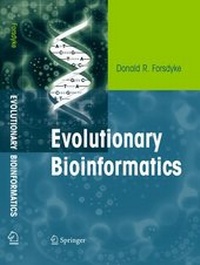
Evolutionary Bioinformatics
1st Edition
Published on 7. March 2011
Book
Paperback/Softback
XXII, 424 pages
978-1-4419-4129-9 (ISBN)
Description
For decades, bioinformatics textbooks have primarily served gene-hunters and biologists constructing family trees showing tidy lines of descent. Written to make the 'new' information-based bioinformatics intelligible to both the 'bio' and the 'info' audiences, this book identifies the types of information that genomes transmit, shows how competition between different types is resolved in the genomes of different organisms, and identifies the evolutionary forces involved. Early chapters relate the form of information with which we are most familiar, namely written texts, to the DNA text that is our genome. Providing a pathway for introducing historical aspects dating back to the nineteenth century.
More details
Edition
1., st Edition. Softcover version of original hardcover edition 2006
Language
English
Place of publication
New York, NY
United States
Target group
College/higher education
Professional and scholarly
Graduate
Illustrations
86
15 s/w Tabellen, 86 s/w Abbildungen
86 black & white illustrations, 15 black & white tables
Dimensions
Height: 23.5 cm
Width: 15.5 cm
ISBN-13
978-1-4419-4129-9 (9781441941299)
Schweitzer Classification
Other editions
Additional editions
Donald R. Forsdyke
Evolutionary Bioinformatics
Book
06/2006
1st Edition
Springer
€58.80
Article exhausted; check for reprint
Content
Prologue.- Part 1: Memory-A Phenomenon of Arrangement.- Chargaff's First Parity Rule.- Information Levels and Barriers.- Part 2: Chargaff's Second Parity Rule.- Stems and Loops.- Chargaff's Cluster Rule.- Part 3: Mutation and Speciation.- Species Survival and Arrival.- Chargaff's GC Rule.- Part 4: Conflict with Genomes.- Conflict Resolution.- Exons and Introns.- Complexity.- Part 5: Conflict Between Genomes.- Sef/Not-Self?- The Crowded Cytosol.- Part 6: Sex and Error-Correction.- Rebooting the Genome.- The Fifth Letter.- Epilogue.- Appendix 1: What the Graph Says.- Appendix 2: Scoring Information Potential.- Appendix 3: No Line?- Acknowledgements.- References and Index.