

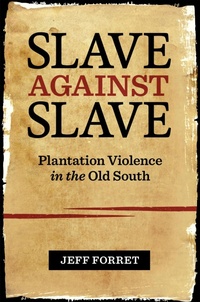
Slave Against Slave
Plantation Violence in the Old South
Published on 30. November 2015
Book
Hardback
544 pages
978-0-8071-6111-1 (ISBN)
Description
In the first-ever comprehensive analysis of violence between slaves in the antebellum South, Jeff Forret challenges persistent notions of slave communities as sites of unwavering harmony and solidarity. Though existing scholarship shows that intraracial black violence did not reach high levels until after Reconstruction, contemporary records bear witness to its regular presence among enslaved populations. Slave against Slave explores the roots of and motivations for such violence and the ways in which slaves, masters, churches, and civil and criminal laws worked to hold it in check. Far from focusing on violence alone, Forret's work also adds depth to our understanding of morality among the enslaved, revealing how slaves sought to prevent violence and punish those who engaged in it.
Forret mines a vast array of slave narratives, slaveholders' journals, travelers' accounts, and church and court records from across the South to approximate the prevalence of slave-against-slave violence prior to the Civil War. A diverse range of motives for these conflicts emerges, from tensions over status differences, to disagreements originating at work and in private, to discord relating to the slave economy and the web of debts that slaves owed one another, to courtship rivalries, marital disputes, and adulterous affairs. Forret also uncovers the role of explicitly gendered violence in bondpeople's constructions of masculinity and femininity, suggesting a system of honor among slaves that would have been familiar to southern white men and women, had they cared to acknowledge it.
Though many generations of scholars have examined violence in the South as perpetrated by and against whites, the internal clashes within the slave quarters have remained largely unexplored. Forret's analysis of intraracial slave conflicts in the Old South examines narratives of violence in slave communities, opening a new line of inquiry into the study of American slavery.
Forret mines a vast array of slave narratives, slaveholders' journals, travelers' accounts, and church and court records from across the South to approximate the prevalence of slave-against-slave violence prior to the Civil War. A diverse range of motives for these conflicts emerges, from tensions over status differences, to disagreements originating at work and in private, to discord relating to the slave economy and the web of debts that slaves owed one another, to courtship rivalries, marital disputes, and adulterous affairs. Forret also uncovers the role of explicitly gendered violence in bondpeople's constructions of masculinity and femininity, suggesting a system of honor among slaves that would have been familiar to southern white men and women, had they cared to acknowledge it.
Though many generations of scholars have examined violence in the South as perpetrated by and against whites, the internal clashes within the slave quarters have remained largely unexplored. Forret's analysis of intraracial slave conflicts in the Old South examines narratives of violence in slave communities, opening a new line of inquiry into the study of American slavery.
More details
Language
English
Place of publication
Baton Rouge
United States
Target group
Professional and scholarly
Product notice
sewn/stitched
Cloth over boards
Dimensions
Height: 244 mm
Width: 157 mm
Thickness: 38 mm
Weight
903 gr
ISBN-13
978-0-8071-6111-1 (9780807161111)
Copyright in bibliographic data and cover images is held by Nielsen Book Services Limited or by the publishers or by their respective licensors: all rights reserved.
Schweitzer Classification
Other editions
Additional editions
E-Book
11/2015
University of Pennsylvania Press, Inc.
€19.49
Available for download
Person
Jeff Forret is professor of history at Lamar University and the author of Race Relations at the Margins: Slaves and Poor Whites in the Antebellum Southern Countryside.