

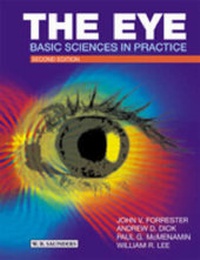
The Eye
Basic Sciences in Practice
2nd Edition
Published on 25. October 2001
Book
Hardback
464 pages
978-0-7020-2541-9 (ISBN)
Description
A new edition of the only compact and all-embracing textbook of basic science for trainee ophthalmologists.
More details
Edition
2nd Revised edition
Language
English
Place of publication
London
United Kingdom
Publishing group
Elsevier Health Sciences
Target group
College/higher education
Trainee ophthalmologists, optometry students
Edition type
Revised edition
Illustrations
424 ills.
Dimensions
Height: 248 mm
Width: 191 mm
Weight
1220 gr
ISBN-13
978-0-7020-2541-9 (9780702025419)
Copyright in bibliographic data and cover images is held by Nielsen Book Services Limited or by the publishers or by their respective licensors: all rights reserved.
Schweitzer Classification
Other editions
New editions
Book
11/2020
5th Edition
Elsevier
€112.50
Available immediately
Book
12/2007
3rd Edition
Saunders
€124.78
Article exhausted; check for reprint
Persons
Content
Chapter 1 Anatomy of the eye and orbit Anatomical terms of reference Osteology of the skull and orbits Structure of the eye Orbital contents Cranial nerves associated with the eye and orbit Ocular appendages (Adnexa) Anatomy of the visual pathway Chapter 2 Embryology and early development of the eye and adnexia Introduction General embryology Ocular embryology: general introduction Neural crest-derived periocular mesenchyme Development of structures derived from neuroepithelium: the neural retina and retinal pigment epithelium Optic nerve and disk development Development of the extraocular muscles Development of the eyes and surrounding structures influenced by the pattern of development of the skull, pharyngeal arches and face Congenital malformations Chapter 3 Genetics Chromosomes and cell division Molecular genetics (DNA and genes) Chromosome defects and gene mutations Clinical genetics Population genetics Understanding the human genome: DNA analysis Molecular and cell biology:controlling cell destiny Molecular genetics and opthalmology Chapter 4 Biochemistry and cell biology Introduction Cells and tissues Biochemical pathways that affect ocular function The ocular surface Cornea and sclera Uveal tract Aqueous humour tract The lens The vitreous The retina Retinal neurochemistry Conclusion Chapter 5 Physiology of vision and the visual system Introduction Light detection and dark adaptation Visual acuity and contrast sensitivity Electrophysiology of the visual system Color vision Visual perception Control of the ocular movement Conclusion Chapter 6 General and ocular pharmacology Introduction Pharmacokinetics: drug trafficking in the body Pharmacodynamics: drug handling by the body Drug-receptor interactions Ocular pharmacology: drug handling by cells and tissues of the eye Delivery methods of ocular medication Reconstituting the tear film Ocular drugs and the autonomic nervous system Clinical control of intraocular pressure The histaminergic system: histamine is released from conjunctival mast cells during allergic reactions Eicosanoids affect multiple ocular functions Serotonin: a potent neurotransmitter Glucocorticoids Immunosuppressant agents: combating ocular inflammatory disease Local anaesthetics: an integral part of opthalmic examination and surgery Ocular toxicity from systemic administration of drugs Chapter 7 Immunology Introduction Overview of the immune system Cells and tissues of the immune system Initial response of the host to injury Development of acquired immunity and immunological memory Effector mechanisms Organization of the immune system Antigen recognition The major histocompatability system T cell activation B cell activation Immunological tolerance and autoimmunity Allergy and immediate hypersensitivity The eye and the immune system Conclusion Chapter 8 Microbiology and infection Introduction Host defence mechanisms and bacterial pathogenicity Bacteria Viruses Fungi Intracellular parasites Helminths Antimicrobials Sterilization and disinfectants Chapter 9 Pathology Introduction Inflammatory diseases Trauma Vascular diseases Metabolic diseases Dystrophies Degenerative diseases Phakomatoses, malformations, and chromosomal abnormalities Neoplasia Recent technological advances ACKNOWLEDGMENTS PAGE