

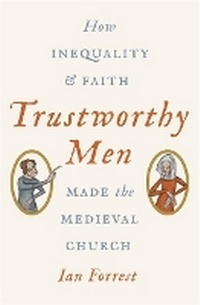
Trustworthy Men
How Inequality and Faith Made the Medieval Church
Published on 10. July 2018
Book
Hardback
520 pages
978-0-691-18060-1 (ISBN)
Description
The medieval church was founded on and governed by concepts of faith and trust--but not in the way that is popularly assumed. Offering a radical new interpretation of the institutional church and its social consequences in England, Ian Forrest argues that between 1200 and 1500 the ability of bishops to govern depended on the cooperation of local people known as trustworthy men and shows how the combination of inequality and faith helped make the medieval church.
Trustworthy men (in Latin, viri fidedigni) were jurors, informants, and witnesses who represented their parishes when bishops needed local knowledge or reliable collaborators. Their importance in church courts, at inquests, and during visitations grew enormously between the thirteenth and fifteenth centuries. The church had to trust these men, and this trust rested on the complex and deep-rooted cultures of faith that underpinned promises and obligations, personal reputation and identity, and belief in God. But trust also had a dark side. For the church to discriminate between the trustworthy and untrustworthy was not to identify the most honest Christians but to find people whose status ensured their word would not be contradicted. This meant men rather than women, and-usually-the wealthier tenants and property holders in each parish.
Trustworthy Men illustrates the ways in which the English church relied on and deepened inequalities within late medieval society, and how trust and faith were manipulated for political ends.
Trustworthy men (in Latin, viri fidedigni) were jurors, informants, and witnesses who represented their parishes when bishops needed local knowledge or reliable collaborators. Their importance in church courts, at inquests, and during visitations grew enormously between the thirteenth and fifteenth centuries. The church had to trust these men, and this trust rested on the complex and deep-rooted cultures of faith that underpinned promises and obligations, personal reputation and identity, and belief in God. But trust also had a dark side. For the church to discriminate between the trustworthy and untrustworthy was not to identify the most honest Christians but to find people whose status ensured their word would not be contradicted. This meant men rather than women, and-usually-the wealthier tenants and property holders in each parish.
Trustworthy Men illustrates the ways in which the English church relied on and deepened inequalities within late medieval society, and how trust and faith were manipulated for political ends.
Reviews / Votes
"One of The Tablet's Best Books of 2018" "[A] riveting social history full of vivid characters in everyday wrangles and powerful reflections on trust and faith."---Teresa Morgan, The Tablet "Trustworthy Men presents a captivating portrait. . . . [It] opens a window onto a fascinating aspect of medieval life, and the study is a model for scholarship across specializations."---G.E. Myers, Choice "Forrest's book is an impressive work which will probably exert a strong influence on medieval English Church history."---Justin Kirkland, European LegacyMore details
Language
English
Place of publication
New Jersey
United States
Product notice
Trade binding
Illustrations
12 b/w illus., 4 tables, 1 maps
Dimensions
Height: 235 mm
Width: 155 mm
Weight
885 gr
ISBN-13
978-0-691-18060-1 (9780691180601)
Copyright in bibliographic data and cover images is held by Nielsen Book Services Limited or by the publishers or by their respective licensors: all rights reserved.
Schweitzer Classification
Other editions
Additional editions
E-Book
08/2018
1st Edition
Princeton University Press
€45.99
Available for download
Person
Ian Forrest is fellow and tutor in history at Oriel College, University of Oxford. He is the author of The Detection of Heresy in Late Medieval England.