

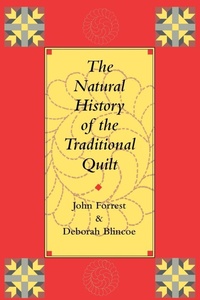
The Natural History of the Traditional Quilt
Published on 1. December 1995
Book
Paperback/Softback
374 pages
978-0-292-72497-6 (ISBN)
Description
Traditional quilts serve many purposes over the course of a useful life. Beginning as a beautiful bed covering, a quilt may later function as a ground cover at picnics until years of wear relegate it to someone's ragbag for scrap uses.
Observing this life cycle led authors John Forrest and Deborah Blincoe to the idea that quilts, like living things, have a natural history that can be studied scientifically. They explore that natural history through an examination of the taxonomy, morphology, behavior, and ecology of quilts in their native environment-the homes of humans who make, use, keep, and bestow them.
The taxonomy proposed by Forrest and Blincoe is rooted in the mechanics of replicating quilts so that it can be used to understand evolutionary and genetic relationships between quilt types. The morphology section anatomizes normal and abnormal physical features of quilts, while the section on conception and birth in the life cycle discusses how the underlying processes of replication intersect with environmental factors to produce tangible objects.
This methodology is applicable to many kinds of crafts and will be of wide interest to students of folklore, anthropology, and art history. Case studies of traditional quilts and their makers in the Catskills and Appalachia add a warm, human dimension to the book.
Observing this life cycle led authors John Forrest and Deborah Blincoe to the idea that quilts, like living things, have a natural history that can be studied scientifically. They explore that natural history through an examination of the taxonomy, morphology, behavior, and ecology of quilts in their native environment-the homes of humans who make, use, keep, and bestow them.
The taxonomy proposed by Forrest and Blincoe is rooted in the mechanics of replicating quilts so that it can be used to understand evolutionary and genetic relationships between quilt types. The morphology section anatomizes normal and abnormal physical features of quilts, while the section on conception and birth in the life cycle discusses how the underlying processes of replication intersect with environmental factors to produce tangible objects.
This methodology is applicable to many kinds of crafts and will be of wide interest to students of folklore, anthropology, and art history. Case studies of traditional quilts and their makers in the Catskills and Appalachia add a warm, human dimension to the book.
More details
Language
English
Place of publication
Austin, TX
United States
Target group
College/higher education
Dimensions
Height: 229 mm
Width: 152 mm
Thickness: 22 mm
Weight
609 gr
ISBN-13
978-0-292-72497-6 (9780292724976)
Copyright in bibliographic data and cover images is held by Nielsen Book Services Limited or by the publishers or by their respective licensors: all rights reserved.
Schweitzer Classification
Persons
Content
"Toward the End of Winter ..."
"I Never Saw My Mamaw Making Quilts ..."
Preface
Acknowledgements
1. Taxonomy
1.1. Introduction
1.2. The Cell
1.3. Seamed Base Categories
1.4. Unseamed Base Categories
1.5. Hybrids and Anomalies
2. Morphology
2.1. Introduction
2.2. Overall Construction
2.3. Materials
2.4. Pathology and Anomaly
3. Life Cycle
3.1. Introduction
3.2. Conception
3.3. Gestation
3.4. Life Span
3.5. Death (and Rebirth)
4. Ecology
4.1. Introduction
4.2. Interaction with Artifacts
4.3. Interaction with People
4.4. Interaction with the Natural Environment
5. Case Study
5.1. Introduction
5.2. Extant Quilts of Anna Butcher Mayo
5.3. The Quilts in the Lives of the Quilter and Her Family
5.4. Kindred Cells in Kindred Quilts
5.5. Anomaly as a Clue to Innovation
6. Conclusion
6.1. Quilts and the Transmission of Culture
References
General Index
Index of Quilt Names
"I Never Saw My Mamaw Making Quilts ..."
Preface
Acknowledgements
1. Taxonomy
1.1. Introduction
1.2. The Cell
1.3. Seamed Base Categories
1.4. Unseamed Base Categories
1.5. Hybrids and Anomalies
2. Morphology
2.1. Introduction
2.2. Overall Construction
2.3. Materials
2.4. Pathology and Anomaly
3. Life Cycle
3.1. Introduction
3.2. Conception
3.3. Gestation
3.4. Life Span
3.5. Death (and Rebirth)
4. Ecology
4.1. Introduction
4.2. Interaction with Artifacts
4.3. Interaction with People
4.4. Interaction with the Natural Environment
5. Case Study
5.1. Introduction
5.2. Extant Quilts of Anna Butcher Mayo
5.3. The Quilts in the Lives of the Quilter and Her Family
5.4. Kindred Cells in Kindred Quilts
5.5. Anomaly as a Clue to Innovation
6. Conclusion
6.1. Quilts and the Transmission of Culture
References
General Index
Index of Quilt Names