

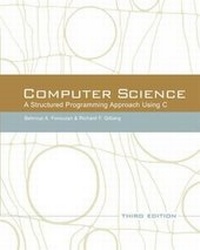
Computer Science: A Structured Programming Approach Using C
3rd Edition
Will be published approx. on 6. February 2006
Book
Paperback/Softback
1184 pages
978-0-534-49132-1 (ISBN)
Description
The third edition of Computer Science: A Structured Programming Approach Using C continues to present both computer science theory and C-language syntax with a principle-before-implementation approach. Forouzan and Gilberg employ a clear organizational structure, supplemented by easy-to-follow figures, charts, and tables.
Reviews / Votes
1. Introduction to Computers 2. Introduction to the C Language 3. Structure of a C Program 4. Functions 5. Selection-Making Decisions 6. Repetition 7. Text Input/Output 8. Arrays 9. Pointers 10. Pointer Applications 11. Strings 12. Enumerated, Structure, and Union Types 13. Binary Input/Output 14. Bitwise Operators 15. Lists Appendices A: Character Sets B: Keywords C: Flowcharting D: Numbering Systems E: Integer and Float Libraries F: Function Libraries G: Preprocessor Commands H: Command-Line Arguments I: Pointers to Void and to Functions J: Storage Classes and Type Qualifiers K: Program Development L: Understanding Complex DeclarationsMore details
Edition
3rd edition
Language
English
Place of publication
Boston, MA
United States
Publishing group
Cengage Learning, Inc
Target group
College/higher education
Dimensions
Height: 43 mm
Width: 190 mm
Thickness: 231 mm
Weight
1720 gr
ISBN-13
978-0-534-49132-1 (9780534491321)
Copyright in bibliographic data and cover images is held by Nielsen Book Services Limited or by the publishers or by their respective licensors: all rights reserved.
Schweitzer Classification
Other editions
New editions
Book
02/2023
4th Edition
Course Technology Inc
€275.50
Shipment within 15-20 days
Persons
Behrouz A. Forouzan has more than 38 years of electronics and computer science experience in industry and academia. His industry experience includes designing electronic systems. After leaving the industry, he joined De Anza College as a professor of computer science. In addition to this text, he has authored and co-authored nine other textbooks including: Computer Science: A Structured Approach Using C, Computer Science: A Structured Approach Using C++, and Data Structures: A Pseudocode Approach with C++, as well as titles on Data Communication and Networking, and TCP/IP Protocols. Richard F. Gilberg has more than 40 years of computer science experience in industry and academia. His industrial experience includes the development of large application systems, database administration, system testing, and data administration. After leaving the industry, he joined De Anza College as a professor of computer science. In addition to this text, he has also co-authored several others including Computer Science: A Structured Approach Using C, Computer Science: A Structured Approach Using C++, and Data Structures: A Pseudocode Approach with C++.
Content
1. Introduction to Computers
2. Introduction to the C Language
3. Structure of a C Program
4. Functions
5. Selection-Making Decisions
6. Repetition
7. Text Input/Output
8. Arrays
9. Pointers
10. Pointer Applications
11. Strings
12. Enumerated, Structure, and Union Types
13. Binary Input/Output
14. Bitwise Operators
15. Lists
Appendices
A: Character Sets
B: Keywords
C: Flowcharting
D: Numbering Systems
E: Integer and Float Libraries
F: Function Libraries
G: Preprocessor Commands
H: Command-Line Arguments
I: Pointers to Void and to Functions
J: Storage Classes and Type Qualifiers
K: Program Development
L: Understanding Complex Declarations
2. Introduction to the C Language
3. Structure of a C Program
4. Functions
5. Selection-Making Decisions
6. Repetition
7. Text Input/Output
8. Arrays
9. Pointers
10. Pointer Applications
11. Strings
12. Enumerated, Structure, and Union Types
13. Binary Input/Output
14. Bitwise Operators
15. Lists
Appendices
A: Character Sets
B: Keywords
C: Flowcharting
D: Numbering Systems
E: Integer and Float Libraries
F: Function Libraries
G: Preprocessor Commands
H: Command-Line Arguments
I: Pointers to Void and to Functions
J: Storage Classes and Type Qualifiers
K: Program Development
L: Understanding Complex Declarations