

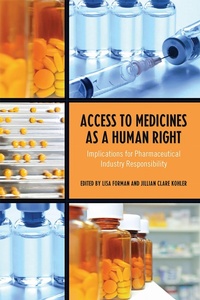
Access to Medicines As a Human Right
Implications for Pharmaceutical Industry Responsibility
Published on 1. February 2017
Book
Paperback/Softback
222 pages
978-1-4875-2215-5 (ISBN)
Description
According to the World Health Organization, one-third of the global population lacks access to essential medicines. Should pharmaceutical companies be ethically or legally responsible for providing affordable medicines for these people, even though they live outside of profitable markets? Can the private sector be held accountable for protecting human beings' right to health?
This thought-provoking interdisciplinary collection grapples with corporate responsibility for the provision of medicines in low- and middle-income countries. The book begins with an examination of human rights, norms, and ethics in relation to the private sector, moving to consider the tensions between pharmaceutical companies' social and business duties. Broad examinations of global conditions are complemented by case studies illustrating different approaches for addressing corporate conduct. Access to Medicines as a Human Right identifies innovative solutions applicable in both global and domestic forums, making it a valuable resource for the vast field of scholars, legal practitioners, and policymakers who must confront this challenging issue.
This thought-provoking interdisciplinary collection grapples with corporate responsibility for the provision of medicines in low- and middle-income countries. The book begins with an examination of human rights, norms, and ethics in relation to the private sector, moving to consider the tensions between pharmaceutical companies' social and business duties. Broad examinations of global conditions are complemented by case studies illustrating different approaches for addressing corporate conduct. Access to Medicines as a Human Right identifies innovative solutions applicable in both global and domestic forums, making it a valuable resource for the vast field of scholars, legal practitioners, and policymakers who must confront this challenging issue.
More details
Language
English
Place of publication
Toronto
Canada
Target group
Professional and scholarly
Product notice
Paperback (trade)
Illustrations
3 b&w tables
Dimensions
Height: 226 mm
Width: 152 mm
Thickness: 18 mm
Weight
340 gr
ISBN-13
978-1-4875-2215-5 (9781487522155)
Copyright in bibliographic data and cover images is held by Nielsen Book Services Limited or by the publishers or by their respective licensors: all rights reserved.
Schweitzer Classification
Persons
Lisa Forman is the Lupina Assistant Professor in the Dalla Lana School of Public Health and the director of the Comparative Program on Health and Society at the University of Toronto.
Jillian Clare Kohler is a professor in the Leslie Dan Faculty of Pharmacy and the director of the WHO Collaborating Centre for Governance, Transparency, and Accountability in the Pharmaceutical Sector at the University of Toronto.
Jillian Clare Kohler is a professor in the Leslie Dan Faculty of Pharmacy and the director of the WHO Collaborating Centre for Governance, Transparency, and Accountability in the Pharmaceutical Sector at the University of Toronto.
Content
Table of Contents
Preface
Acknowledgements
List of Contributors
Introduction
1. "Access to Medicines as a Human Right and Pharmaceutical Industry Responsibilities."
Part One: Rights, Norms and Ethics
2. "Human Rights Responsibilities of Pharmaceutical Companies in relation to Access to Medicines."
3. "Improving Access to Essential Medicines: International Law and Normative Change."
4. "Corporate Social Responsibility and the Right to Essential Medicines."
Part Two: Social versus Business Responsibilities
5. "Benchmarking and Transparency: Incentives for the Pharmaceutical Industry's Corporate Social Responsibility."
6. "Social Responsibility and Marketing of Drugs in Developing Countries: A Goal or an Oxymoron."
Part Three: Case-Studies for Achieving Corporate Responsibility
7. "Managing the Market for Medicines Access: Realizing the Right to Health by Facilitating Compulsory Licensing of Pharmaceuticals - A Case Study of Legislation and the Need for Reform."
8. "Ubuntu, AIDS and the King II Report: Reflections on Corporate Social Responsibility in South Africa."
Annexure
Human Rights Guidelines for Pharmaceutical Companies in relation to Access to Medicines
Bibliography
Preface
Acknowledgements
List of Contributors
Introduction
1. "Access to Medicines as a Human Right and Pharmaceutical Industry Responsibilities."
Part One: Rights, Norms and Ethics
2. "Human Rights Responsibilities of Pharmaceutical Companies in relation to Access to Medicines."
3. "Improving Access to Essential Medicines: International Law and Normative Change."
4. "Corporate Social Responsibility and the Right to Essential Medicines."
Part Two: Social versus Business Responsibilities
5. "Benchmarking and Transparency: Incentives for the Pharmaceutical Industry's Corporate Social Responsibility."
6. "Social Responsibility and Marketing of Drugs in Developing Countries: A Goal or an Oxymoron."
Part Three: Case-Studies for Achieving Corporate Responsibility
7. "Managing the Market for Medicines Access: Realizing the Right to Health by Facilitating Compulsory Licensing of Pharmaceuticals - A Case Study of Legislation and the Need for Reform."
8. "Ubuntu, AIDS and the King II Report: Reflections on Corporate Social Responsibility in South Africa."
Annexure
Human Rights Guidelines for Pharmaceutical Companies in relation to Access to Medicines
Bibliography