

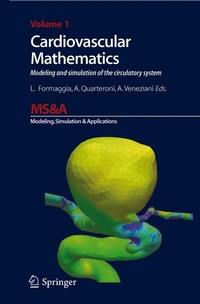
Cardiovascular Mathematics
Modeling and simulation of the circulatory system
1st Edition
Published on 8. April 2009
Book
Hardback
XIII, 522 pages
978-88-470-1151-9 (ISBN)
Description
Mathematical models and numerical simulations can aid the understanding of physiological and pathological processes. This book offers a mathematically sound and up-to-date foundation to the training of researchers and serves as a useful reference for the development of mathematical models and numerical simulation codes.
More details
Other editions
Additional editions
Luca Formaggia | Alfio Quarteroni | Allesandro Veneziani
Cardiovascular Mathematics
Modeling and simulation of the circulatory system
Book
08/2016
Springer
€171.19
Shipment within 10-15 days
Luca Formaggia | Alfio Quarteroni | Allesandro Veneziani
Cardiovascular Mathematics
Modeling and simulation of the circulatory system
E-Book
06/2010
1st Edition
Springer
€160.49
Available for download
Content
Chapter 1 introduces the most important terms and concepts of cardiovascular physiopathology ,while Chapter 2 illustrates the basic mathematical models for blood flow and biochemical transfer. The derivation of the equations that governs blood flow is covered in Chapter 3, while Chapter 4 is devoted to the treatment of medical images to obtain geometries suitable for numerical computations. Chapter 5 illustrates the important relationship between geometry and type of flow, focusing on the main characteristics of the different flow regimes encountered in the cardiovascular system. Mathematical models for blood rheology are discussed in Chapter 6. In Chapter 7 mathematical and numerical models of biochemical transport are explained in detail, with practical examples. The mathematical analysis of coupled models for fluid-structure interaction is addressed in Chapter 8, while Chapter 9 focuses on numerical methods for the mechanical coupling between blood flow and the vessel structure. Reduced models play an important role in cardiovascular modelling to enable the simulating of large parts of (or even th whole) vascular system. Their derivation is presented in Chapter 10. The intertwining of such models with more complex three dimensional ones is the foundation of the so called geometric multiscale approach, illustrated in detail in Chapter 11. Finally, Chapter 12 provides a set of well described and reproducible test cases and applications.