

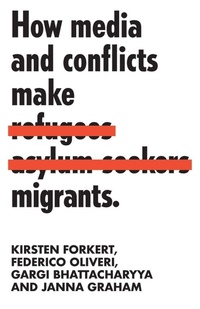
How Media and Conflicts Make Migrants
Will be published approx. on 22. April 2020
Book
Paperback/Softback
224 pages
978-1-5261-3813-2 (ISBN)
Description
The book explores how we understand global conflicts as they relate to the "European refugee crisis", and draws on a range of empirical fieldwork carried out in the UK and Italy. It examines how global conflict has been constructed in both countries through media representations - in a climate of changing media habits, widespread mistrust, and fake news. In so doing, it examines the role played by historical amnesia about legacies of imperialism - and how this leads to a disavowal of responsibility for the causes why people flee their countries. The book explores how this understanding in turn shapes institutional and popular responses in receiving countries, ranging from hostility-such as the framing of refugees by politicians, as 'economic migrants' who are abusing the asylum system; to solidarity initiatives. Based on interviews and workshops with refugees in both countries, the book develops the concept of "migrantification" - in which people are made into migrants by the state, the media and members of society. In challenging the conventional expectation for immigrants to tell stories about their migration journey, the book explores experiences of discrimination as well as acts of resistance. It argues that listening to those on the sharpest end of the immigration system can provide much-needed perspective on global conflicts and inequalities which challenges common Eurocentric misconceptions. Interludes, interspersed between chapters, explore these issues in another way through songs, jokes and images. -- .
Reviews / Votes
'This volume explores connections between media representations, global migrants, and perceptions upheld and challenged by viewers in the UK and Italy during the 2010s. The text oscillates between chapters that unpack issues like "white amnesia" and "postcolonial innocence" among white, Western viewers, and brief "interlude" chapters that convey migrants' insights into navigating different media perspectives and experiences within their new settings. For instance, the authors note a shift from print to new media consumption that necessitates steady access to the internet and mobile technology, which flies in the face of stagnant images of migrants as "not entitled" to such technology, further limiting their access to and sharing of information. Ultimately, the authors call for building international systems to disrupt the willful "forgetting" of interconnected global histories fueling migrants' voyages, and to help them thrive in their new countries. This book could be useful for courses in political science, media studies, communications, and ethnic studies. Visual pairings might include pertinent excerpts from British and Italian newscasts from the period, along with relevant news articles and online posts, with the potential to integrate these media into a reflective "migrantification" assignment.'CHOICE -- .
More details
Series
Language
English
Place of publication
Manchester
United Kingdom
Target group
College/higher education
Professional and scholarly
Illustrations
15 black & white illustrations
Dimensions
Height: 216 mm
Width: 140 mm
Thickness: 14 mm
Weight
347 gr
ISBN-13
978-1-5261-3813-2 (9781526138132)
Copyright in bibliographic data and cover images is held by Nielsen Book Services Limited or by the publishers or by their respective licensors: all rights reserved.
Schweitzer Classification
Other editions
Additional editions
Kirsten Forkert | Federico Oliveri | Gargi Bhattacharyya
How Media and Conflicts Make Migrants
E-Book
04/2020
1st Edition
Manchester University Press
€33.99
Available for download
Kirsten Forkert | Federico Oliveri | Gargi Bhattacharyya
How Media and Conflicts Make Migrants
E-Book
04/2020
1st Edition
Manchester University Press
€21.49
Available for download
Persons
Kirsten Forkert is Reader in Media Theory at Birmingham City University
Federico Oliveri is Research Fellow at the University of Pisa
Gargi Bhattacharyya is Professor of Sociology at the University of East London
Janna Graham is Lecturer in Visual Cultures at Goldsmiths, University of London -- .
Federico Oliveri is Research Fellow at the University of Pisa
Gargi Bhattacharyya is Professor of Sociology at the University of East London
Janna Graham is Lecturer in Visual Cultures at Goldsmiths, University of London -- .
Content
List of figures
Introduction: Conflict, media and displacement in the Twenty-First Century
1 How postcolonial innocence and white amnesia shape our understanding of the "refugee crisis"
Interlude: Global war and media absences
2 War Narratives: Making sense of conflict
Interlude: Songs, jokes, movies and other diversions
3 Social media, mutual aid and solidarity movements as a response to institutional breakdown
Interlude: How it feels to be made a migrant: restrictions, frustration and longing
4 The processes of migrantification: how displaced people are made into migrants
Interlude: Telling stories about war differently
5 Refusing the demand for sad stories
Conclusion: Unsettling dominant narratives about migration in a time of flux
Bibliography -- .
Introduction: Conflict, media and displacement in the Twenty-First Century
1 How postcolonial innocence and white amnesia shape our understanding of the "refugee crisis"
Interlude: Global war and media absences
2 War Narratives: Making sense of conflict
Interlude: Songs, jokes, movies and other diversions
3 Social media, mutual aid and solidarity movements as a response to institutional breakdown
Interlude: How it feels to be made a migrant: restrictions, frustration and longing
4 The processes of migrantification: how displaced people are made into migrants
Interlude: Telling stories about war differently
5 Refusing the demand for sad stories
Conclusion: Unsettling dominant narratives about migration in a time of flux
Bibliography -- .