

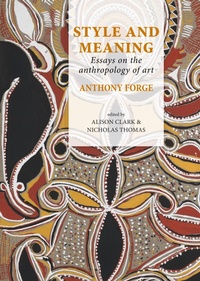
Style and Meaning
Essays on the anthropology of art
1st Edition
Published on 15. September 2017
Book
Hardback
300 pages
978-90-8890-447-9 (ISBN)
Description
Anthropology's engagement with art has a complex and uneven history. While material culture, 'decorative art', and art styles were of major significance for founding figures such as Alfred Haddon and Franz Boas, art became marginal as the discipline turned towards social analysis in the 1920s. This book addresses a major moment of renewal in the anthropology of art in the 1960s and 1970s. British anthropologist Anthony Forge (1929-1991), trained in Cambridge, undertook fieldwork among the Abelam of Papua New Guinea in the late 1950s and 1960s, and wrote influentially, especially about issues of style and meaning in art. His powerful, questioning-raising arguments addressed basic issues, asking why so much art was produced in some regions, and why was it so socially important?
Fifty years later, art has renewed global significance, and anthropologists are again considering both its local expressions among Indigenous peoples and its new global circulation. In this context, Forge's arguments have renewed relevance: they help scholars and students understand the genealogies of current debates, and remind us of fundamental questions that remain unanswered.
This volume brings together Forge's most important writings on the anthropology of art, published over a thirty year period, together with six assessments of his legacy, including extended reappraisals of Sepik ethnography, by distinguished anthropologists from Australia, Germany, Switzerland and the United Kingdom.
Anthony Forge was born in London in 1929. A student at Downing College, Cambridge, he studied anthropology with Edmund Leach, and went on to undertake research with Raymond Firth at the London School of Economics. Over 1958-63 he undertook several periods of fieldwork among the Abelam of the Sepik region of Papua New Guinea, made major collections for the Museum der Kulturen, Basel, and went on to write a series of essays which were enormously influential for the anthropology of art and for studies of Melanesia. He was appointed Foundation Professor of Anthropology at the Australian National University in 1974 and taught there until his death in 1991.
Fifty years later, art has renewed global significance, and anthropologists are again considering both its local expressions among Indigenous peoples and its new global circulation. In this context, Forge's arguments have renewed relevance: they help scholars and students understand the genealogies of current debates, and remind us of fundamental questions that remain unanswered.
This volume brings together Forge's most important writings on the anthropology of art, published over a thirty year period, together with six assessments of his legacy, including extended reappraisals of Sepik ethnography, by distinguished anthropologists from Australia, Germany, Switzerland and the United Kingdom.
Anthony Forge was born in London in 1929. A student at Downing College, Cambridge, he studied anthropology with Edmund Leach, and went on to undertake research with Raymond Firth at the London School of Economics. Over 1958-63 he undertook several periods of fieldwork among the Abelam of the Sepik region of Papua New Guinea, made major collections for the Museum der Kulturen, Basel, and went on to write a series of essays which were enormously influential for the anthropology of art and for studies of Melanesia. He was appointed Foundation Professor of Anthropology at the Australian National University in 1974 and taught there until his death in 1991.
More details
Series
Edition
1. Auflage
Language
English
Place of publication
Leiden
Netherlands
Target group
Professional and scholarly
Illustrations
70 fc / 16 bw
Dimensions
Height: 263 mm
Width: 187 mm
Thickness: 24 mm
Weight
1084 gr
ISBN-13
978-90-8890-447-9 (9789088904479)
Copyright in bibliographic data and cover images is held by Nielsen Book Services Limited or by the publishers or by their respective licensors: all rights reserved.
Schweitzer Classification
Persons
Prof. dr. Anthony Forge was born in London in 1929. A student at Downing College, Cambridge, he studied anthropology with Edmund Leach, and went on to undertake research with Raymond Firth at the London School of Economics. Over 1958-63 he undertook several periods of fieldwork among the Abelam of the Sepik region of Papua New Guinea, made major collections for the Museum der Kulturen, Basel, and went on to write a series of essays which were enormously influential for the anthropology of art and for studies of Melanesia. He was appointed Foundation Professor of Anthropology at the Australian National University in 1974 and taught there until his death in 1991. Dr. Alison Clark is a Research Associate at the Museum of Archaeology and Anthropology, University of Cambridge. She currently works on the ERC funded Pacific Presences project. Both her masters (2007) and PhD (2013) theses on the Indigenous Australian collections of the British Museum drew on the work of Anthony Forge. Her current research is focused on Kiribati, where she is interested in the contemporary resonance of historic museum collections, and the revival of certain cultural practices. She has previously worked on projects at the British Museum, and the October Gallery in London.
Key publications:
2014, 'What Happens Next? Sustaining Relationships Beyond the Life of a Research Project', Journal of Museum Ethnography, No.27.
2013, 'Eliciting a History, Reflections on a Photograph Album', in Adams, Burt, Bonshek, Bolton and Thomas (eds.) Melanesia Art and Encounter 2013 pp.64-66. Prof. Dr. Nicholas Thomas was an undergraduate at the Australian National University from 1979 to 1982; his BA (Honours) thesis, on Fijian politics, was supervised by Anthony Forge. He visited the Pacific first in 1984 to undertake doctoral research in the Marquesas Islands and has since written extensively on exploration and cross-cultural encounters and on art histories in the Pacific. He has been Director of the Museum of Archaeology and Anthropology in Cambridge since 2006.
Key publications:
2014, 'What Happens Next? Sustaining Relationships Beyond the Life of a Research Project', Journal of Museum Ethnography, No.27.
2013, 'Eliciting a History, Reflections on a Photograph Album', in Adams, Burt, Bonshek, Bolton and Thomas (eds.) Melanesia Art and Encounter 2013 pp.64-66. Prof. Dr. Nicholas Thomas was an undergraduate at the Australian National University from 1979 to 1982; his BA (Honours) thesis, on Fijian politics, was supervised by Anthony Forge. He visited the Pacific first in 1984 to undertake doctoral research in the Marquesas Islands and has since written extensively on exploration and cross-cultural encounters and on art histories in the Pacific. He has been Director of the Museum of Archaeology and Anthropology in Cambridge since 2006.
Content
List of images
Preface (NT)
General Introduction (NT)
Part 1: Anthony Forge on art, 1960-1990
1 Introduction to Primitive Art and Society 1973a
2 Three Kamanggabi figures from the Arambak people of the Sepik district 1960a
3 Notes on Eastern Abelam designs painted on paper, New Guinea 1960b
4 Paint, a magical substance. 1962
5 Art and environment in the Sepik. 1965
6 The Abelam artist. 1967
7 Style and meaning in Sepik Art. 1973b
8 The problem of meaning in art. Exploring the visual art of Oceania. 1979
9 Learning to see in New Guinea. 1970
10 The power of culture and the culture of power. 1990
11 Undated introduction to the proceedings from the second Wenner-Gren conference on Sepik Culture History 1986, Mijas, Spain.
Part 2: On Forge
12 Anthony Forge and Alfred Buehler: From Field Collecting to Friendship
Christian Kaufmann
13 Style and meaning: Abelam art through Yolngu eyes
Howard Morphy
14 Anthony Forge and Innovation: perspectives from Vanuatu Lissant Bolton
15 The Problem of Agency in Art
Ludovic Coupaye
16 Looking back, Abelam art and some of Forge's theses from a 2015 perspective
Brigitta Hauser-Schaeublin
17. Communicating with Anthony Forge Michael O'Hanlon
Appendix: Forge's collections (Basel, NY, UCSD)
Bibliography
Acknowledgements
Preface (NT)
General Introduction (NT)
Part 1: Anthony Forge on art, 1960-1990
1 Introduction to Primitive Art and Society 1973a
2 Three Kamanggabi figures from the Arambak people of the Sepik district 1960a
3 Notes on Eastern Abelam designs painted on paper, New Guinea 1960b
4 Paint, a magical substance. 1962
5 Art and environment in the Sepik. 1965
6 The Abelam artist. 1967
7 Style and meaning in Sepik Art. 1973b
8 The problem of meaning in art. Exploring the visual art of Oceania. 1979
9 Learning to see in New Guinea. 1970
10 The power of culture and the culture of power. 1990
11 Undated introduction to the proceedings from the second Wenner-Gren conference on Sepik Culture History 1986, Mijas, Spain.
Part 2: On Forge
12 Anthony Forge and Alfred Buehler: From Field Collecting to Friendship
Christian Kaufmann
13 Style and meaning: Abelam art through Yolngu eyes
Howard Morphy
14 Anthony Forge and Innovation: perspectives from Vanuatu Lissant Bolton
15 The Problem of Agency in Art
Ludovic Coupaye
16 Looking back, Abelam art and some of Forge's theses from a 2015 perspective
Brigitta Hauser-Schaeublin
17. Communicating with Anthony Forge Michael O'Hanlon
Appendix: Forge's collections (Basel, NY, UCSD)
Bibliography
Acknowledgements