

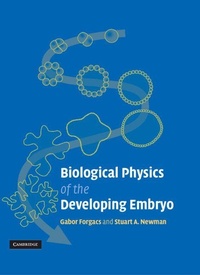
Biological Physics of the Developing Embryo
Published on 24. November 2005
Book
Hardback
346 pages
978-0-521-78337-8 (ISBN)
Description
During development cells and tissues undergo changes in pattern and form that employ a wider range of physical mechanisms than at any other time in an organism's life. This book shows how physics can be used to analyze these biological phenomena. Written to be accessible to both biologists and physicists, major stages and components of the biological development process are introduced and then analyzed from the viewpoint of physics. The presentation of physical models requires no mathematics beyond basic calculus. Physical concepts introduced include diffusion, viscosity and elasticity, adhesion, dynamical systems, electrical potential, percolation, fractals, reaction-diffusion systems, and cellular automata. With full-color figures throughout, this comprehensive textbook teaches biophysics by application to developmental biology and is suitable for graduate and upper-undergraduate courses in physics and biology.
Reviews / Votes
'There is no shortage of textbooks devoted to development biology, but it is remarkably rare to find any substantial treatment of physical considerations ... Forgacs and Newman have ... done the developmental biology community a great service ... An interesting feature of this book is the inclusion of a substantial amount of material on models of genetic/biochemical networks and pattern formation ...' Nick Monk, University of Sheffield '... one way to describe [the book] is to say that it is an extension of D'Arcy Thompson's great work ... I should not omit to mention the illustrations, which are artistic. Students with a background in physics, chemistry or mathematics, and an interest in biological problems, will benefit greatly from this book ... Forgacs and Newman have assimilated much from a vast and diverse literature. They manage to convey a great deal of information, interesting in itself ... my guess is that most developmental biologists will be familiar with only a tiny part of it.' Current ScienceMore details
Language
English
Place of publication
Cambridge
United Kingdom
Target group
Professional and scholarly
College/higher education
Illustrations
110 Line drawings, color
Dimensions
Height: 260 mm
Width: 208 mm
Thickness: 23 mm
Weight
965 gr
ISBN-13
978-0-521-78337-8 (9780521783378)
Copyright in bibliographic data and cover images is held by Nielsen Book Services Limited or by the publishers or by their respective licensors: all rights reserved.
Schweitzer Classification
Other editions
Additional editions
Gabor Forgacs | Stuart A. Newman
Biological Physics of the Developing Embryo
E-Book
02/2006
1st Edition
Cambridge University Press
€79.99
Available for download
Gabor Forgacs | Stuart A. Newman
Biological Physics of the Developing Embryo
Book
Cambridge University Press
€35.33
The article will not be published
Previous edition
Gabor Forgacs | Stuart A. Newman
Biological Physics of the Developing Embryo
Book
Cambridge University Press
€35.33
The article will not be published
Persons
Gabor Forgacs grew up in Budapest, Hungary. He worked as a bellboy, a waiter and as a front desk concierge before he gradually became a hotelier there during the 1970s. That was a lucrative career at the time. He worked his way up to the top and became the General Manager of a three-star full service hotel in Budapest. He was 38 and already an accomplished hotelier when he immigrated with his wife and two small children to Toronto, Ontario, Canada. There he worked at The Inn on the Park, a Four Seasons hotel for nearly two years before he switched to academia and became an associate professor at Ryerson University. He taught hospitality management courses, presented at international conferences and published papers in international journals. Gabor is also a textbook author: his book "Revenue Management. Maximizing Revenue in Hospitality Operations" published by the American Hotel and Lodging Educational Institute is used by educators and practitioners in dozens of countries all over the world. In his memoire he shares with the readers the most memorable stories from his time at hotel operations. He also provides readers with an entertaining insight into the world of hotels.
Content
Introduction; 1. The cell: fundamental unit of developmental systems; 2. Cleavage and blastula formation; 3. Cell states: stability, oscillation, differentiation; 4. Cell adhesion, compartmentalization and lumen formation; 5. Epithelial morphogenesis: gastrulation and neurulation; 6. Mesenchymal morphogenesis; 7. Pattern formation: segmentation, axes and asymmetry; 8. Organogenesis; 9. Fertilization: generating one living dynamical system from two; 10. Evolution of developmental mechanisms; Glossary; References; Index.