

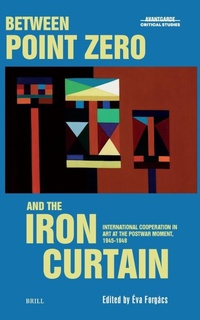
Between Point Zero and the Iron Curtain
International Cooperation in Art at the Postwar Moment, 1945-1948
Published on 7. November 2024
Book
Hardback
420 pages
978-90-04-71063-4 (ISBN)
Description
This volume, edited by Eva Forgacs, with contributions from art historians from across Europe and the Americas, analyzes the artistic initiatives of the short time span between the end of World War II and the onset of the Cold War. In this moment, a new internationalism was anticipated by retrieving pre-war modernism, as well as creating the new era's new artistic lingua franca.
The chapters include in-depth case studies that analyze the complex, often interconnected, projects throughout the world-South America and Eastern and Western Europe-that were soon ended by the Cold War.
The chapters include in-depth case studies that analyze the complex, often interconnected, projects throughout the world-South America and Eastern and Western Europe-that were soon ended by the Cold War.
Reviews / Votes
"Between Point Zero and the Iron Curtain situates the issue of abstraction in art on a new historiographic and theoretical basis, particularly in relation to recent decolonial scholarship. The chapters discuss abstraction not as a process of stripping contexts into select variables that can be distantly manipulated (such the metropole ruling over the colony); but rather, as pure creative potential-the white canvas onto which Malevich painted his Suprematist forms-which survives after everything else that people love and by which they live is lost to sight.""Standing on top of ruins and "scan[ning] the horizon of time ... with open eye," as the director of the Stedelijk Museum in Amsterdam and CoBrA supporter Willem Sandberg wrote in a 1946 editorial of the journal Open oog: avantgardecahier voor visuele vormgeving (Open Eye: Avant-Garde Notebook for Visual Design), artists and architects were left to reassemble what was under their feet. Only with those available materials-and through the need to affirm their own existence-could they build toward a liberated future. Such visions that are presented in Forgacs's timely and important volume would soon, however, join the growing pile of wreckage, as the angel of history, summoned at the "zero hour," proved not only to be a saving grace but a harbinger of another catastrophe to come."_Alexander Bala. in:
More details
Series
Language
English
Place of publication
Leiden
Netherlands
Target group
Professional and scholarly
Product notice
sewn/stitched
Cloth over boards
Dimensions
Height: 239 mm
Width: 157 mm
Thickness: 28 mm
Weight
699 gr
ISBN-13
978-90-04-71063-4 (9789004710634)
Copyright in bibliographic data and cover images is held by Nielsen Book Services Limited or by the publishers or by their respective licensors: all rights reserved.
Schweitzer Classification
Person
Eva Forgacs, Ph.D. (1992), is an Adjunct Professor at Art Center College of Design, Pasadena, and Professor Emerita of the Laszlo Moholy-Nagy University, Budapest. Her publications include Malevich and Interwar Modernism (Bloomsbury, 2022) and other monographs and essays on Modernism and contemporary art and culture.
Content
Acknowledgments
List of Figures
Notes on Contributors
Introduction
PART I: Local Developments
1 A New Beginning: the Dresden Artists' Group Der Ruf, 1945-1948
?Isabel Wuensche
2 The Struggle for Dominating the Discourse: the Conflict between Traditionalists and Modernists in Hungary, 1945?1948
?Edit Sasvari
3 Art in Poland Immediately after the War in Search of Social Context
?Marcin Lachowski
4 In the Realm of Contradictions: Outlines of Czech Cultural Policy, 1945?1948
?Tomas Glanc
PART II: Reaching Out
5 The Bucharest Surrealist Group and the Networks of Post-war Surrealism
?Imre Jozsef Balazs
6 'Democratic Art par excellence'? The 1947 Polish-Czechoslovak Exchange of Modern Graphic Art Exhibitions
?Petra Skarupsky
7 The European School in Budapest, 1945?1948
?Eva Forgacs
8 Cobra: Vital Manifestation
?Sascha Bru and Eva Forgacs
PART III: Wide Networks
9 New Realities in Paris: Abstract Art and Internationalism, 1946?1950
?Natalie Adamson
10 Resilient Modernism: the 1946 Visit of Polish Architects to the United States
?Anna Jozefacka
11 Materiality and Migration in Latin American Modernism: Caracas to Buenos Aires, 1944?1950
?Pia Gottschaller
12 The Chicago Art That Wasn't, 1945?1948
?Barbara Jaffee
13 Turnabout is Fair Play: Institution Building and the Idea of International Art in Sao Paulo after World War II
?Adele Nelson
14 American Surrealism, Late Style: Horizontal Circulations in the 1940s
?Tyrus Miller
Index
List of Figures
Notes on Contributors
Introduction
PART I: Local Developments
1 A New Beginning: the Dresden Artists' Group Der Ruf, 1945-1948
?Isabel Wuensche
2 The Struggle for Dominating the Discourse: the Conflict between Traditionalists and Modernists in Hungary, 1945?1948
?Edit Sasvari
3 Art in Poland Immediately after the War in Search of Social Context
?Marcin Lachowski
4 In the Realm of Contradictions: Outlines of Czech Cultural Policy, 1945?1948
?Tomas Glanc
PART II: Reaching Out
5 The Bucharest Surrealist Group and the Networks of Post-war Surrealism
?Imre Jozsef Balazs
6 'Democratic Art par excellence'? The 1947 Polish-Czechoslovak Exchange of Modern Graphic Art Exhibitions
?Petra Skarupsky
7 The European School in Budapest, 1945?1948
?Eva Forgacs
8 Cobra: Vital Manifestation
?Sascha Bru and Eva Forgacs
PART III: Wide Networks
9 New Realities in Paris: Abstract Art and Internationalism, 1946?1950
?Natalie Adamson
10 Resilient Modernism: the 1946 Visit of Polish Architects to the United States
?Anna Jozefacka
11 Materiality and Migration in Latin American Modernism: Caracas to Buenos Aires, 1944?1950
?Pia Gottschaller
12 The Chicago Art That Wasn't, 1945?1948
?Barbara Jaffee
13 Turnabout is Fair Play: Institution Building and the Idea of International Art in Sao Paulo after World War II
?Adele Nelson
14 American Surrealism, Late Style: Horizontal Circulations in the 1940s
?Tyrus Miller
Index