

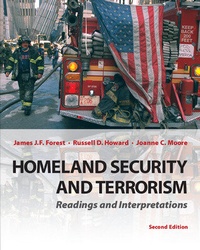
Homeland Security and Terrorism: Readings and Interpretations
2nd Edition
Published on 16. March 2013
Book
Paperback/Softback
609 pages
978-0-07-802629-4 (ISBN)
Description
A timely, thought-provoking collection of essays from homeland security and terrorism expertsFeaturing contributions by Peter Bergen, Brian Michael Jenkins, Bruce Hoffman, James Carafano, John Sullivan, Stephen Flynn and many others, this volume addresses:*The complex nature of the contemporary terrorist threat against America*New federal, state, and local efforts to prepare for a terrorist attack and foster resiliency*Legal and ethical dimensions of homeland security *Changing relationships and responsibilities among government, civil society, and private business enterprise
More details
Edition
2nd edition
Language
English
Place of publication
London
United States
Publishing group
McGraw-Hill Education - Europe
Target group
College/higher education
Dimensions
Height: 234 mm
Width: 191 mm
Thickness: 22 mm
Weight
912 gr
ISBN-13
978-0-07-802629-4 (9780078026294)
Schweitzer Classification
Persons
Dr. James Forest has published over a dozen books and teaches courses on terrorism and homeland security for military, law enforcement, and civilian programs.
Brigadier General (retired) Russell D. Howard is an American veteran Special Forces officer, academic, tutor, writer and counter-terrorism strategist. He was the founding Director of the Combating Terrorism Center at West Point and Co-Editor of four McGraw-Hill terrorism focused books: Terrorism and Counterterrorism with Dr. Bruce Hoffman, Weapons of Mass Destruction and Terrorism with Dr. James J. F. Forest, Homeland Security and Terrorism with Dr. James J. F. Forest and Lieutenant Colonel Joanne Moore, and Defeating Terrorism with Lieutenant Colonel Reid L. Sawyer.
Brigadier General (retired) Russell D. Howard is an American veteran Special Forces officer, academic, tutor, writer and counter-terrorism strategist. He was the founding Director of the Combating Terrorism Center at West Point and Co-Editor of four McGraw-Hill terrorism focused books: Terrorism and Counterterrorism with Dr. Bruce Hoffman, Weapons of Mass Destruction and Terrorism with Dr. James J. F. Forest, Homeland Security and Terrorism with Dr. James J. F. Forest and Lieutenant Colonel Joanne Moore, and Defeating Terrorism with Lieutenant Colonel Reid L. Sawyer.
Content
Homeland Security and Terrorism: Readings and Interpretations, 2e
TOPIC GUIDE
FOREWORD BY BRUCE HOFFMAN
PREFACE
UNIT ONE: DEFINITIONS AND FRAMEWORKSIntroduction to Unit One1.1: Defining Homeland Security1.1.1 Changing Homeland Security: What is Homeland Security? Christopher Bellavita1.1.2 Defining Homeland Security: Analysis and Congressional Considerations Shawn Reese1.2: Defining the Threat1.2.1 The Terrorism Delusion: America's Overwrought Response to September 11 John Mueller and Mark G. Stewart1.2.2 Assessing the Jihadist Terrorist Threat to America and American Interests Peter Bergen, Bruce Hoffman, and Katherine Tiedemann1.2.3 Najibullah Zazi's Plot to Bomb the New York City Subway System: A Case Study of How U.S. Domestic Counterterrorism Operates Joshua Sinai1.2.4 Lessons from Mumbai: Assessing Armed Assault Threats to the United States James Jay Carafano1.2.5 Preventing Lone Wolf Terrorism: Some CT Approaches Addressed Edwin Bakker and Beatrice de Graff1.3: Specific Areas of Vulnerability1.3.1 Flight of Fancy? Air Passenger Security Since 9/11 K. Jack Riley1.3.2 Soft Targets, Hard Choices James S. Robbins1.3.3 Cyber Threats: Ten Issues to Consider Frank Cilluffo and Paul Byron Pattak1.3.4 Homeland Security on the Hyperborder: U.S.-Mexico Drug War Interactions John P. SullivanUNIT TWO: RESPONSE AND RESILIENCEIntroduction to Unit Two2.1: National Response2.1.1 Coordinating for Contingencies: Taking Stock of Post-9/11 Homeland Security Reforms Erik Brattberg2.1.2 Tradition v. Efficiency: What Role for DoD in the Homeland Security? Joanne Moore2.1.3 Have We Succumbed to Nuclear Terror? Brian Michael Jenkins2.1.4 The Homeland Security Dilemma: Imagination, Failure and the Escalating Costs of Perfecting Security Frank P. Harvey2.1.5 DHS: Assessing the Value Proposition David Trybula and John Whitley2.2: State and Local Response2.2.1 Information Sharing: Exploring the Intersection of Policing with National and Military Intelligence Gary Cordner and Kathryn Scarborough2.2.2 Catastrophic Terrorism: Local Response to a National Threat Frank Keating2.2.3 State and Local Fusion Centers: Emerging Trends and Issues Kevin D. Eack2.3: Fostering Resilience2.3.1 Critical Transportation Infrastructure And Societal Resilience Stephen E. Flynn and Sean P. Burke2.3.2 Building Population Resilience to Terror Attacks: Unlearned Lessons from Military and Civilian Experience Michael T. Kindt2.3.3 A Social Infrastructure for Hometown Security: Advancing the Homeland Security Paradigm Robert Bach and David KaufmanUNIT THREE: PUBLIC SECURITY AND CIVIL LIBERTIESIntroduction to Unit Three3.1: Legal and Ethical Controversies in Securing the Homeland3.1.1 Domestic Intelligence Today: More Security but Less Liberty? Erik J. Dahl3.1.2 The Future of Security? Surveillance Operations at Homeland Security Fusion Centers Torin Monahan3.1.3 Immigration And National Security: The Illusion of Safety through Local Law Enforcement Action David A. Harris3.2: Competing Perspectives on the USA PATRIOT Act3.2.1 The USA PATRIOT Act: What's so Patriotic about Trampling on the Bill of Rights? Nancy Chang3.2.2 The USA PATRIOT Act and Information Sharing between the Intelligence and Law Enforcement Communities Brian H. Hook, Margaret J. A. Peterlin, and Peter L. Welsh3.2.3 What Price Security? The USA PATRIOT Act and America's Balance Between Freedom and Security Roger Dean GoldenUNIT FOUR: ALTERNATIVES TO EXPLOREIntroduction to Unit Four4.1.1 Progress Made and Work Remaining in Implementing Homeland Security Missions 10 Years after 9/11 Gene L. Dodaro4.2.1 Disasters, Catastrophes, and Policy Failure in the Homeland Security Era Thomas A. Birkland4.3.1 Abolish the Department of Homeland Security David Rittgers4.4.1 Does Homeland Security Exist Outside the United States? Nadav Morag4.5.1 Lessons from the Singapore Home Team Approach to Homefront Security Susan Sim
TOPIC GUIDE
FOREWORD BY BRUCE HOFFMAN
PREFACE
UNIT ONE: DEFINITIONS AND FRAMEWORKSIntroduction to Unit One1.1: Defining Homeland Security1.1.1 Changing Homeland Security: What is Homeland Security? Christopher Bellavita1.1.2 Defining Homeland Security: Analysis and Congressional Considerations Shawn Reese1.2: Defining the Threat1.2.1 The Terrorism Delusion: America's Overwrought Response to September 11 John Mueller and Mark G. Stewart1.2.2 Assessing the Jihadist Terrorist Threat to America and American Interests Peter Bergen, Bruce Hoffman, and Katherine Tiedemann1.2.3 Najibullah Zazi's Plot to Bomb the New York City Subway System: A Case Study of How U.S. Domestic Counterterrorism Operates Joshua Sinai1.2.4 Lessons from Mumbai: Assessing Armed Assault Threats to the United States James Jay Carafano1.2.5 Preventing Lone Wolf Terrorism: Some CT Approaches Addressed Edwin Bakker and Beatrice de Graff1.3: Specific Areas of Vulnerability1.3.1 Flight of Fancy? Air Passenger Security Since 9/11 K. Jack Riley1.3.2 Soft Targets, Hard Choices James S. Robbins1.3.3 Cyber Threats: Ten Issues to Consider Frank Cilluffo and Paul Byron Pattak1.3.4 Homeland Security on the Hyperborder: U.S.-Mexico Drug War Interactions John P. SullivanUNIT TWO: RESPONSE AND RESILIENCEIntroduction to Unit Two2.1: National Response2.1.1 Coordinating for Contingencies: Taking Stock of Post-9/11 Homeland Security Reforms Erik Brattberg2.1.2 Tradition v. Efficiency: What Role for DoD in the Homeland Security? Joanne Moore2.1.3 Have We Succumbed to Nuclear Terror? Brian Michael Jenkins2.1.4 The Homeland Security Dilemma: Imagination, Failure and the Escalating Costs of Perfecting Security Frank P. Harvey2.1.5 DHS: Assessing the Value Proposition David Trybula and John Whitley2.2: State and Local Response2.2.1 Information Sharing: Exploring the Intersection of Policing with National and Military Intelligence Gary Cordner and Kathryn Scarborough2.2.2 Catastrophic Terrorism: Local Response to a National Threat Frank Keating2.2.3 State and Local Fusion Centers: Emerging Trends and Issues Kevin D. Eack2.3: Fostering Resilience2.3.1 Critical Transportation Infrastructure And Societal Resilience Stephen E. Flynn and Sean P. Burke2.3.2 Building Population Resilience to Terror Attacks: Unlearned Lessons from Military and Civilian Experience Michael T. Kindt2.3.3 A Social Infrastructure for Hometown Security: Advancing the Homeland Security Paradigm Robert Bach and David KaufmanUNIT THREE: PUBLIC SECURITY AND CIVIL LIBERTIESIntroduction to Unit Three3.1: Legal and Ethical Controversies in Securing the Homeland3.1.1 Domestic Intelligence Today: More Security but Less Liberty? Erik J. Dahl3.1.2 The Future of Security? Surveillance Operations at Homeland Security Fusion Centers Torin Monahan3.1.3 Immigration And National Security: The Illusion of Safety through Local Law Enforcement Action David A. Harris3.2: Competing Perspectives on the USA PATRIOT Act3.2.1 The USA PATRIOT Act: What's so Patriotic about Trampling on the Bill of Rights? Nancy Chang3.2.2 The USA PATRIOT Act and Information Sharing between the Intelligence and Law Enforcement Communities Brian H. Hook, Margaret J. A. Peterlin, and Peter L. Welsh3.2.3 What Price Security? The USA PATRIOT Act and America's Balance Between Freedom and Security Roger Dean GoldenUNIT FOUR: ALTERNATIVES TO EXPLOREIntroduction to Unit Four4.1.1 Progress Made and Work Remaining in Implementing Homeland Security Missions 10 Years after 9/11 Gene L. Dodaro4.2.1 Disasters, Catastrophes, and Policy Failure in the Homeland Security Era Thomas A. Birkland4.3.1 Abolish the Department of Homeland Security David Rittgers4.4.1 Does Homeland Security Exist Outside the United States? Nadav Morag4.5.1 Lessons from the Singapore Home Team Approach to Homefront Security Susan Sim