

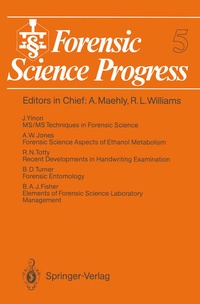
Forensic Science Progress
Springer (Publisher)
Published on 5. November 2012
Book
Paperback/Softback
182 pages
978-3-642-63510-6 (ISBN)
Description
One of the surprising things about the natural world is that animals are dying around us all the time and yet we rarely see any evidence of it. This is a testimony to the efficiency of the large variety of organisms which decompose animal corpses. Whilst bacteria and fungi are the main groups involved in decomposition processes, the larger insects additionally provide an important physical disruption of body tissues, which aids the penetration of micro organisms and speeds the collapse of the body structure. A human corpse is treated no differently and the same groups of organisms are involved. From a forensic science viewpoint the universality of the decay process provides two major advantages. Information based on the decomposition of animals is of considerable value when considering human cases and the successional pattern of decay is broadly equivalent wherever the process is being studied. Historically, the usefulness of insects in solving crime can be traced back in the literature to the 13th century. McKnight [1, 2] translated a Chinese text of this period which contains an account of how a law officer dealt with a case of murder in the rice fields. Death had been caused by a sickle and the official ordered all the field workers to line up and lay their sickles on the ground in front of them. Flies began to be attracted to one of the sickles whereupon its owner confessed to the crime.
More details
Series
Edition
Softcover reprint of the original 1st ed. 1991
Language
English
Place of publication
Berlin
Germany
Publishing group
Springer Berlin
Target group
Professional and scholarly
Research
Illustrations
182 p.
Dimensions
Height: 235 mm
Width: 155 mm
Thickness: 11 mm
Weight
306 gr
ISBN-13
978-3-642-63510-6 (9783642635106)
DOI
10.1007/978-3-642-58233-2
Schweitzer Classification
Other editions
Additional editions
Persons
Content
Contents: J. Yinon, Rehovot, Israel: MS/MS Techniques in Forensic Science.- A.W. Jones, Linköping, Sweden: Forensic Science Aspects of Ethanol Metabolism.- R.N. Totty, Gwent, United Kingdom: Recent Developments in Handwriting Examination.- B.D. Turner, London: Forensic Entomology.- B.A.J. Fisher, Los Angeles, CA: Elements of Forensic Science Laboratory Management. Der Band enthält folgende Beiträge:J. Yinon, Rehovot, Israel: MS/MS Techniken in der Kriminalistik.- A.W. Jones, Linköping, Schweden: Forensische Aspekte des Ethanolstoffwechsels.- R.N. Totty, Gwent, Großbritannien: Neue Entwicklungen in der Handschriftenuntersuchung.- B.D. Turner, London: Forensische Entomologie.- B.A.J. Fisher, Los Angeles: Grundlagen für das Management forensischer Laboratorien.